
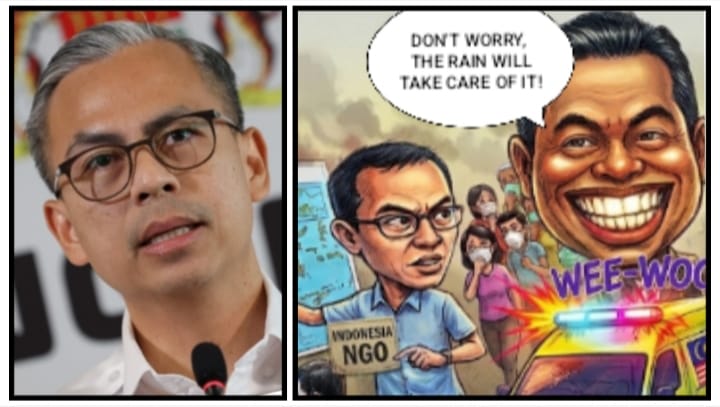
While blue skies slowly emerge, arguments still rage on—like the fires that triggered the crippling cross-border haze…
Just a fortnight ago, Communications Minister Fahmi Fadzil reportedly said that there were no Malaysian plantation companies with palm oil concessions in Indonesia involved in the massive “forest fires” linked to the regional haze phenomenon.
He stated that this was based on “cross-reference checks” conducted with local companies that maintain palm oil concessions in Indonesia.
Fahmi clarified that the Plantation and Commodities Minister Noraini Ahmad had informed the Cabinet that the burning activities occurred outside the concession areas owned by Malaysian companies.
Interestingly, he also said that the Malaysian Palm Oil Board (MPOB) will continue to hold engagement sessions with Malaysian plantation companies that have operations in Indonesia.
So that's it—no need to investigate further. Case closed!
Then came the shocker…
Recently, however, Indonesian environmental non-governmental organization Wahana Lingkungan Hidup Indonesia (WALHI) contradicted our government’s earlier claims.
According to the NGO, a total of 21 companies linked to business groups with Malaysian links were allegedly involved in forest and land fires in Indonesia between January and September this year!
The findings were part of a mapping analysis report titled "Who Are Behind the Fires?" released by WALHI's National Executive.
The report further stated that satellite data recorded at least 30,927 hotspots across Indonesia in the first nine months of this year, with nearly 50 percent located within the operating concessions of oil palm plantation and forestry companies.
The NGO’s findings also appear to support the claims by Greenpeace Indonesia and Pantau Gambut, which alleged that plantation companies from Malaysia and Singapore were among 20 entities linked to forest fires based on satellite datasets covering August 1 to October 1 this year.
These latest revelations have raised some serious concerns and questions:
With the disparity between both sides’ claims as wide as the Straits of Malacca, who exactly is speaking the truth?
While Indonesian NGOs deployed high-tech satellite data mapping, what did we do? Merely conduct cross-checks and engagement sessions?
Seriously, when did "cross-checks" become the standard response when millions of citizens are choking on toxic air every day—with nowhere to run?
This will surely prompt critics to ask some really hard questions: are we terrified of offending our giant neighbour—or worse still, are we simply “shielding” some of our Malaysian-linked plantation behemoths in that country from public scrutiny?
As it is, our authorities are already facing fierce public backlash over their perceived lack of resolve and resourcefulness in tackling this crisis head-on.
The thing is, laying the blame squarely on rogue smallholder farmers, peat swamps, the dry season, and maybe even El Niño won't cut it.
More must be done, and heads must roll, if indeed wrongdoing has been committed—so that the people in this region are never again deprived of clean air to breathe.
Then came more embarrassment…
On Monday (October 26), reports emerged that the same Indonesian NGO (WALHI) was now planning to take legal action against Malaysian and Singaporean-linked plantation companies allegedly involved in the transboundary haze.
More tellingly, it also urged Putrajaya to conduct a “proper investigation” rather than simply assume that no Malaysian companies are involved.
Now, if that isn't a slap in the face for failing to do our homework, what is?
So, will our authorities get down to serious business, now that we appear to have been caught cold by our neighbours?
And will the guilty firms be made to face the music for putting profit ahead of public health?
Truth be told, even Singapore had the guts to name and probe its own firms. Talk about integrity and accountability.
What about us?
For how long do we have to bear all the suffering—and the suffocating?
And how much longer must we pray and hope for the rain to grant us a reprieve every time the haze strikes our land?
Hardcore critics may even question: is this another classic Malaysian-style slow-motion response—hoping that the haze will gradually vanish into thin air?
The thing is, if people’s health is affected and lives are threatened, then surely it must be treated as a serious security crisis that warrants immediate action—just like a pandemic!
Finally, here is the burning question: now that there are serious allegations backed by satellite mapping, will those responsible face swift investigation, prosecution, and heavy financial penalties?
Shouldn't they also be legally compelled to keep their concession areas strictly free of fire hotspots at all times, failing which they risk having their licence suspended?
As for the authorities, will they act, or just wait for the skies to clear, quietly hoping that weeks of despair and dystopian darkness will slip our minds—until the next burning season returns to haunt us?
Main information sources: Malay Mail, NST, and FMT.
JK Joseph (jtkingsworld@gmail.com) is a content creator under the Newswav Creator programme, where you get to express yourself, be a citizen journalist, and at the same time monetize your content & reach millions of users on Newswav. Log in to creator.newswav.com and become a Newswav Creator now!
The User Content (as defined on Newswav Terms of Use) above including the views expressed and media (pictures, videos, citations etc) were submitted & posted by the author. Newswav is solely an aggregation platform that hosts the User Content. If you have any questions about the content, copyright or other issues of the work, please contact creator@newswav.com.