.jpg)
By Mihar Dias February 2025
There is something oddly liberating—and faintly irritating—about Rafizi Ramli’s latest declaration that he is not obsessed with becoming prime minister. https://m.malaysiakini.com/news/767114#google_vignette
In one breezy thread on X, the former PKR deputy president managed to present himself as a man free of ambition, unburdened by power, content with jogging, inner peace and the occasional podcast titled Yang Berhenti Menteri. One almost expects him to add that he also waters plants, feeds stray cats and meditates at sunrise.
The contrast he draws is deliberate. Unlike Anwar Ibrahim, says Rafizi, whose “only passion in life” was to become prime minister, he is merely a humble servant of the people, accidentally a Member of Parliament, temporarily a former minister, and permanently at peace with the universe. https://m.malaysiakini.com/news/767114#google_vignette
Politics, in his telling, is a form of spiritual investment for the afterlife, not a ladder to Putrajaya.
It is a seductive narrative. Also a deeply political one.
Because when a politician insists—loudly and repeatedly—that he does not want power, what he is really saying is that he wants something else: moral authority. And in Malaysian politics, moral authority is often the most valuable currency of all.
Rafizi’s critique of Anwar is not new. He has long positioned himself as the technocrat, the numbers man, the uncomfortable truth-teller in a party increasingly shaped by dynastic reality and coalition compromises. Since losing the PKR deputy presidency to Nurul Izzah Anwar and resigning from the cabinet, his voice has grown freer, sharper and, some might say, more theatrical. Freed from cabinet collective responsibility, he now speaks of “continuous improvement”, unchecked power, and corruption creeping in through comfort and complacency.
All fair points. Necessary points, even.
But the question remains: if Rafizi truly believes that those who feel the country “needs them” suffer from a kind of psychological problem, what exactly is he doing now?
He is, after all, still speaking for the country. Warning on behalf of the rakyat. Diagnosing structural weaknesses in governance. Hosting a podcast to explain why things are not working as they should. Posting long threads to remind Malaysians that macroeconomic growth means little if daily life remains punishing.
This is not the behaviour of a man retiring quietly into the sunset. This is the behaviour of someone auditioning—for relevance, if not leadership.
There is also a curious contradiction at play. Rafizi says he is not sentimental, that he is “easy to be content”, that he already has everything he needs. Yet he appears deeply invested in how history will judge him: the principled insider who spoke up, the reformist who refused to clap on cue, the politician who warned that power unchallenged inevitably curdles into corruption.
That is not obsession with office. But it is obsession with legacy.
And perhaps that is the real tension here. Anwar Ibrahim spent decades chasing the prime minister’s office and finally got it—only to discover that power in a fractured coalition is more constrained than romanticised. Rafizi, on the other hand, seems determined to prove that one can be politically significant without holding the highest office, that influence can exist outside the cabinet room, and that moral clarity matters more than titles.
Yet Malaysian politics is not a seminar room. It is brutal, transactional and unforgiving. Criticism without a clear alternative risks sounding like commentary. Reform without power risks becoming content.
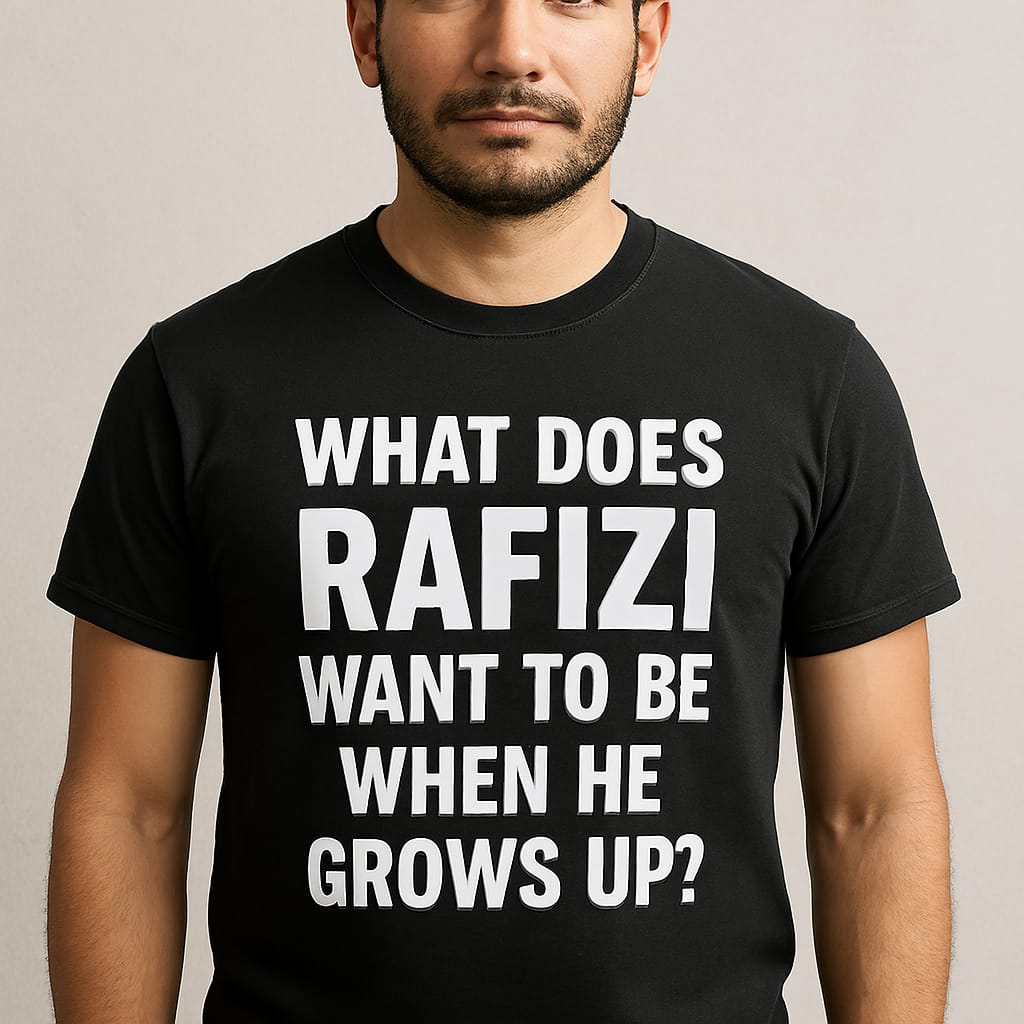
So what does Rafizi want to be when he grows up?
If he truly wants to be a backbench MP who jogs daily and speaks his mind, then he should accept that his criticisms will irritate those in power and inspire those already disillusioned—but change little. If he wants to be the conscience of PKR, he must accept that parties rarely reward consciences. And if he wants to be a reformist voice above factional politics, he must also accept that politics will keep dragging him back down into the mud.
The irony is this: by declaring he does not want to be prime minister, Rafizi has reignited the very conversation about leadership, succession and ambition that PKR has tried hard to suppress. In denying obsession, he has highlighted it. In rejecting power, he has reminded everyone who holds it—and how precarious that hold can be.
Perhaps Rafizi is sincere. Perhaps he really is content jogging into political obscurity, armed only with spreadsheets, principles and a microphone. Or perhaps this is simply another phase in a long political coming-of-age story—one where ambition has matured into something more subtle, more palatable, and more morally framed.
Either way, Malaysians would do well to listen to what he is saying, even as they remain sceptical of why he is saying it. Because in a system where applause often replaces accountability, an irritating voice can still be a useful one—even if it insists, rather too much, that it wants nothing at all.
Mihar Dias (mihardias@gmail.com) is a content creator under the Newswav Creator programme, where you get to express yourself, be a citizen journalist, and at the same time monetize your content & reach millions of users on Newswav. Log in to creator.newswav.com and become a Newswav Creator now!
The User Content (as defined on Newswav Terms of Use) above including the views expressed and media (pictures, videos, citations etc) were submitted & posted by the author. Newswav is solely an aggregation platform that hosts the User Content. If you have any questions about the content, copyright or other issues of the work, please contact creator@newswav.com.
