Let me tell you a bedtime story about Malaysian democracy.
In school, teacher taught us: one person, one vote. Simple right? One person goes, puts an X, goes home, eats nasi lemak. Democracy done.
In Malaysia, we added a small footnote in invisible ink: terms and conditions apply. Your vote may be worth less if you live in the wrong postcode.
Welcome to ‘Malapportionment’. Try saying it three times fast after teh tarik. It basically means our election map looks like it was drawn by someone who failed math, geography, and common sense but passed political science with flying colors.
Here’s how it works in layman terms:
Imagine you have two mamak stalls. Stall A has 28,000 customers, one waiter. Stall B has 303,000 customers, also one waiter. Both waiters get paid the same. Both have one vote in the Waiters Association meeting.
Does that sound fair? No. Does that sound exactly like our Parliament? Yes.
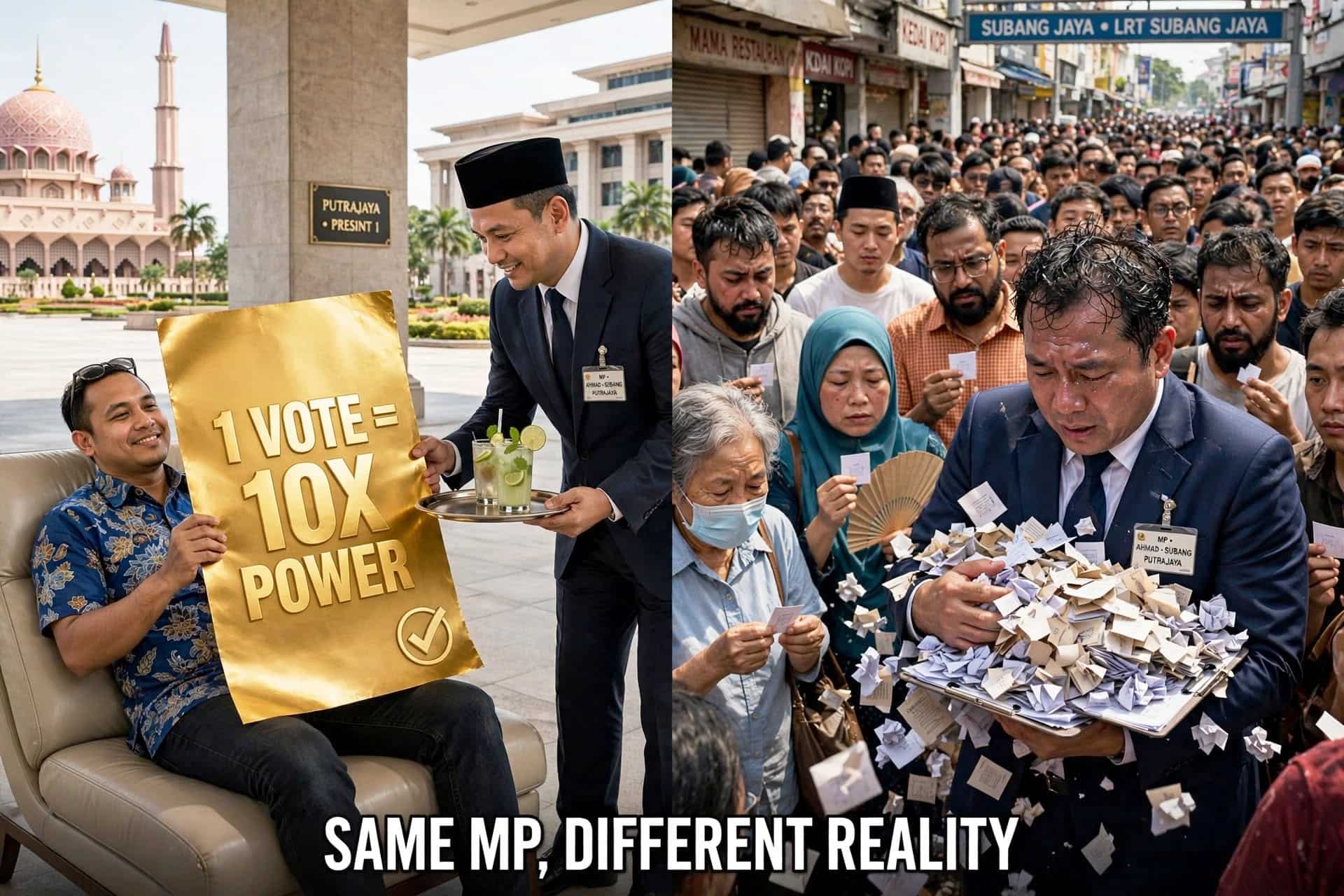
The 28,000 stall is Putrajaya. The 303,000 stall is Subang. Both send exactly one MP to Parliament. So if you are unlucky enough to be born in Subang, congratulations, your vote is worth about one-tenth of your cousin in Putrajaya. Your democratic voice comes with a 90% discount.
Even inside the same state, it’s magic. Take Selangor. Selangor has 2.9 million voters but only 22 MPs. Average 132,000 voters per MP. Tanjung Karang inside Selangor? Only 51,000 voters. Subang? 303,430 voters. So a Tanjung Karang voter has SIX TIMES more power than a Subang voter. Same state. Same sultan. Different democratic caste system.
The Election Commission deputy chairman himself, Azmi Sharom, said it out loud last December. He said, “Imagine in Selangor — overcrowded. There are far too many people, but the number of parliamentary seats is small.”
Imagine. We are imagining, Tan Sri. We have been imagining for 10 years while stuck in a queue in Subang, Petaling Jaya, Klang, Damansara.
Sabah and Sarawak? They average 65,000 to 76,000 voters per seat. Half of Selangor. So East Malaysia is, in EC’s own words, “overrepresented.” But don’t worry; they said it’s constitutional, so we cannot question it. Ah, okay. Constitutional. Like how eating rice with a fork is not illegal, but still feels wrong.
Now, why did we end up here? Three reasons and none of them is “because Malaysians are stupid.”
One: Everyone moved to Klang Valley. In 1965, Klang Valley had 600,000 people. Now 8.8 million. That’s like 15 times. We all moved there for jobs, condos, and traffic jams. The constituencies didn’t move with us.
Two: Undi18. We lowered the voting age to 18 and made registration automatic. Good idea. Millions of new voters appeared overnight, mostly in cities. The map still thought it was 2018.
Three: The law said cannot touch the map for eight years. Article 113, they call it. The map was frozen like ikan in the freezer since 2018. The freezer defrosted only in March 2026. So for eight years, Subang kept getting fatter, and Putrajaya stayed on a diet, and we pretended both were healthy.
And there is history. In 1963 we had 159 seats. Now 222. How did we grow? Not exactly by science. As FMT put it so politely: “Malapportionment tilted the system towards smaller constituencies, often in rural areas, while overcrowded urban seats were left untouched.” Translation: If you keep the city seats super packed and the kampung seats super small, it’s easier to win. Everyone who was in power benefited, so everyone kept quiet.
The numbers in GE15 are so funny you have to laugh or you cry. In Lenggong and Padang Rengas, Perak, total electors 60-70k. Turnout 50k. In Subang, majority alone was 69,701. Meaning the losing votes in Subang could form a whole government in Lenggong. In Klang, majority 70k. In Petaling Jaya, majority 50k+.
Meaning: The majority in Petaling Jaya alone is bigger than the entire population of Lenggong and Padang Rengas combined, plus their cows and goats. One MP wins with a majority that could populate two other constituencies. That's not election, that's comedy show.
So your vote’s value depends on GPS. That’s not democracy, that’s real estate.
Why should you care? Because four things happen when you let this rot:
First, your voice is not equal. Your postcode decides your worth.
Second, parties can win big without winning popular vote. You can get 47% of votes and 60% of seats. Then you act surprised when young people say “why vote?”
Third, imagine you are the MP of Subang. 303,000 people WhatsApp you at midnight about longkang, flood, and cat stuck on roof. MP of Putrajaya has 28,000. Who do you think can serve better? The Subang MP needs three clones and still cannot finish.
Fourth, trust dies. When people feel the game is rigged, they don’t line up on voting day. They line up at the airport.
Now, Sarawak is doing a test run. Seventh Redelineation Review. Civil society groups in Malaysia looked at the first proposal and said with maximum politeness —“this is still rubbish.”
Their audit: Pelagus still 50% below average. 34 seats too small, 30 too big. In Bandar Kuching, where everyone actually lives and traffic is already hell, all four seats are bloated at 140% above average. So you are punishing urban voters for the crime of being urban. Brilliant.
Is there a fix before GE16?
There is. And it doesn’t even need a constitutional amendment. No need for two-thirds majority, no need for wayang.
Public policy experts had proposed it and amplified it. The one-third rule.
Very simple. For each state, calculate average voters per seat. No constituency should be more than one-third bigger or smaller than that average.
No state loses seats. Perlis still has 3, Pahang has 14, Selangor has 22. Nobody cries.
Take Selangor: Average is about 167,000 voters. So every seat must be between 111,000 and 222,000. Subang currently 303k? Potong. Shrink it. Tanjung Karang 51k? Makan sikit. Give it more voters. Balance.
Rural weightage still allowed — Constitution says give a little extra weight to rural areas because they are big and hard to reach, which is fair. If you have to take a boat and then a buffalo to meet voters, okay, give you discount. But not six-times discount. Not ten-times.
And the best part: This only needs simple majority in Dewan Rakyat. 112 votes. Because you are not adding seats, you are just redrawing lines inside the state. Last time we did it in 2018, it took 18 months.
Deadline is real: EC must start before end of 2026. Do first display, hear objections, revise, second display, then send to PM, then table in Parliament Oct-Nov 2027. Parliament auto-dissolves Dec 19, 2027. If we miss it, we fight GE16 on the same broken 2018 map. Again.
This is separate from the Sabah Sarawak one-third demand under MA63. That one giving Sabah Sarawak 33% of all Dewan Rakyat seats needs constitutional amendment and two-thirds majority. That’s a different fight. This one is just fixing inequality *within* each state first. Don’t wait for the big fight to fix the small leak.
So what’s stopping us?
Political will. That magical thing politicians mention when they don’t want to do something.
Because some safe seats will become competitive. Some MPs who have been comfortable in a tiny, safe kampung seat will suddenly have to work for 150,000 voters. Poor thing.
As Azmi Sharom said, flexibility is necessary, but needs justification. Flexibility was never meant to mean “my vote is worth ten times yours.”
We have a rare window. The freezer is open. The map is on the table. We have the data. We have the formula.
All we need now is someone to pick up the pen and draw a fair line.
If not, we can keep telling our kids the fairy tale: All votes are equal. Some just happen to be more equal than others.
ENDS
By
Sam Trailerman
Nganasegaran (tapessam@gmail.com) is a content creator under the Newswav Creator programme, where you get to express yourself, be a citizen journalist, and at the same time monetize your content & reach millions of users on Newswav. Log in to creator.newswav.com and become a Newswav Creator now!
The User Content (as defined on Newswav Terms of Use) above including the views expressed and media (pictures, videos, citations etc) were submitted & posted by the author. Newswav is solely an aggregation platform that hosts the User Content. If you have any questions about the content, copyright or other issues of the work, please contact creator@newswav.com.