
For nearly four years, Prime Minister Dato' Seri Anwar Ibrahim has defended the Unity Government as a necessary arrangement to ensure political stability after years of turmoil. The partnership between Pakatan Harapan (PH) and Barisan Nasional (BN) was sold to Malaysians as a mature political compromise designed to move the country beyond endless power struggles.
However, recent developments in Johor and Negeri Sembilan have exposed an uncomfortable reality: stability on paper does not necessarily mean unity in practice.
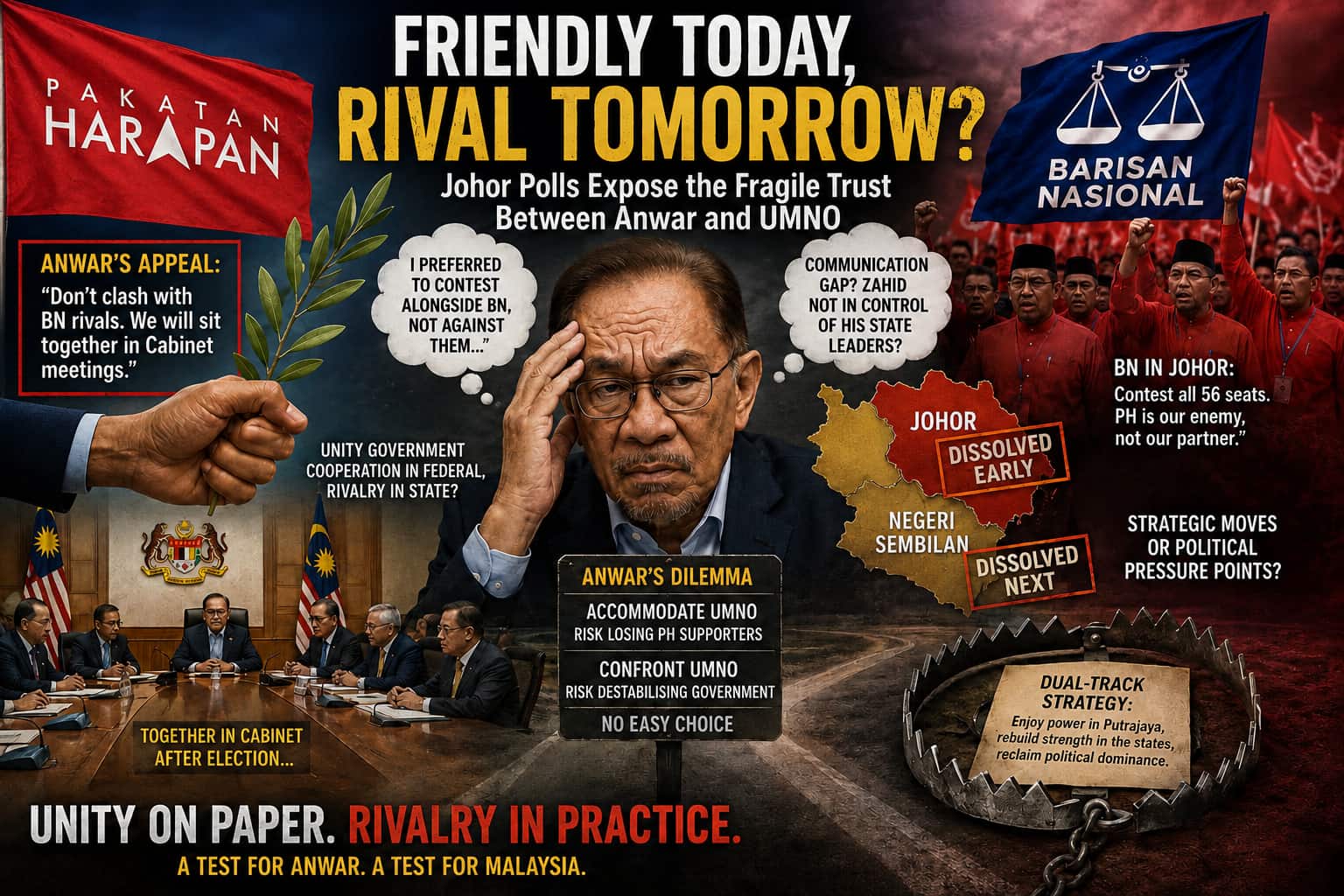
Anwar's latest appeal for PH leaders not to clash aggressively with BN during the upcoming Johor election appears noble and statesmanlike. Yet it also raises a fundamental question: Is PH showing political maturity, or is it walking into a trap set by a far more experienced political operator?
When launching the Johor PH machinery, Anwar openly admitted that PH and BN contesting against one another had created a "headache." He even revealed that he would have preferred to contest alongside BN rather than against them.
The problem is that BN clearly does not appear to share that sentiment.
While Anwar speaks the language of cooperation, BN leaders in Johor have chosen confrontation. While Anwar says they will sit together in Cabinet meetings after the election, Johor BN has announced its intention to contest all 56 seats, treating PH not as a partner but as a direct electoral enemy.
The contradiction could not be clearer.
If both coalitions are truly committed to long-term cooperation, why are they behaving like bitter rivals at the state level?
More importantly, why does Anwar repeatedly appear surprised by BN's actions?
His comments regarding Johor's snap election are particularly revealing. The Prime Minister admitted he would have preferred Johor to delay elections so the government could focus on economic recovery. Yet Johor proceeded anyway.
This naturally raises questions about communication between Anwar and BN president Dato' Seri Ahmad Zahid Hamidi.
If the leaders of the Unity Government are genuinely coordinating strategy, how could a major political decision such as dissolving a state assembly occur against the wishes of the Prime Minister?
Either communication between Anwar and Zahid is not as close as publicly portrayed, or Zahid himself lacks sufficient control over influential UMNO state leaders.
Neither explanation is politically comforting for Anwar.
The Johor and Negeri Sembilan elections increasingly look less like routine state polls and more like strategic pressure points created by UMNO.
Political observers have long noted that UMNO is perhaps Malaysia's most experienced political machine. Since joining the Unity Government after the 2022 general election, UMNO has enjoyed significant benefits despite possessing far fewer parliamentary seats than PH. Yet the party has never hidden its ambition to rebuild itself and eventually reclaim political dominance.
The recent sequence of events appears consistent with that objective.
Johor was dissolved early. Negeri Sembilan soon followed. UMNO assemblymen in Negeri Sembilan withdrew support for the PH-led administration despite both parties governing together under the Unity Government framework. In Johor, BN and PH are preparing for direct confrontation in every seat.
These are not the actions of a coalition partner focused on strengthening a long-term alliance.
Instead, they resemble the actions of a party testing its electoral strength while retaining all the advantages of federal power.
In essence, UMNO appears to be pursuing a dual-track strategy: remain inside the federal government while simultaneously rebuilding its independent political identity at the state level.
For Anwar, this presents a growing dilemma.
If he continues accommodating UMNO, he risks appearing weak and indecisive to PH supporters who increasingly question why their coalition keeps making concessions to a partner that shows little reciprocity.
If he confronts UMNO directly, he risks destabilising the very government he spent decades fighting to lead.
The bigger concern is perception.
Anwar has often portrayed himself as the architect of stability, yet recent events suggest he is increasingly reacting to developments rather than shaping them. The Johor and Negeri Sembilan dissolutions were not his preference. The state-level clashes were not his preference. Even the timing of these elections was not his preference.
That creates an image of a leader managing crises rather than directing the political agenda.
The coming state elections will therefore be about far more than Johor and Negeri Sembilan. They will serve as an early referendum on whether the Unity Government remains a genuine partnership or merely a temporary arrangement of convenience.
For now, Anwar continues extending an olive branch. But politics is rarely a game of goodwill alone.
The question many PH supporters may soon be asking is whether Anwar is playing a long game of statesmanship - or whether UMNO is playing a longer game of power politics. And if the latter is true, the Prime Minister may find himself increasingly cornered by allies who have never stopped behaving like competitors.
By: Kpost
Information Source:
Kpost (ckhorsk@gmail.com) is a content creator under the Newswav Creator programme, where you get to express yourself, be a citizen journalist, and at the same time monetize your content & reach millions of users on Newswav. Log in to creator.newswav.com and become a Newswav Creator now!
The User Content (as defined on Newswav Terms of Use) above including the views expressed and media (pictures, videos, citations etc) were submitted & posted by the author. Newswav is solely an aggregation platform that hosts the User Content. If you have any questions about the content, copyright or other issues of the work, please contact creator@newswav.com.
