
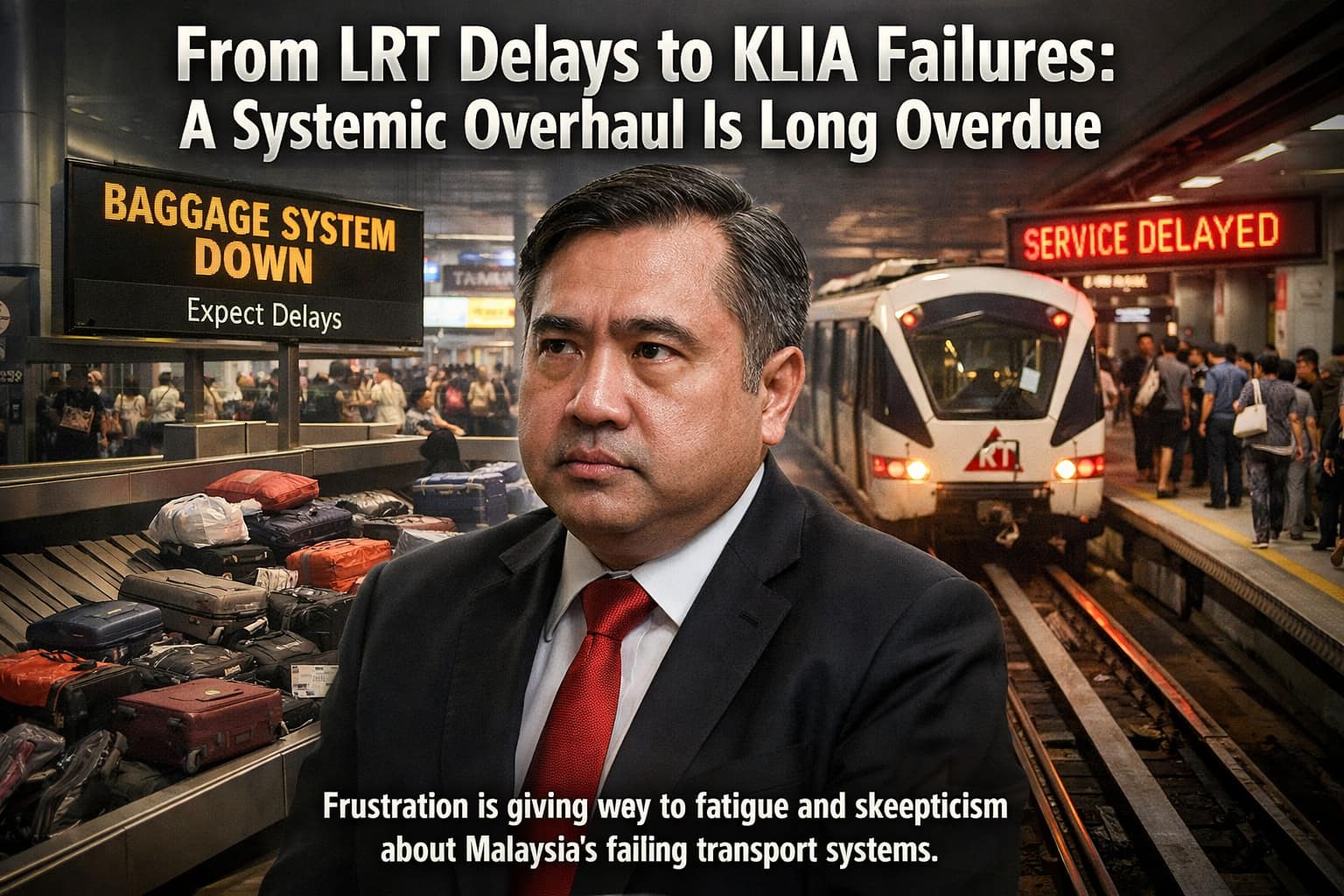
Frustration is no longer the public’s only response to Malaysia’s recurring transport disruptions - it has evolved into fatigue, distrust, and growing skepticism.
From rail delays to airport system failures, the cracks in the nation’s transport infrastructure are becoming too frequent to dismiss as isolated technical glitches. While Transport Minister Anthony Loke has openly expressed his anger over the situation, anger alone will not fix a system that many now believe is suffering from deeper structural flaws.
The latest breakdown at Kuala Lumpur International Airport Terminal 1, which saw baggage handling systems fail and delays stretch up to four hours, has reignited concerns over reliability and preparedness. This incident, coupled with repeated disruptions on the Kelana Jaya LRT line and the Putrajaya MRT line, paints a worrying picture: the problem is not occasional - it is systemic.
Opposition coalition Perikatan Nasional (PN), through its secretary-general Dato' Seri Takiyuddin Hassan, has described these incidents as clear indicators of deeper weaknesses in operational management, maintenance standards, and system resilience. When failures occur across multiple transport modes - airports, LRT, MRT - it suggests not coincidence, but a pattern of inefficiency that demands urgent and comprehensive reform.
To his credit, Loke has responded by calling emergency meetings and ordering reviews of standard operating procedures (SOPs). However, such reactive measures risk becoming routine fire-fighting exercises rather than meaningful solutions. The real question is whether the government is prepared to move beyond short-term fixes and confront the root causes.
A more decisive approach would be the establishment of an independent, multi-stakeholder task force comprising industry experts, engineers, regulators, and operators. This task force should not merely advise but actively monitor service reliability, enforce preventive maintenance standards, and conduct full technical audits of critical systems. These audits must go beyond surface-level checks - they should scrutinize maintenance processes, assess staff competency and training regimes, and evaluate the condition of aging rail assets.
Equally important is the human factor and safety protocol. Decision-making during disruptions often determines whether an incident becomes a minor inconvenience or a full-blown crisis. Passengers forced to disembark mid-journey or left uninformed during delays highlight gaps in crisis management. Reviewing ground-level training and empowering frontline staff to respond swiftly could significantly reduce the impact on commuters.
Moreover, transparency must become a cornerstone of reform. The public deserves clear answers: Were preventive maintenance protocols sufficient? Are system upgrades being implemented effectively? Are contingency plans robust enough to handle worst-case scenarios? Without honest disclosure, public confidence will continue to erode.
Loke himself has acknowledged the contradiction - urging Malaysians to embrace public transport while service reliability remains inconsistent. Incentives such as travel passes may encourage ridership, but they cannot compensate for a lack of trust. Reliability, not affordability, is the true value of public transport success.
The stakes are higher than daily inconvenience. Malaysia’s transport infrastructure, particularly KLIA, serves as a gateway for tourism, trade, and investment. Persistent failures risk damaging the country’s reputation on the global stage.
In the end, this is not merely a technical issue - it is a governance challenge. Malaysia stands at a crossroads: continue patching problems as they arise, or undertake a systemic overhaul that restores confidence in its transport network.
Public frustration is evident, and confidence in lasting solutions is fading. What remains to be seen is whether a concrete response will match the scale of the problem.
By: Kpost
Kpost (ckhorsk@gmail.com) is a content creator under the Newswav Creator programme, where you get to express yourself, be a citizen journalist, and at the same time monetize your content & reach millions of users on Newswav. Log in to creator.newswav.com and become a Newswav Creator now!
The User Content (as defined on Newswav Terms of Use) above including the views expressed and media (pictures, videos, citations etc) were submitted & posted by the author. Newswav is solely an aggregation platform that hosts the User Content. If you have any questions about the content, copyright or other issues of the work, please contact creator@newswav.com.