
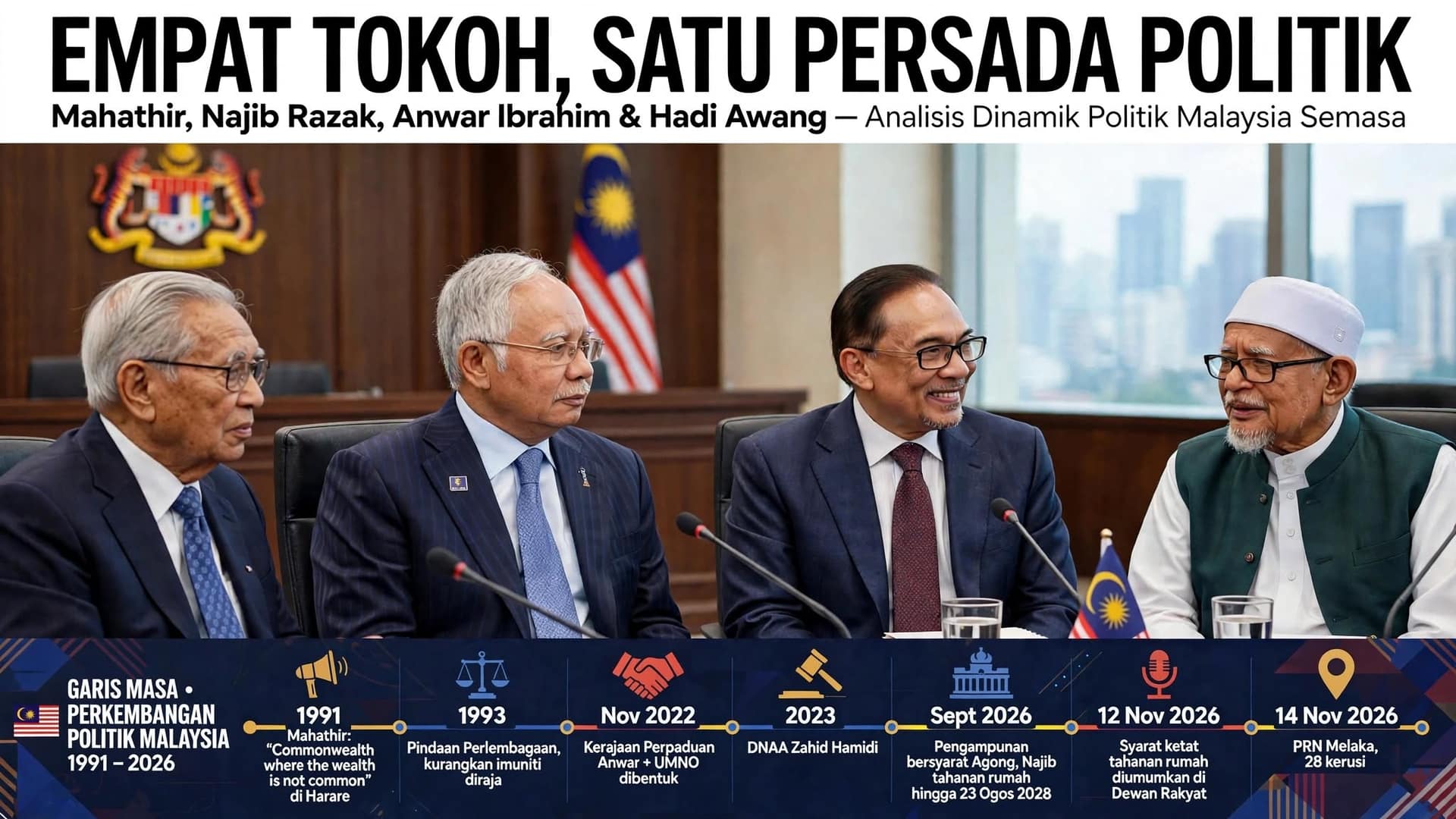
In 1991, at a Commonwealth summit in Harare, then-Prime Minister Dr Mahathir Mohamad stood before Queen Elizabeth II and delivered a line that still circulates online whenever Malaysians reminisce about sharper diplomatic theatre. Pointing out how British titles rarely matched reality, he observed that Parliament is led by a "Mr Speaker" who may not speak, that colonial Malaya was run by "Advisers" whose advice had to be obeyed, and that the Malay Sultans were designated as "the Rulers, but they may not rule." He closed with the punchline: a "Commonwealth where the wealth is not common."
Queen Elizabeth II laughed. The banquet hall applauded. Back home, Mahathir was untouchable.
Thirty-five years later, in November 2026, nobody in Malaysian politics is cracking witty banquet jokes about who rules and who merely reigns. Writing as a political columnist watching the final hours of campaigning before tomorrow's November 14 Melaka state election, what stands out most is how thoroughly the boundaries of political speech, institutional deference, and party loyalty have been rewritten.
When Mahathir delivered his quip in front of the British monarch, he was ostensibly skewering colonial double-speak while simultaneously pushing through domestic constitutional amendments culminating in 1993 that curbed royal legal immunity. Today, under Malaysia's constitutional monarchy, the prerogative of mercy vested in the Yang di-Pertuan Agong under Article 42 of the Federal Constitution is settled law, and modern "3R" (Race, Religion, and Royalty) boundaries leave zero room for politicians to turn royal institutions into rhetorical props.
Consider the developments unfolding in Putrajaya and Kuala Lumpur on Thursday, November 12, as reported by The Star, Free Malaysia Today, and The Edge Malaysia. Following Yang di-Pertuan Agong Sultan Ibrahim's September conditional pardon allowing former Prime Minister Najib Razak to serve the remainder of his SRC International sentence until August 23, 2028 under house arrest upon settling his RM50 million fine, Najib returned to his Jalan Langgak Duta residence on Tuesday night. In the Dewan Rakyat on Thursday, Home Minister Saifuddin Nasution Ismail laid out the strict legal boundaries of that arrangement: while Najib's immediate family his spouse, children, in-laws, and grandchildren are permitted to reside with him at the designated premises (with a written request for a second residence rejected), he may only use a telecommunications device registered with the Prisons Department for location verification, cannot receive outside visitors without prior written consent, and is strictly barred from making public comments, social media posts, or engaging in political activity.
To a political writer looking at the long arc of Malaysian history, the contrast in political speech is striking. In 1991, Mahathir spoke freely before monarchs and turned historical paradoxes into global applause lines; in 2026, Najib returns home under a conditional royal pardon only to be legally silenced from political speech all while DAP Secretary-General Anthony Loke has stepped down as Transport Minister in protest and the government navigates fresh legal scrutiny. On Thursday, even as the Attorney-General's Chambers moved to object to the Malaysian Bar's judicial review application (with the High Court fixing March 17, 2027, to hear objections), Law and Institutional Reform Minister Azalina Othman Said noted that while Article 42 places the prerogative of mercy squarely within the Yang di-Pertuan Agong's discretion, the Bar remains legally entitled to bring a challenge if it believes it has grounds to do so.
Yet beyond the constitutional mechanics which rightly command institutional respect the deeper story ahead of tomorrow's Melaka polls is how Malaysia’s political class has invented its own version of Mahathir’s 1991 paradox. Today, it is no longer colonial titles that defy their own meaning, but domestic political slogans, as every major bloc bends its past rhetoric in the name of electoral survival.
Start with PAS. Ahead of the 2022 general election and during the hung-parliament negotiations that followed PAS leaders rejected working with Barisan Nasional on moral grounds, refusing to compromise with UMNO's "court cluster" over unresolved corruption cases. Four years later, older Malaysian sayings about how principles bend when the political wind shifts feel all too familiar. Having tested non-aggression pacts in Johor and Negeri Sembilan, UMNO and PAS are now campaigning side by side in Melaka under a Penyatuan Ummah banner, dividing the state's 28 seats 23 for BN and five for PN without clashing. Across Melaka’s semi-urban junctions and rural heartlands this week, party machinery that spent years trading bitter accusations of betrayal are suddenly sharing stages. Along the way, PAS leaders have gone conspicuously silent on UMNO President Ahmad Zahid Hamidi's Yayasan Akalbudi discharge not amounting to an acquittal (DNAA), while PAS Secretary-General Takiyuddin Hassan publicly welcomed Najib's conditional house arrest and urged swift execution of the royal order, citing "justice delayed is justice denied."
UMNO faces its own credibility test. Campaigning on its track record of administrative stability and experience, the party has nevertheless spent years navigating leadership turbulence and high-profile court battles. Rather than undertaking sweeping internal renewal after its 2022 defeat, UMNO leveraged its parliamentary seats to remain central to federal power leaving critics to question whether party survival has consistently outranked institutional reform.
Nor has Prime Minister Anwar Ibrahim's Unity Government escaped scrutiny over its Reformasi promises. Forming a coalition with UMNO in November 2022 brought parliamentary stability, yet as Universiti Teknologi Malaysia political analyst Mazlan Ali told Free Malaysia Today this week ahead of Saturday's Melaka polls, urban and semi-urban voters particularly young people, the middle class, and non-Malays are inclined to view Najib's house arrest as raising serious questions about political integrity and principles. As a political columnist watching this unfold, it is clear that skepticism does not exist in a vacuum; it compounds earlier public unease over Zahid's 2023 DNAA, the Sabah mineral licensing scandal which erupted from whistleblower videos and led to court charges alongside disputed allegations against enforcement officials and Bloomberg's February 2026 investigative reports into Malaysian Anti-Corruption Commission (MACC) Chief Commissioner Azam Baki's shareholdings and alleged corporate takeover networks, reports that prompted both a government task force and a defamation lawsuit from Azam as Bloomberg stood by its journalism.
From Mahathir's 1991 banquet hall to tomorrow's Melaka ballot boxes, the arc of Malaysian politics tells a sobering story. In 1991, Mahathir joked that the Commonwealth was a club where wealth was not common. In 2026 Malaysia, voters across every divide are left wondering whether unwavering political principles from any camp have become equally rare.
Annan Vaithegi writes that Malaysian politics rarely suffers from a shortage of clever speeches or convenient alliances what it lacks are leaders whose principles remain intact when the political wind changes direction.
Annan Vaithegi (annanvaithegi@icloud.com) is a content creator under the Newswav Creator programme, where you get to express yourself, be a citizen journalist, and at the same time monetize your content & reach millions of users on Newswav. Log in to creator.newswav.com and become a Newswav Creator now!
The User Content (as defined on Newswav Terms of Use) above including the views expressed and media (pictures, videos, citations etc) were submitted & posted by the author. Newswav is solely an aggregation platform that hosts the User Content. If you have any questions about the content, copyright or other issues of the work, please contact creator@newswav.com.