
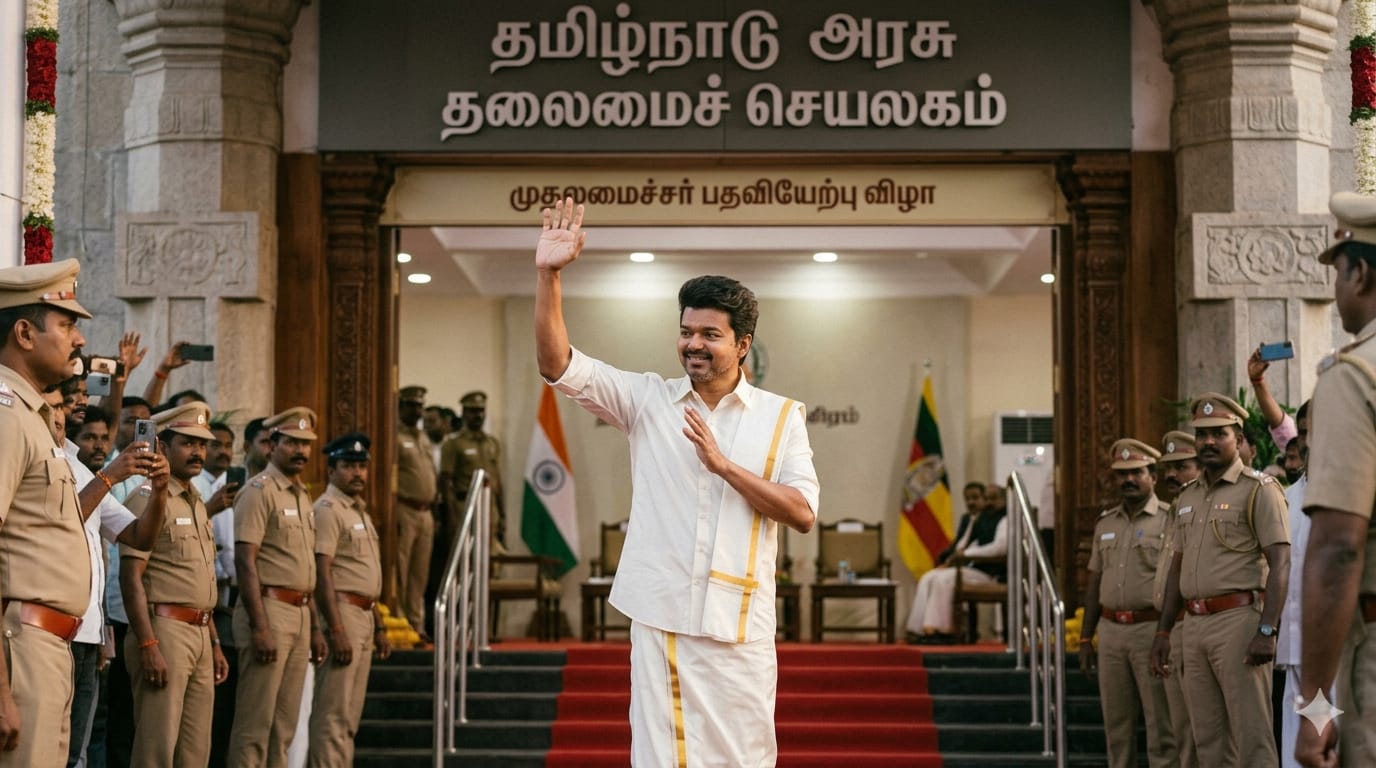
In 1996, many of us first saw Vijay on our television screens as the charming “boy next door” hero. At the time, he was far from the untouchable superstar he is seen as today. Soft-spoken and shy in interviews, he was best known for his romantic roles, which resonated deeply with young audiences.
We did not just grow up watching an actor.
We grew up watching someone grow alongside us.
From school uniforms to working life, from cassette tapes to YouTube algorithms, Vijay’s journey slowly merged with the emotional memory of an entire generation.
And today, in 2026, the same man has taken oath as the Chief Minister of Tamil Nadu.
That sentence alone sounds cinematic.
But perhaps the biggest irony is this: for years, critics mocked his political films as fantasy. Movies like Sarkar and Mersal were dismissed as exaggerated “mass hero dreams.” Yet the very audiences who once cheered those dialogues have now transformed cinematic imagination into political reality.
The critics called it a three-hour fantasy. The people turned it into a five-year mandate.
The Digital Crowd the Experts Never Understood
For decades, politics in Tamil Nadu revolved around a familiar cycle between the Dravida Munnetra Kazhagam and the All India Anna Dravida Munnetra Kazhagam. Many political analysts viewed this dominance as an unbreakable pattern.
And because Vijay came from cinema, many experts refused to take him seriously.
They analysed caste equations. They analysed political machinery. They analysed traditional vote banks.
But they failed to analyse emotional momentum.
While analysts were looking at old political formulas, another movement was growing silently online.
YouTube trailers breaking records. Dance clips flooding social media. Fans organising digitally before political parties even understood the scale of online mobilisation.
What experts dismissed as “fan culture” eventually became political energy.
The algorithm changed.
Years ago, searching Vijay’s name online meant songs, dance moves, fight scenes, and comedy clips. Today, those same search results are flooded with speeches, rallies, campaign promises, and governance debates.
That transformation says something larger about modern politics.
In the digital era, emotional connection is no longer entertainment alone. It can become organisation, loyalty, and eventually political power.
The Quiet Man with the Loudest Crowd
One of the strangest parts of Vijay’s rise is how different his real-life personality always seemed from his on-screen image.
Off-screen, he was often quiet and reserved. On-screen, he roared.
Twenty years ago, he was known as an actor uncomfortable with lengthy public speaking. Today, he stands as the elected voice of millions.
That contrast matters.
Because his political rise was never built only on charisma. It was built on familiarity. Audiences did not merely admire him; they felt they knew him.
For many fans, Vijay was not just a star. He was part of memory itself.
That is why moments like the Jana Nayagan audio launch in Bukit Jalil carried emotional weight beyond cinema. Fans were not simply attending an event. Many felt they were witnessing the final bridge between “actor Vijay” and “politician Vijay.”
Looking back now, the atmosphere makes more sense.
The cheering. The farewell energy. The emotional reactions. The sense that something larger was ending.
And beginning.
More Than Stardom
To reduce Vijay’s political victory to celebrity alone would be intellectually lazy.
Tamil Nadu has seen actors enter politics before some succeeded, others disappeared quickly.
What made Vijay different was timing.
A younger generation frustrated with old political patterns saw him as disruption. A digital generation raised on instant connection saw him as accessible. And an exhausted electorate saw in him the possibility of a third direction.
For over sixty years, Tamil Nadu politics breathed through two lungs. Today, a new wind is blowing.
That does not mean success is guaranteed. Winning power and governing effectively are entirely different challenges.
Cinema gives symbolism. Government demands structure.
The screen can create hope. Reality must sustain it.
The Real Test Starts Now
Becoming Chief Minister is the climax of a political story. Staying effective is the difficult sequel.
The same audiences who once celebrated punch dialogues will now expect policy. The same digital crowd that amplified his rise will also scrutinise his governance.
And perhaps that is the greatest transition of all.
For years, Vijay represented cinematic escape. Now he represents public expectation.
The screen has faded. The spotlight has changed. The applause has become accountability.
And somewhere in that transformation lies an important lesson for every analyst who underestimated him:
Never mistake a fan’s silence for the absence of a vote.
“In 1996, we searched for his name to find a reason to smile. In 2026, we searched for his name to find a reason to hope. The screen has finally faded to black, and the real work has begun.”
Annan Vaithegi writes to explore how culture, memory, and public emotion shape the politics of our time and how entertainment sometimes becomes history before we realise it.
Annan Vaithegi (annanvaithegi@icloud.com) is a content creator under the Newswav Creator programme, where you get to express yourself, be a citizen journalist, and at the same time monetize your content & reach millions of users on Newswav. Log in to creator.newswav.com and become a Newswav Creator now!
The User Content (as defined on Newswav Terms of Use) above including the views expressed and media (pictures, videos, citations etc) were submitted & posted by the author. Newswav is solely an aggregation platform that hosts the User Content. If you have any questions about the content, copyright or other issues of the work, please contact creator@newswav.com.