
As Malaysia moves closer to the 16th General Election (GE16), one question dominates political discussions: Can Dato' Seri Anwar Ibrahim retain power and remain Prime Minister?
The answer is far from straightforward.
Malaysia's political landscape has become increasingly fragmented, coalition-based, and dependent on post-election negotiations rather than outright victories. Recent developments, particularly the growing tensions and eventual split between PAS and Bersatu, have introduced new uncertainties that could reshape the country's political future.
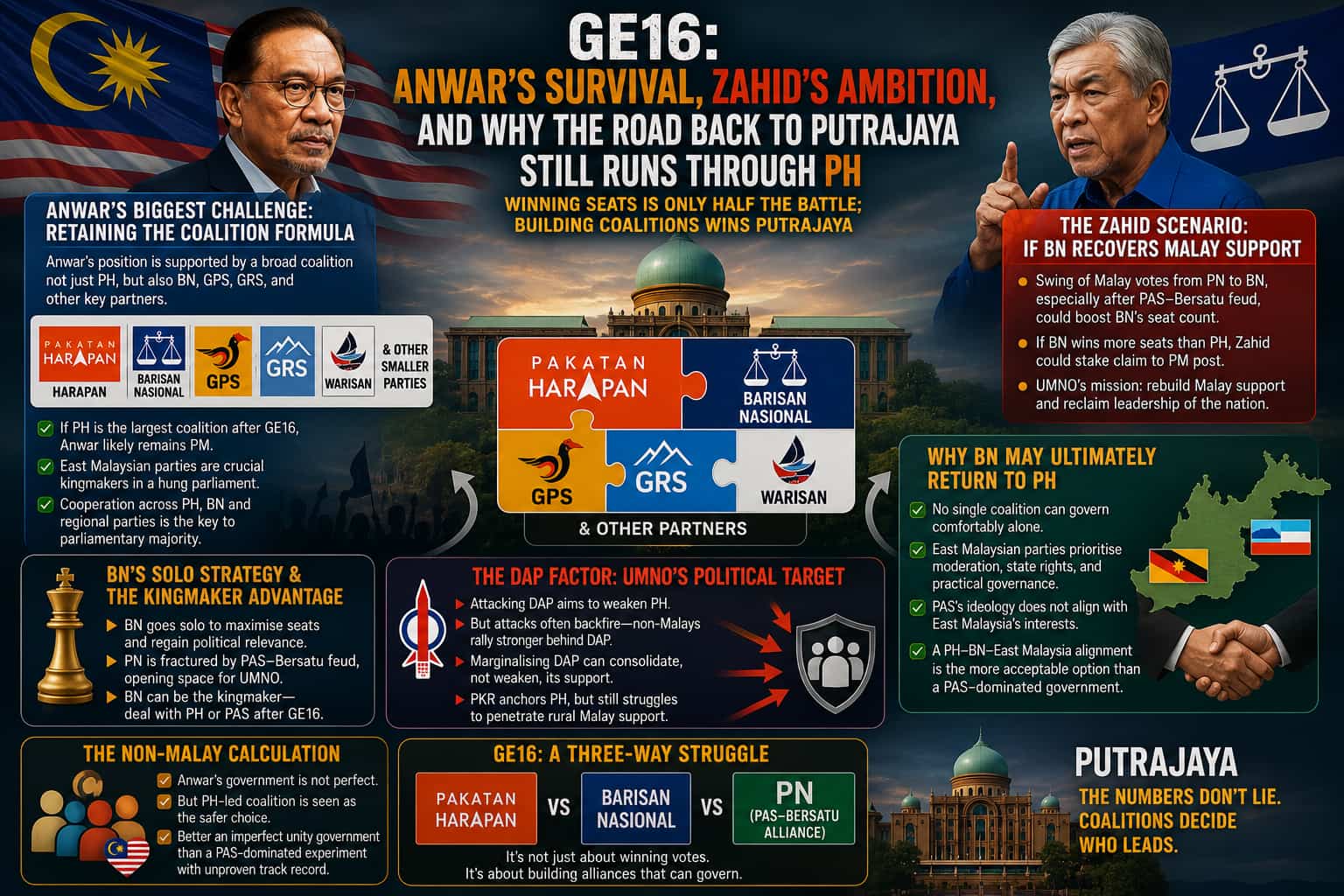
Anwar's Biggest Challenge: Retaining the Coalition Formula
Anwar's position as Prime Minister is not supported solely by Pakatan Harapan (PH), but by a broader coalition of political partners. It rests on a broad coalition comprising PH, Barisan Nasional (BN), Gabungan Parti Sarawak (GPS), Gabungan Rakyat Sabah (GRS), and several smaller parties. This arrangement has provided relative political stability since GE15.
If PH emerges as the largest coalition after GE16, Anwar would likely remain the central figure in government formation. PH can continue relying on support from parties such as Democratic Action Party, Parti Amanah Negara, Gabungan Parti Sarawak, Gabungan Rakyat Sabah, and Parti Warisan to maintain a parliamentary majority. East Malaysian parties have repeatedly demonstrated their crucial alliances as kingmakers in federal politics, particularly in hung parliament scenarios.
The Zahid Scenario: If BN Recovers Malay Support
However, another scenario is increasingly discussed among political observers.
Should there be a significant swing of Malay votes away from PN and back toward BN, particularly following the PAS-Bersatu feud, BN could regain substantial parliamentary ground. If BN wins more seats than PH, the coalition could argue that it deserves to lead the next federal government.
In such circumstances, BN chairman Dato' Seri Ahmad Zahid Hamidi could potentially emerge as a candidate for Prime Minister, depending on post-election negotiations and which coalition BN chooses to support. BN leaders have openly spoken about contesting more seats and seeking to reclaim a leading role in government rather than remaining a junior partner.
This possibility explains why many political analysts view UMNO's efforts to rebuild Malay support as crucial to GE16.
BN's Solo Strategy and the Kingmaker Advantage
For BN, contesting independently may be a logical strategy.
The coalition understands that remaining perpetually dependent on PH risks reducing its political relevance. By going solo, BN seeks to maximise its seat count and position itself as a dominant coalition by its own or the decisive kingmaker after the election.
The fragmentation within PN following the PAS-Bersatu fallout could create opportunities for UMNO to regain traditional Malay constituencies. Analysts have already noted that Malaysia is entering a new phase of political realignment where old alliances may no longer hold.
If BN performs strongly, it would have the flexibility to negotiate with either PH or PAS-led forces.
The DAP Factor: UMNO's Political Target
A recurring feature of Malaysian politics is UMNO's criticism of DAP.
From a strategic perspective, weakening DAP cripples PH because DAP remains the coalition's strongest electoral machinery among non-Malay voters. However, there is a political paradox.
Every major attack on DAP often reinforces support among its non-Malay voter base, who view the party as a necessary counterbalance within Malaysia's political system. As a result, attempts to marginalise DAP can sometimes consolidate rather than weaken its support.
Meanwhile, although Parti Keadilan Rakyat remains the anchor party of PH and provides leadership through Anwar, PKR continues to face challenges expanding its influence among rural Malay voters due to intense competition from UMNO and PAS.
Why BN May Ultimately Return to PH
Despite political rhetoric and electoral competition, the realities of coalition-building remain unavoidable.
Malaysia's electoral arithmetic increasingly suggests that no single coalition can comfortably govern alone. Analysts consistently note that coalition politics is now embedded in Malaysia's political DNA.
Significantly, many East Malaysian parties prioritise moderation, state rights, and practical governance. Their political interests do not always align with PAS's vision of governance. GPS, GRS, and other regional parties have traditionally adopted pragmatic positions focused on Sabah and Sarawak's interests.
This reality could make a PH-BN-East Malaysia alignment more acceptable option than a federal government dominated by PAS.
The Non-Malay Calculation
Among non-Malay voters, support for Anwar's administration is often less about complete satisfaction and more about political comparison.
Many acknowledge that the Unity Government has imperfections and unresolved issues. Rising living costs, governance reforms, and coalition tensions have created dissatisfaction among some segments of the electorate.
Nevertheless, a sizable portion of non-Malay voters may still view a PH-led coalition as the safer option compared with a government dominated by PAS. For these voters, the choice is not necessarily between perfection and failure, but between an imperfect coalition government and a political experiment whose national governance record remains largely untested.
In the end, GE16 may not be a simple contest between Anwar and PAS. It could become a three-way struggle involving PH, BN, and a reconfigured opposition bloc. Yet one lesson from Malaysia's recent political history remains undisputed: winning seats is only half the battle; assembling a workable coalition is what ultimately determines who governs Putrajaya.
And for now, the numbers suggest that any path to power will still require cooperation among PH, BN, and East Malaysian parties.
By: Kpost
Information Source:
Nst , TheStar , TheStar , Malaymail , Newswav
Kpost (ckhorsk@gmail.com) is a content creator under the Newswav Creator programme, where you get to express yourself, be a citizen journalist, and at the same time monetize your content & reach millions of users on Newswav. Log in to creator.newswav.com and become a Newswav Creator now!
The User Content (as defined on Newswav Terms of Use) above including the views expressed and media (pictures, videos, citations etc) were submitted & posted by the author. Newswav is solely an aggregation platform that hosts the User Content. If you have any questions about the content, copyright or other issues of the work, please contact creator@newswav.com.
