
A decade of open-source evidence shows China's amphibious forces becoming a more tightly linked system, but the public record cannot show how that system would perform in wartime, argues Lu Wen-hao, a researcher at the Chinese Society for Strategic Studies. His assessment comes as Taiwan's Ministry of National Defense says the People's Liberation Army (PLA) still falls short of a full joint island landing.
The ministry's 2026 China Military Power Report flags the buildup, training, and support of PLA landing forces as areas to watch. Outside observers have floated 2030 to 2035 as the window in which related programs could be completed.
Taiwan Defense Ministry Report Says Landing Gaps Persist
Lu tested that debate against publicly available material from 2016 to 2026, sorting it into three linked layers: force building, training, and war preparation. Rather than extrapolate from one weapons count or a single exercise, he cross-checked the timing of drills, the units involved, where they trained, and the navy's amphibious platforms.
The decade coincided with sweeping change: theater commands replaced regional commands, the army was rebuilt around combined brigades, the Marine Corps was reorganized, and amphibious assault ships entered service quickly. Lu's central caution is that open sources show which drills took place, not how many units are fully manned, how many vehicles work, or whether large forces could be delivered continuously in war.
Ten Years Turned Surf Drills Into Joint Assault Practice
Lu starts in 2016, when Beijing began replacing seven military regions with five theater commands. Off southern Fujian, the former 31st Group Army practiced swimming, boat handling, sea transit, and live fire with amphibious armored vehicles. Those drills already included opposing forces, electromagnetic jamming, and special forces infiltration, a sign, Lu reads, that training was shifting from coping with waves to completing missions under enemy pressure.
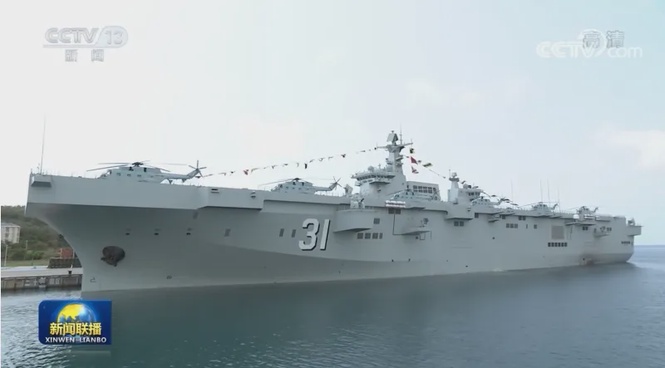
By 2026 the picture had changed. In June, the Type 075 assault ship Guangxi rehearsed coordinated vertical and surface assaults. In August, her sister ship Hubei underwent a comprehensive training assessment in the South China Sea. In September, East China Sea drills featured an assault ship and hovercraft launching several rapid waves, entering and leaving the dock in rough seas, then unloading and recovering craft.
Lu divides the decade into three phases. From 2016 to 2018, units reorganized and deepened realistic sea training. From 2019 to 2022, army, navy, and marine coordination became clearer. From 2023 to 2026, the focus moved to formation coordination, three-dimensional delivery, and continuous landings.
He also notes what the PLA admits. In 2024, a brigade of the 72nd Group Army acknowledged that multi-channel communications remained a weak point in a complex electromagnetic environment. Such cycles of exposing problems and retraining, Lu argues, reveal more about real capability than polished success stories.
Hardware Alone Does Not Make An Amphibious Force
Counting platforms is the most common trap, Lu warns, because amphibious operations depend on organization. Vehicles need trained crews, landing ships must carry them, hovercraft must work with a mother ship, marines must embark, cross the sea, and assault the shore, and aviation must provide vertical delivery and fire support. A weakness in any one link can cap the whole.
The 2021 commissioning of the Type 075 ship Hainan added a flight deck for helicopters and a well deck for armored vehicles and hovercraft. In a 2022 exercise, amphibious vehicles boarded and left landing ships, while a marine brigade used hovercraft to carry vehicles and troops toward the beach. Units, Lu says, now hold more settled roles: army amphibious units handle the water's edge and the assault ashore, marines supply specialist sea-assault forces, landing ships and hovercraft move the load, and the Type 075 adds helicopter delivery and room for command.
Open Sources Cannot Confirm Wartime Readiness
Public evidence is thickest near the Taiwan Strait, Lu notes, especially around southern Fujian, where official reports on amphibious training have long clustered. Farther away, the record thins. Assembling it means cross-referencing Chinese maritime navigation warnings with state media, though the warnings rarely say what military task is under way.
Even so, each finding has a ceiling. One brigade's success does not prove the same for every unit. One assault ship completing drills does not equal the navy's overall delivery capacity. A multiwave hovercraft exercise shows units can sortie repeatedly in training, not that they could do so under fire, jamming, damaged ports, and logistics strain.
Lu lists what public data cannot answer: actual manning and equipment availability, how many Type 071 and Type 075 ships are ready for use, the shipping needed to move large forces at once, supplies and repairs over days of intense fighting, and whether a landing force could expand and hold ground. He frames the gap as three questions. Force building asks what has been created. Training asks what that force can do in observable drills. War readiness asks whether it can mass quickly, deliver continuously, absorb losses, and run joint command under fire. The public record, he says, answers the first two far better than the third.
Tracking Method Matters More Than Any Single Estimate
Lu concludes that the forces are becoming more systematic in four ways: organization is more combined, delivery means are more varied, the training chain from launch to beach assault and recovery is more complete, and joint activity across services is more common. He pairs that finding with four caveats: public data cannot show true manning, drills are not wartime readiness, multiwave delivery in exercises is not sustained delivery under fire, and repeated successful drills do not prove large-scale joint operations are mature.
That is why he calls his work a preliminary study. Rather than lowering his standards for lack of data, he argues, he is drawing a deliberate line between what public information can and cannot prove. The lasting value lies in a method that can be tracked over time: read force building for the foundation of capability, training for how it is generated, training gaps for its limits, and long-term change for the direction of war preparation.
As of 2026, he concludes, the PLA's amphibious forces are more organized, combined, and practiced at sea delivery than a decade ago, but how much of that holds under large-scale, high-intensity, contested conditions remains unconfirmed. For Taiwan, whose defense planning centers on repelling a cross-strait landing, that gap is the part worth watching.
Lu Wen-hao is a researcher at the Chinese Society for Strategic Studies. The views expressed are the author's own.