.jpg)
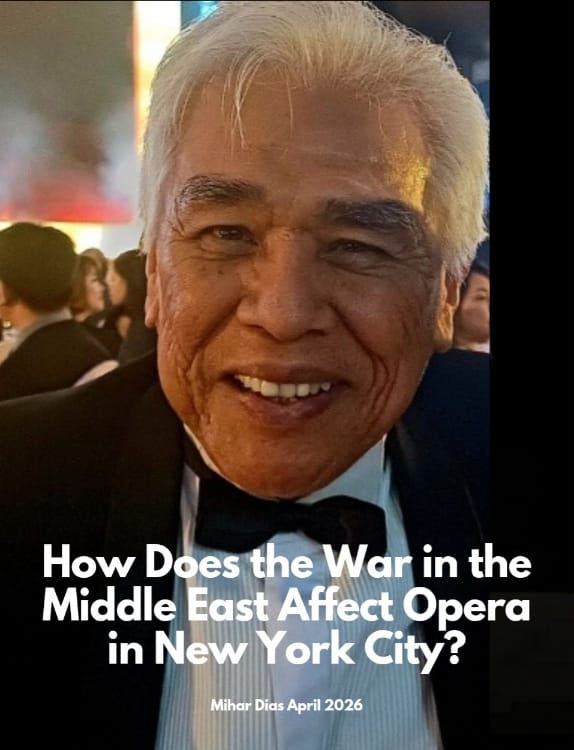
How Does the War in the Middle East Affect Opera in New York City?
By Mihar Dias April 2026
There's no way that the war raging in the Middle East could hit the Metropolitan Opera in New York City. It's too far away.
Yet, the fate of grand opera apparently hangs on the Strait of Hormuz.
In one of those absurd plot twists that only modern life can produce, war in the Middle East has reached Lincoln Center in New York City. https://www.nytimes.com/2026/04/23/arts/music/met-opera-saudi-deal-funding.html
Missiles fly near Iran, oil tankers hesitate in the Gulf, Saudi Arabia tightens its purse strings — and suddenly in Manhattan, people are worrying whether La Traviata can afford another season.
Who knew that one day Carmen would be vulnerable to shipping disruptions?
The story has the makings of opera itself: lavish promises, misplaced optimism, a fortune that vanishes in Act Three.
The Saudis had pledged what looked like a royal rescue package — up to $200 million over eight years — enough to help steady the Met as it limped back from the financial bruises of the pandemic. https://www.nytimes.com/2026/04/23/arts/music/met-opera-saudi-deal-funding.html
There were even plans for the company to decamp to Riyadh each February in a kind of operatic migration, as though New York’s aristocratic swans would winter in the desert.
One can only mourn what might have been.
Imagine Aida performed under Saudi patronage — which, admittedly, would have had a certain historical symmetry.
Imagine oil ministers discussing Puccini over dates and cardamom coffee.
Imagine a board meeting where someone asks, with complete seriousness, whether The Marriage of Figaro should have a falconry component.
And then, as in every proper opera, doom arrives by messenger.
Not on horseback, but on Zoom.
The Saudis, facing war jitters and economic uncertainty, inform the Met the money is gone. https://www.nytimes.com/2026/04/23/arts/music/met-opera-saudi-deal-funding.html
Curtain.
There is something almost perfect about receiving operatic tragedy through a video call.
Once, a king’s envoy would burst into the palace to announce catastrophe.
Now someone in New York hears, “Peter, can you hear us?” and by the end of the call there is a $30 million hole in the budget.
Modern civilization condensed into one scene.
But what makes the episode irresistible is not merely the financial drama. It is the exquisite absurdity of the world it reveals.
For years we were told globalization would bind nations through trade and shared prosperity.
No one mentioned it would also mean a conflict near the Persian Gulf could reduce the number of performances of Rigoletto.
Yet here we are.
A blockade threatens oil.
Oil threatens budgets.
Budgets threaten opera.
And somehow geopolitics ends with a mezzo-soprano in Manhattan wondering if her production has been cut.
This is not economics.
This is satire writing itself.
There is, too, a delicious irony in the Met turning to petro-royalty for salvation.
Grand opera — the citadel of old European refinement — seeking rescue from sovereign wealth funds.
One half expected the next season to open with “The Barber of Seville, presented by Aramco.”
Perhaps intermissions would include crude-price bulletins.
Perhaps applause would depend on Brent futures.
And now, with the Saudi dream evaporating, the Met contemplates selling naming rights to the opera house.
This is where farce becomes poetry.
Can we be far from attending performances at the ExxonMobil Metropolitan Opera Center?
Will donors one day rise for Tosca in the Goldman Sachs Grand Tier?
Might the Chagall murals survive only because someone bought them but agreed to leave them hanging, like aristocrats renting back their ancestral portraits?
There is something deeply New York in all this — desperate, grandiose, entrepreneurial and faintly ridiculous.
And perhaps deeply human too.
For what is opera, after all, if not the art of surviving impossible circumstances through magnificent overreaction?
The Met has survived wars, depressions, pandemics, strikes and avant-garde productions that looked like airport lounges.
It will survive this.
But one cannot resist admiring the sheer absurd majesty of a world in which Middle Eastern conflict may influence whether a soprano reaches her high note on schedule.
Some people see geopolitics.
Others see comedy.
I see a libretto.
Because if someone had written this as fiction — oil chokepoints threatening Mozart in Manhattan — an editor would have rejected it as implausible.
Yet reality, as usual, has a more eccentric imagination.
And perhaps that is the real lesson.
In our age, even opera no longer dies of heartbreak.
It dies of interrupted cash flow.
Mihar Dias (mihardias@gmail.com) is a content creator under the Newswav Creator programme, where you get to express yourself, be a citizen journalist, and at the same time monetize your content & reach millions of users on Newswav. Log in to creator.newswav.com and become a Newswav Creator now!
The User Content (as defined on Newswav Terms of Use) above including the views expressed and media (pictures, videos, citations etc) were submitted & posted by the author. Newswav is solely an aggregation platform that hosts the User Content. If you have any questions about the content, copyright or other issues of the work, please contact creator@newswav.com.