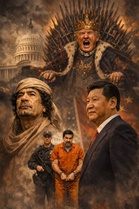
Can we ever truly know which country is responsible for starting the COVID-19 pandemic? The world has argued about this question for more than five years now. In June 2025 a World Health Organization expert group said that evidence is still inconclusive and that no theory has been proven beyond doubt on where SARS-CoV-2 first jumped into humans. Businesstoday
This question still ignites anger, blame, politics, and deep mistrust. It affects how countries shape global health rules, trade, and diplomacy. It has shaped how Malaysians think about China and the rest of the world. It fuels claims that certain nations must prove their version of the story. But science, facts, and politics don’t line up in a neat timeline. They collide and conflict.
Here is the reality: no country has conclusive proof of the pandemic’s origin. The evidence remains incomplete, contested, and heavily shaped by political motivations. This article traces why the origin question still divides scientists, governments, and the public. It shows why proof is elusive and suggests how the world should respond next.
What We Know and Don’t Know
Scientists have spent years studying the origins of SARS-CoV-2, the virus behind COVID-19. The earliest confirmed outbreak of COVID-19 was recorded in Wuhan, China, in late 2019. Many of the first reported cluster cases were linked to the Huanan Seafood Wholesale Market in Wuhan. (Encyclopedia Britannica)
But that does not equate to proving where the first spillover occurred. Genetic sequencing shows the virus is closely related to coronaviruses circulating in bats in Southeast Asia, suggesting it likely came from animals. (National Geographic)
Efforts to find the intermediate host species the animal that passed the virus to humans have so far failed. This differs from previous epidemics like SARS in 2003, where civets were quickly traced as the bridge between bats and humans. (National Geographic)
The World Health Organization’s Scientific Advisory Group for Origins of Novel Pathogens (SAGO) has said many key data needed to conclude how SARS-CoV-2 entered humans have not been shared. They specifically note that lab leak theories cannot be excluded because relevant information has not been made available by all countries. (BusinessToday)
This means the virus could have come from animals in a marketplace, from a laboratory accident, or from another unknown route. Officially, scientists classify the origin as unknown and unresolved. (STAT)
Science And Politics Mixed Together
In some political circles, the idea that the virus escaped from a laboratory has been elevated to near certainty. U.S. intelligence agencies like the CIA have said the pandemic most likely came from a lab in Wuhan, though with low confidence. (Wikipedia)
Meanwhile, some political investigations in Washington concluded in reports that supported a lab origin, alleging problems with transparency and research protocols. (oversight.house.gov)
At the same time, a majority of virologists and epidemiologists surveyed say natural spillover remains more plausible based on current evidence. (science.org)
This difference shows how scientific uncertainty has been translated into certainty in some political arenas, despite ongoing debate. Even national intelligence agencies and scientific bodies report different conclusions. This fuels public confusion rather than clarity.
Why Political Interest Makes Proof Hard
Countries have reasons to avoid giving full access to pandemic origin data. In many cases, political interests outweigh scientific transparency.
China has repeatedly rejected external pressure to share raw data from its early cases, laboratory records, and other potentially revealing information. It has questioned whether the virus started in China at all and has suggested unlikely theories such as introduction through frozen food imports. (Bulletin of the Atomic Scientists)
Western governments, including the United States, have pressured for more openness. Efforts to push for unrestricted scientific investigation repeatedly met limits due to diplomatic tensions and mutual distrust. (Council on Foreign Relations)
In global public opinion, every nation tends to promote the explanation that protects its image. This makes any claim of proof inherently political. There is no impartial arbiter with full access to all evidence.
Why It Matters To Malaysians And The World
People all over the world live with the effects of COVID-19 every day. Over 20 million deaths worldwide have been attributed to the pandemic. (STAT) Loss of life, economic devastation, school closures, travel bans, and long-term health issues make the origin question deeply personal.
In Malaysia, debates about responsibility have surfaced on social media, in parliament, and within public health discussions. Blame can strain diplomatic relations and obscure the core need for better pandemic prevention.
Public polls show that a high percentage of people, especially in Western countries, believe the virus originated in a Chinese lab, despite conflicting evidence. (MDPI) This reveals how public perception is shaped by national narratives rather than solid proof.
Facts about origins have real consequences: how resources are allocated for future pandemic surveillance, how international cooperation is structured, and how public trust in science and governance is built or eroded.
What If We Never Find Definitive Proof?
The possibility that no country will ever prove where the pandemic began is real. The evidence may always be incomplete. Key records may never be shared. Memories fade. Data may be lost. Investigations may hit political walls.
Scientific investigations are hindered when essential data never enters the public domain. The WHO and multiple national health agencies have repeatedly stated that without transparency and access to original records, definitive answers are impossible. (BusinessToday)
This is not a failure of science alone. It is a structural problem in global health governance. No single entity has the power to demand full compliance, and countries value their sovereignty above external scrutiny.
Practical Lessons for The Future
If the world can learn anything from the unresolved origin question, it is this:
- Strengthen international rules for outbreak reporting. Nations must agree to legally binding data-sharing obligations. Data must be shared in real time, not retrospectively. This can prevent delays and blind spots in early outbreak detection.
- Establish independent international investigation bodies. These bodies must have full access and legal authority to review labs, markets, animal trade records, and early case files without political restrictions.
- Create shared scientific repositories. All genomic, clinical, environmental and lab data should be stored in globally accessible platforms to prevent data loss or selective reporting.
- Build public literacy on scientific uncertainty. People should be educated to understand why uncertainty remains and how science progresses through evidence rather than assumptions.
These are not easy reforms. They require countries to accept that transparency may reveal uncomfortable truths. They require global leadership that prioritizes collective safety over national pride.
What do you think? I’d love to hear your opinion in the comments section.
No country has proved where COVID-19 began. The pandemic’s origins remain unresolved because science, politics, secrecy, and public perception are deeply entangled. We live in a world where national interest often outweighs global safety, and where transparency is conditional.
Rather than asking which country started the pandemic, the world must focus on how to prevent the next one through cooperation, transparency, and shared scientific commitment.
AM World (tameer.work88@gmail.com) is a content creator under the Newswav Creator programme, where you get to express yourself, be a citizen journalist, and at the same time monetize your content & reach millions of users on Newswav. Log in to creator.newswav.com and become a Newswav Creator now!
The User Content (as defined on Newswav Terms of Use) above including the views expressed and media (pictures, videos, citations etc) were submitted & posted by the author. Newswav is solely an aggregation platform that hosts the User Content. If you have any questions about the content, copyright or other issues of the work, please contact creator@newswav.com.