

There is a persistent view that many unregistered Hindu temples today exist because they were deliberately and illegally built by irresponsible parties.
This is at least, the basis on which the anti-temple movement is deeming these temples to be “illegal” before demanding that these temples to demolished.
While it might be the case that there are indeed cases where procedural or approval issues exist, or that there are indeed some temples or shrines that have been built by unscrupulous or irresponsible parties, it is neither accurate nor fair to generalize that all temples without land titles were unlawfully constructed.
The real source of concern for the Indian community is not registration itself. The unease arises when a narrative emerges suggesting that any temple built on land it does not legally own “has no right to exist.”
This narrative ignores historical context.
The Estate Ecosystem: From Plantations to Generations
Once upon a time, much of a state like Selangor was covered by rubber and palm oil plantations, cultivated by Indian laborers brought in during the colonial era.
Plantations were more than workplaces—they were complete ecosystems. They provided housing, Tamil schools, dispensaries, cemeteries, community halls, and temples. The estate became a cradle-to-grave environment for generations of Indian workers.
Temples built within these estates were not clandestine structures. They were usually constructed with the agreement of estate owners, as part of a social contract supporting the laborers who worked their land. The land might remain under the estate’s ownership, but the temple’s existence was recognized and accepted as part of the estate’s social structure.
As Malaysia industrialized and urbanized, many estates were closed and converted into residential, commercial, or industrial areas. The areas designated for the rubber or palm oil trees were cleared, workers quarters was also often demolished, but in many cases, the temples themselves remained. They became one of the few physical markers connecting descendants to their historical roots.
Even after the estate communities dispersed, the inhabitant of the estates and their descendants would still continue to return to these temples during festivals, preserving memory, identity, and social networks.
Historical Facts: Selangor 1930
Official data from 1930, shared by Ronnie Liu, provides important perspective.
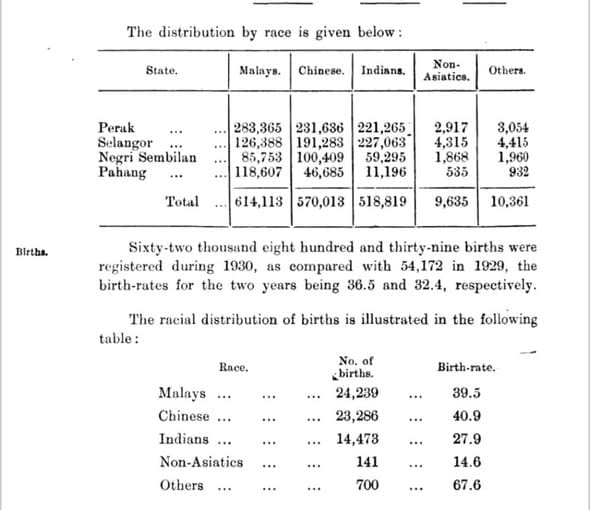
The population composition of Selangor at the time was:
- Indians: 227,063
- Chinese: 191,283
- Malays: 126,388
- Others & Non-Asians: 8,730
Indians in other words, were the largest ethnic group in Selangor in 1930. The Indian population in fact, was so large that it was almost twice the Malay population in Selangor.
This is crucial in understanding the social and religious landscape of the state nearly a century ago. The presence of a large Indian community—especially in the plantation sector—directly contributed to the construction of Hindu temples across the state.
When people today question why there are so many temples in Selangor despite a smaller Indian population, the answer lies in this historical demographic reality.
The existence of many old temples did not happen suddenly or without reason. It emerged from a historical reality in which the Indian community formed the backbone of the plantation economy and was among the largest groups in the state.
“Haram” or “Without Approval”?
In public discourse, the term “kuil haram” (illegal temple) is highly sensitive. In religious terms, haram means “forbidden” or “sinful.” Applying it to places of worship is not only inaccurate but risks inflaming religious tensions.
Yes, some temples may lack official approval or may not comply with modern land procedures. It is for this reason that many Indians are seeking for the the more accurate term of “without approval,” “without permission,” or “non-compliant with procedure.”
While some people also ask as to why the Indians did not buy the land that the temple was on, it is also important to remember that this was not the nature of the agreement that the Indians had with the estate owners, at the time that the temple were built. The agreement that we had was actually for an area to designated for us for our religious needs in return for the labour. While it is our assumption today that all ownership of land must be documented, this was not always the case.
We must also remember that the Indians in the plantation sector were primarily working-class, arranging the conditions of their lives according to agreements with their employers. These were not people who could afford—or even thought in the way of—someone living in the present day, who would demand documentation or at least a receipt for every transaction they made.
Just because there was no paperwork or documentation however, it does not mean that they did not seek and obtain a right for the temple to exist.
In other words, while the structures may not meet current land laws, that does not make them morally or legally haram.
This is the case because many of these temples predate modern land ownership systems. They were built within the context of social agreements between estate owners and laborers who developed the state’s economy.
History Is Not for Politicization—It Is for Understanding
The temple issue is not simply a technical matter of land ownership. It is a matter of history, identity, and community continuity.
Understanding historical facts objectively allows us to view present issues more fairly and equitably. Judging these temples solely through the lens of modern law, without considering their historical context, risks misunderstanding justice.
While it may be true that some newer temples or shrines have been built in recent times by unscrupulous or irresponsible individuals—sometimes using outdated agreements, ignoring necessary terms, or not applying any conditions at all—it is wrong to paint all temples with the same brush. Temples that legally own the land they occupy should not be targeted collectively, and organizing a rally to address all temples in a blanket manner is unjust.
History is not for politicization.
History is for understanding.
TheRealNehruism (nehru.sathiamoorthy@gmail.com) is a content creator under the Newswav Creator programme, where you get to express yourself, be a citizen journalist, and at the same time monetize your content & reach millions of users on Newswav. Log in to creator.newswav.com and become a Newswav Creator now!
The User Content (as defined on Newswav Terms of Use) above including the views expressed and media (pictures, videos, citations etc) were submitted & posted by the author. Newswav is solely an aggregation platform that hosts the User Content. If you have any questions about the content, copyright or other issues of the work, please contact creator@newswav.com.
