
The campaign tents are coming down. The flags will soon disappear from roadsides. Loudspeakers that filled neighbourhoods with promises have finally fallen silent. Yet long after the posters fade, one message remains unmistakably clear.
Johor has spoken.
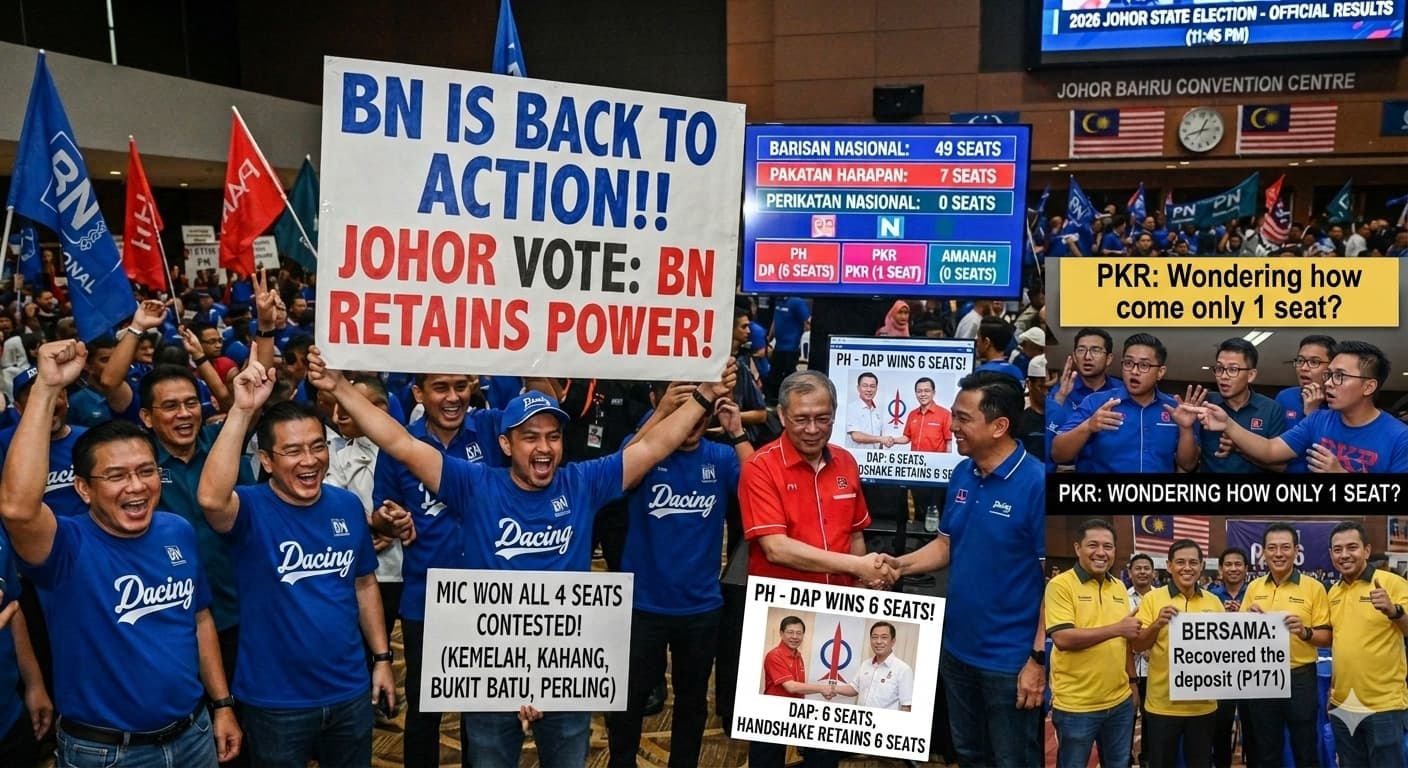
Barisan Nasional emerged with a commanding victory, securing 48 of the 56 seats in the state assembly, while Pakatan Harapan retained eight seats. Other parties, including the newly formed BERSAMA, failed to secure representation despite attracting four-digit vote totals in several constituencies. The result is decisive, and in any democracy, the people's verdict deserves respect.
Every election produces two immediate reactions. Winners celebrate. Losers search for explanations. Social media quickly fills with declarations that the result is either a total endorsement of one side or a complete rejection of another. Reality is rarely that simple.
The public comments following the Johor result reflected that diversity of opinion. Some viewed the election as a vote of confidence in Johor Menteri Besar Onn Hafiz Ghazi and BN's campaign organisation. Others argued it reflected dissatisfaction with the pace of reforms under the federal government. Still others cautioned against reading too much into a single state election, noting Johor's unique political landscape and history.
Whatever interpretation one prefers, the first lesson is straightforward.
Congratulations are due to Barisan Nasional.
Winning an election is never automatic. It requires organisation, disciplined campaigning, credible candidates, and the ability to persuade enough voters that your team deserves the opportunity to govern. Whether supporters voted because they admired BN's campaign, appreciated the state administration, or simply preferred stability, the outcome represents a democratic mandate that should be acknowledged with maturity.
One outcome deserves particular attention. Barisan Nasional's component party, MIC, won all four seats it contested Kemelah, Kahang, Bukit Batu, and Perling. That is no small achievement. For a party that has often argued it remains relevant to the Malaysian Indian community, the voters have now given its candidates a clear mandate.
With that mandate comes responsibility.
The election is over. The campaign slogans have served their purpose. Now begins the harder task of governing and engaging consistently with the community that placed its trust in you. The Malaysian Indian community does not need leaders who appear only when nomination papers are filed or campaign banners go up. It needs representatives who are visible throughout the five-year term, who are prepared to listen, explain, and solve problems even when there are no cameras present.
Winning four seats also strengthens MIC's voice within Barisan Nasional. That voice should now be used constructively. Raise the issues that matter to the community with confidence and professionalism. Continue advocating for quality education, stronger opportunities for young people, the preservation and proper administration of places of worship, entrepreneurship, skills development, and programmes that genuinely improve livelihoods. A convincing electoral victory should never become a licence for complacency. Instead, it should become a reminder that public trust is renewed only when promises are matched by consistent action.
The challenge, however, begins after victory.
Election victories create expectations. Voters who placed their trust in the government will expect improvements in public services, economic opportunities, infrastructure, education, investment, and the everyday issues that shape family life. A convincing electoral mandate is not the finish line; it is the beginning of a much higher standard of accountability.
Pakatan Harapan, meanwhile, faces a different challenge.
Retaining eight seats is not the outcome it sought, yet democratic politics has repeatedly shown that defeats often become moments of renewal if parties are willing to listen honestly. Several public comments suggested frustration over the pace of reforms, campaign messaging, and perceptions of political complacency, while others defended the coalition and argued that support remained resilient in important constituencies.
The important question is not whether every criticism is correct.
The important question is whether political parties are prepared to hear criticism without dismissing it.
That lesson applies to every party in Malaysia.
Democracy becomes healthier when victories encourage humility rather than arrogance, and when defeats encourage reflection rather than denial.
The Johor election also offered an interesting glimpse into the challenges facing newer political movements.
Bersama did not win a seat. By conventional electoral standards, that is disappointment. Yet another perspective deserves consideration. For a newly established party with limited organisational structure, campaign machinery, and financial resources, attracting four-digit support in several constituencies demonstrates that building political recognition is often a gradual process rather than an overnight success.
History offers many examples of political parties that began with modest results before gradually establishing themselves over multiple election cycles. Electoral politics rewards persistence as much as enthusiasm.
That does not guarantee future success.
It simply reminds us that democratic development is measured over years, not only on one election night.
Perhaps the most important lesson from Johor has little to do with campaign slogans.
It concerns voter expectations.
Despite sharp disagreements about who deserved to win, one recurring theme emerged. Citizens continue demanding better governance, stronger institutions, more effective leadership, and policies that improve daily life. Some believe one coalition is better placed to deliver those outcomes. Others strongly disagree. Yet beneath those differences lies a shared desire for competent government and meaningful progress.
That expectation should remain at the centre of Malaysian politics.
Elections are important because they determine who governs.
Governance is even more important because it determines how people live.
The true measure of success will not be the size of a legislative majority but the quality of decisions taken after the celebrations have ended. Will investment continue to grow? Will young people find better opportunities? Will schools, healthcare, housing, and public transport improve? Will public institutions become stronger and more trusted?
Those are the questions that endure long after campaign speeches are forgotten.
Malaysia also benefits when election results are viewed with perspective rather than triumphalism.
One state election does not automatically predict the next general election. Political landscapes evolve. Economic conditions change. Public expectations shift. Parties reorganise. New leaders emerge. Voters reassess their choices. Democracy is an ongoing conversation rather than a single verdict.
Johor's decision should therefore be respected without assuming it settles every national political question.
The most encouraging outcome after any election is not that one side celebrates while another despairs.
It is that every participant returns to the difficult work of serving citizens more effectively.
To Barisan Nasional, congratulations on earning the confidence of Johor voters. That confidence now carries the responsibility to govern well.
To Pakatan Harapan, electoral setbacks need not define the future if they become opportunities to reconnect with public expectations.
To Bersama and other emerging movements, democratic credibility is built patiently, one community, one conversation, and one election at a time.
Ultimately, the real winner should never be a political logo.
It should be the people of Johor.
Because when elections conclude, governments begin.
And history will remember not who celebrated the loudest on election night, but who served the rakyat best in the years that followed.
Annan Vaithegi “Ballots choose governments. Good governance earns history's respect.”
Annan Vaithegi (annanvaithegi@icloud.com) is a content creator under the Newswav Creator programme, where you get to express yourself, be a citizen journalist, and at the same time monetize your content & reach millions of users on Newswav. Log in to creator.newswav.com and become a Newswav Creator now!
The User Content (as defined on Newswav Terms of Use) above including the views expressed and media (pictures, videos, citations etc) were submitted & posted by the author. Newswav is solely an aggregation platform that hosts the User Content. If you have any questions about the content, copyright or other issues of the work, please contact creator@newswav.com.