
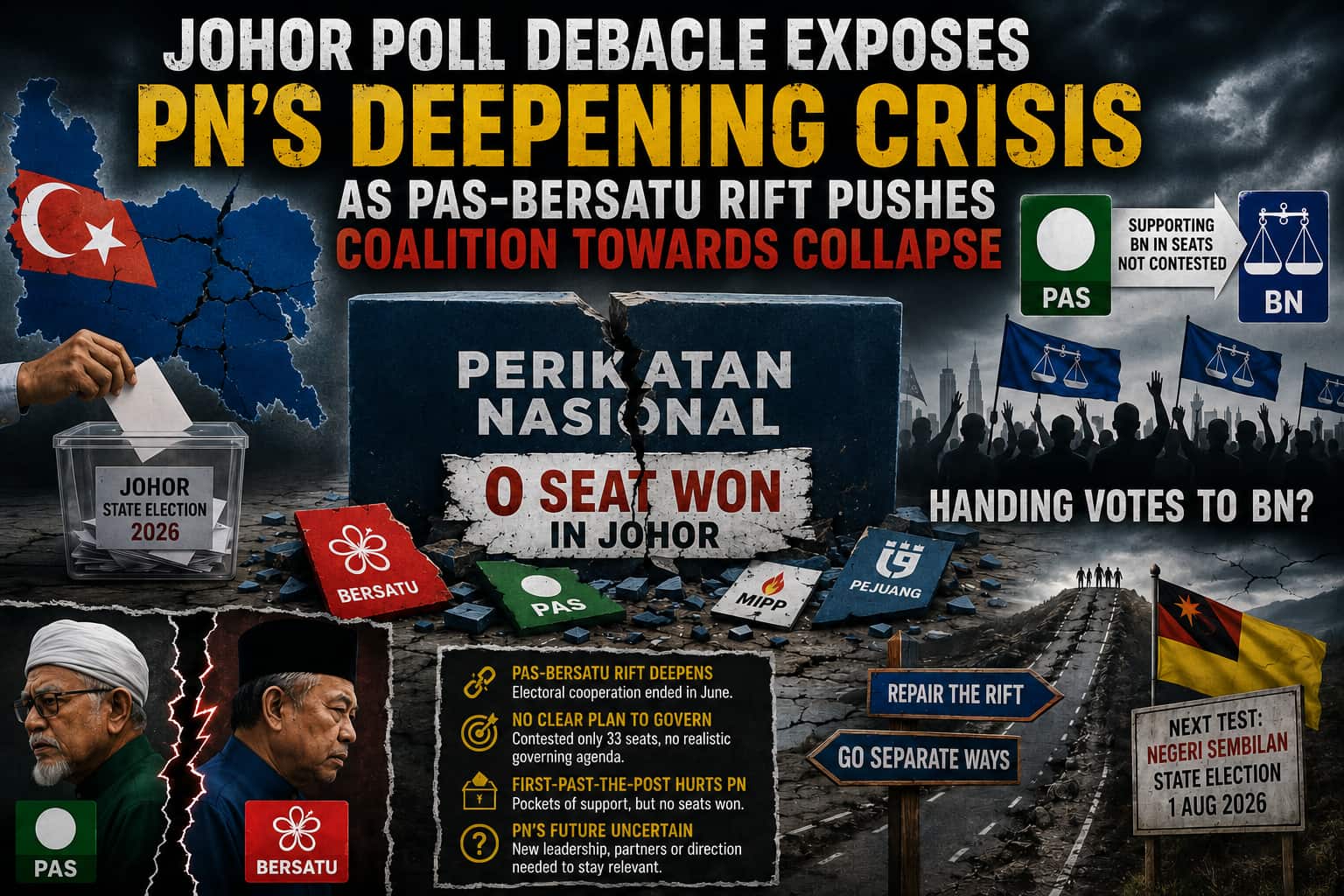
Perikatan Nasional's humiliating wipeout in the Johor state election has intensified speculation that the opposition coalition is approaching a breaking point, with political analysts warning that the once-formidable alliance may no longer be viable in its current form.
PN contested 33 seats in the election but failed to secure a single victory. Bersatu lost all 16 seats it contested, PAS was defeated in all 11 of its contests, while the Malaysian Indian People's Party (MIPP) and Pejuang also failed to make any breakthrough.
The crushing defeat comes at a time when relations between PAS and Bersatu have deteriorated sharply, raising serious questions over the coalition's future.
Universiti Sains Malaysia political analyst Reevany Bustami said the Johor outcome could accelerate a breakup that was already taking shape. He argued that PN would need new leadership, fresh political partners, or an entirely different direction if it hoped to remain relevant after such a devastating setback.
Reevany noted that history has shown many breakaway coalitions struggle to survive beyond two or three election cycles if they fail to establish a durable support base.
A key factor that attracted attention throughout the Johor campaign was PAS' decision not to actively support Bersatu after ending their electoral cooperation in June 2026. Instead, PAS instructed its members and supporters to vote for Barisan Nasional (BN) in constituencies where PN was not contesting.
While PAS framed the move as a strategic decision, it effectively undermined PN's broader objective of presenting itself as a credible alternative government.
Rather than maximising opposition votes against BN and Pakatan Harapan, PAS' public endorsement of BN in selected constituencies was widely seen as indirectly strengthening BN's electoral prospects. The move also reinforced perceptions that PAS was no longer prioritising PN's collective success.
This opinionated strategy by political observers reflect a longer-term calculation by PAS. With PN's prospects of forming the federal government appearing increasingly remote, PAS may be repositioning itself to preserve future political leverage.
By demonstrating that its grassroots supporters remain disciplined enough to influence electoral outcomes, PAS could be signalling its value to potential future allies, including BN, should political realignments occur after state elections or the next general election.
Such a strategy may also serve PAS's broader ambition of gradually expanding its influence beyond its traditional rural strongholds. Closer cooperation with parties that possess stronger urban machinery could eventually provide PAS with greater opportunities to penetrate mixed and urban constituencies where it has historically struggled to gain traction.
ISEAS-Yusof Ishak Institute senior fellow Francis Hutchinson likewise viewed the Johor result as evidence that the PAS-Bersatu partnership is rapidly unravelling.
He said Johor presented unique challenges for PAS due to the state's political culture and the prominent role of the Johor royal institution in religious affairs. Nevertheless, the collapse in cooperation between PAS and Bersatu significantly weakened PN's campaign machinery and reduced its competitiveness across the state.
Hutchinson also observed that although PN may have retained pockets of support in several constituencies, the first-past-the-post electoral system meant those votes failed to translate into seats. More importantly, the coalition's decision to contest only a limited number of constituencies projected little confidence that it possessed a realistic plan to govern Johor.
With Negeri Sembilan heading to the polls next, analysts believe the opposition now faces an uphill battle to rebuild public confidence. Whether PAS and Bersatu can repair their fractured relationship - or whether both parties ultimately pursue separate political paths - may determine not only the future of PN but also the shape of Malaysia's opposition politics ahead of the next general election.
By: Kpost
Information Source:
Kpost (ckhorsk@gmail.com) is a content creator under the Newswav Creator programme, where you get to express yourself, be a citizen journalist, and at the same time monetize your content & reach millions of users on Newswav. Log in to creator.newswav.com and become a Newswav Creator now!
The User Content (as defined on Newswav Terms of Use) above including the views expressed and media (pictures, videos, citations etc) were submitted & posted by the author. Newswav is solely an aggregation platform that hosts the User Content. If you have any questions about the content, copyright or other issues of the work, please contact creator@newswav.com.
