
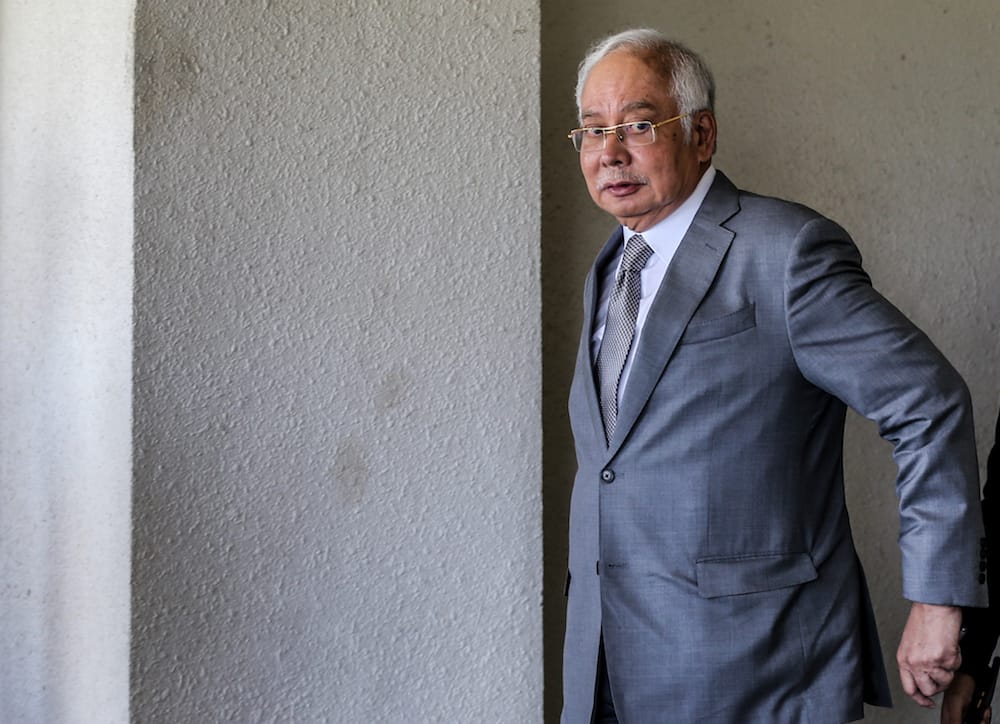
After all the talk about turning Najib Razak's house into something resembling a prison, complete with security arrangements, monitoring and whatever else the authorities deem necessary, we are now told that he could be serving his sentence at home, with family members potentially allowed to live with him.
So, what exactly will this house arrest look like?
I am picturing Najib waking up to the smell of freshly brewed kopi and nasi lemak, having breakfast with the family, and then retreating to his room for a few hours of reflection, contemplating his sins before emerging for a nice, healthy quinoa lunch.
Will there be designated family hours? Dunno.
CCTV in the living room? Maybe.
A prison officer standing outside while everyone enjoys mealtime? Perhaps.
Can the grandchildren have a playtime with Grandpa Najib? Can the family watch television together? Is there a curfew for moving between the bedroom and the kitchen? Not a clue.
And what about phone and computer privileges? Will Najib have personal access to the internet and social media? Or could he access them through his family's devices? Taktau.
I am genuinely curious. If the house is supposed to function as a place of detention, I would like to understand where the house ends and the prison begins.
Welcome to House Arrest 101: Malaysian Edition
Of course, I understand that serving a sentence at home does not automatically mean a person is free to do whatever they please. There may be restrictions on movement, visitors and communications, along with monitoring requirements. Breaching the conditions could have consequences.
Fine. I get that.
But if a family home
is to function as a prison, what exactly makes it a prison? Is it the security officers? An electronic tracking device? The inability to leave the premises? Or simply the fact that someone has officially declared the house a place of detention?
And if family members are allowed to live with the person serving the sentence, what does that arrangement look like in practice?
Are there designated hours for family time and designated hours for solitary confinement? Can they celebrate birthdays? Have fun nights playing cards and board games? Sing karaoke together?
Can they enjoy life as if the house is not a prison?
When an arrangement of this nature is made for a former prime minister convicted in a major financial scandal, the public deserves a clear explanation of how it works.
The public should not have to piece together the meaning of house arrest through statements from different politicians, comments from lawyers and speculation on social media.
If there are restrictions, tell us what they are. If the rules differ from those governing ordinary prisoners, explain why.
If the rules cannot be disclosed in full for legitimate security or operational reasons, the authorities should at least explain the principles governing the arrangement, including who qualifies, what restrictions apply and how compliance is monitored.
These are not unreasonable questions. They are questions about equality before the law.
This is not merely about Najib. It is about the standards we expect from our institutions and the confidence we place in our justice system.
Without sufficient transparency, we risk creating the impression that the rules are one thing for the powerful and another for everyone else. That is a perception our institutions should take seriously.
Ultimately, the question is whether the system can explain its decisions clearly enough for the public to have confidence in them.
Because justice is not just about where a prisoner sleeps at night. It is about the law, the process, the conditions imposed and whether those conditions are applied fairly.
And if we are going to have a prison inside a house, surely the least we can ask is to be told how it works.
Another thing to consider
As things stand, Najib has yet to pay the RM50 million required under the terms of his conditional pardon, and he has not been transferred to the house in Langgak Duta designated for his house arrest. So, for all our speculation about nasi lemak breakfasts, family karaoke and CCTV in the living room, the arrangement has yet to become a reality.
And even if he eventually moves home, it may not be a permanent arrangement.
On October 14, the High Court rejected Najib's application to postpone his separate 15-year prison sentence in the 1MDB case. That sentence is scheduled to begin after his SRC sentence ends in August, 2028, subject to further legal proceedings.
So, yes, he could end up back in prison after his house-arrest period. Unless, of course, he receives another pardon. Who knows? By then, we might be discussing House Arrest 2.0.
But none of this excuses the authorities from answering the questions the public has been asking.
Whether Najib moves home tomorrow, next month or never, we still deserve to know what house arrest is supposed to look like. We deserve clarity on the rules, the restrictions and how they will be enforced.
After all, we shouldn't have to wait for the prisoner to arrive home before finding out what kind of prison we've built.
Fa Abdul (fa.abdul.penang@gmail.com) is a content creator under the Newswav Creator programme, where you get to express yourself, be a citizen journalist, and at the same time monetize your content & reach millions of users on Newswav. Log in to creator.newswav.com and become a Newswav Creator now!
The User Content (as defined on Newswav Terms of Use) above including the views expressed and media (pictures, videos, citations etc) were submitted & posted by the author. Newswav is solely an aggregation platform that hosts the User Content. If you have any questions about the content, copyright or other issues of the work, please contact creator@newswav.com.