.jpg)
By Mihar Dias August 2026
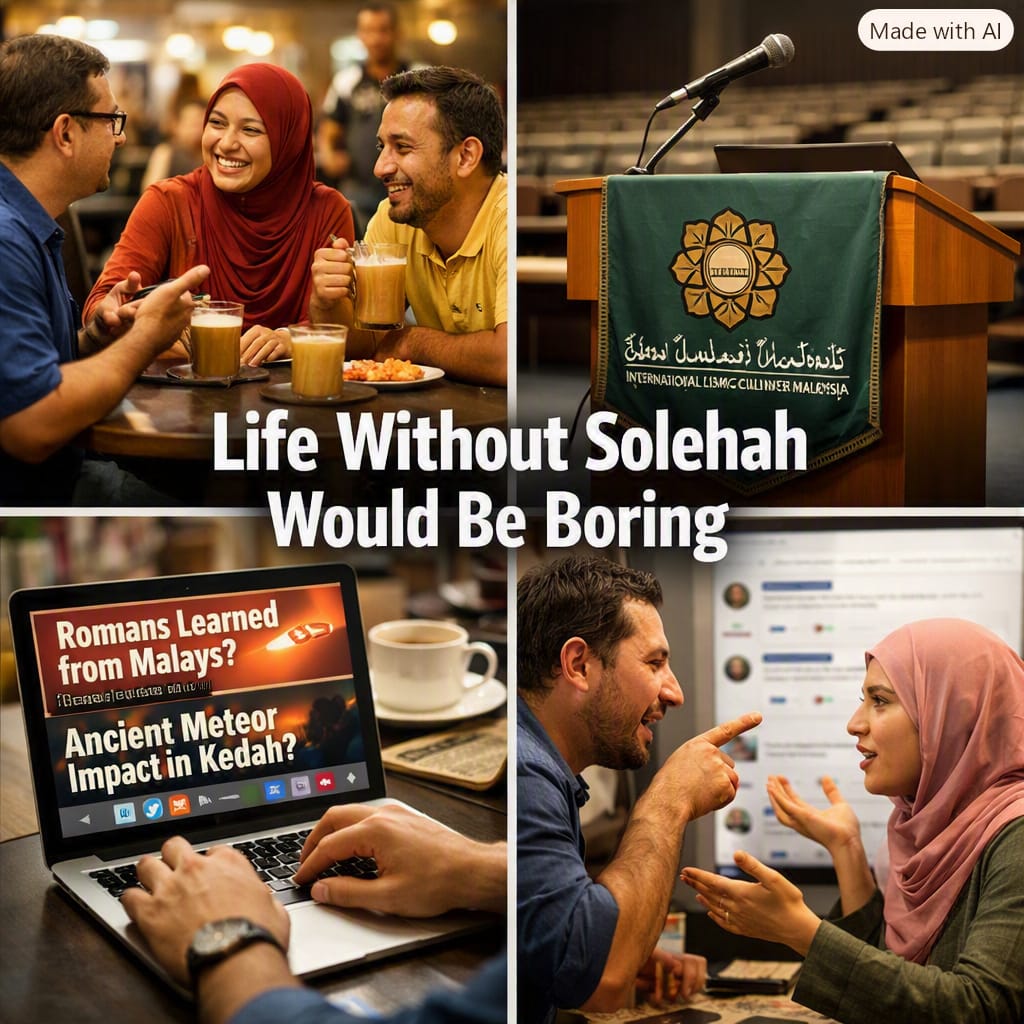
Life without Solehah would probably be a little less exciting — certainly less entertaining for journalists, social-media junkies and those of us who enjoy a good argument over teh tarik.
The latest development is that International Islamic University Malaysia (IIUM) has confirmed that Solehah is no longer with the university. Her academic service was terminated on April 27, and the university has made it clear that she no longer represents IIUM in any official capacity.https://newswav.com/A2608_RdfQvL?s=A_YIwM4zQ&language=en
That is an institutional matter, and IIUM is perfectly entitled to protect the integrity of its academic brand.
But the Solehah phenomenon raises a larger and rather amusing question: What happens to a society when somebody comes along with ideas so far outside the conventional narrative that everyone suddenly wants to talk about them?
Solehah certainly knows how to provoke conversation.
Her suggestion that ancient Romans may have learned shipbuilding from Malay seafarers was enough to send historians, academics, journalists and keyboard warriors reaching for their keyboards.
Then came her theory connecting ancient meteor activity with Kedah's deposits of iron ore.
You could almost hear the collective national reaction:
“Really?”
Followed quickly by:
“Where did she get that from?”
And, inevitably:
“Let's discuss it on social media.”
That last part is important.
In the old days, an eccentric academic theory might have remained confined to a lecture hall, a conference paper or a rather lonely academic journal. Today, one provocative statement can become breakfast conversation, WhatsApp ammunition and prime material for hundreds of Facebook comments before lunch.
The internet has democratised the marketplace of ideas.
Unfortunately, it has also democratised the marketplace of certainty.
Everyone is suddenly an archaeologist, historian, geologist, linguist, epidemiologist and constitutional expert — often before finishing their morning coffee.
So perhaps Solehah has unintentionally performed a useful public service.
She has reminded us that ideas should be examined, not merely celebrated or ridiculed.
If the Romans really did acquire shipbuilding knowledge from Malay seafarers, that would be a fascinating historical discovery. If there is credible evidence connecting meteor activity with Kedah's ancient iron resources, it deserves serious scientific investigation.
But extraordinary claims require extraordinary evidence.
That is where academia is supposed to come in.
Universities exist precisely because civilisation needs places where ideas can be tested, challenged, documented and, when necessary, rejected.
The danger is not that someone proposes an unconventional hypothesis.
The danger is when an unconventional hypothesis is mistaken for an established fact — or when critics dismiss an idea merely because it sounds unconventional.
There is a difference between "This is an interesting hypothesis" and “This is what happened.”
That distinction seems increasingly endangered in the age of social media.
And perhaps this is where the Solehah episode becomes bigger than Solehah herself.
IIUM has now drawn a line between the individual and the institution. That is understandable. Universities cannot have every controversial proposition attributed automatically to them.
But Malaysia should be careful not to turn institutional distancing into intellectual exile.
A university should be able to say: She no longer represents us.
It should also be able to say: Now let us examine whether any part of what she says can withstand evidence.
That would be a far more interesting response.
Because if we simply laugh at unusual ideas, we may occasionally laugh at tomorrow's discovery.
If we accept them uncritically, we abandon scholarship altogether.
The sensible position is somewhere in between: Bring the evidence. Let the experts examine it. Then let the evidence win.
Meanwhile, the journalists and social-media junkies of Malaysia will presumably continue doing what we do best — yakking.
And perhaps that is not entirely a bad thing.
A boring society is one where nobody challenges anything.
A dangerous society is one where everybody believes everything.
Malaysia, fortunately, seems to have found a third category: a society where somebody says something extraordinary, everyone argues about it, half the country becomes an overnight expert, and the other half waits for the next episode.
So life without Solehah may indeed be a little boring.
But the real lesson from the Solehah saga should not be that unconventional ideas are either brilliant or ridiculous.
It should be that Malaysia desperately needs more curiosity — and considerably more evidence.
After all, history is not decided by how loudly we yak about it.
It is decided by what we can prove.
Mihar Dias (mihardias@gmail.com) is a content creator under the Newswav Creator programme, where you get to express yourself, be a citizen journalist, and at the same time monetize your content & reach millions of users on Newswav. Log in to creator.newswav.com and become a Newswav Creator now!
The User Content (as defined on Newswav Terms of Use) above including the views expressed and media (pictures, videos, citations etc) were submitted & posted by the author. Newswav is solely an aggregation platform that hosts the User Content. If you have any questions about the content, copyright or other issues of the work, please contact creator@newswav.com.