
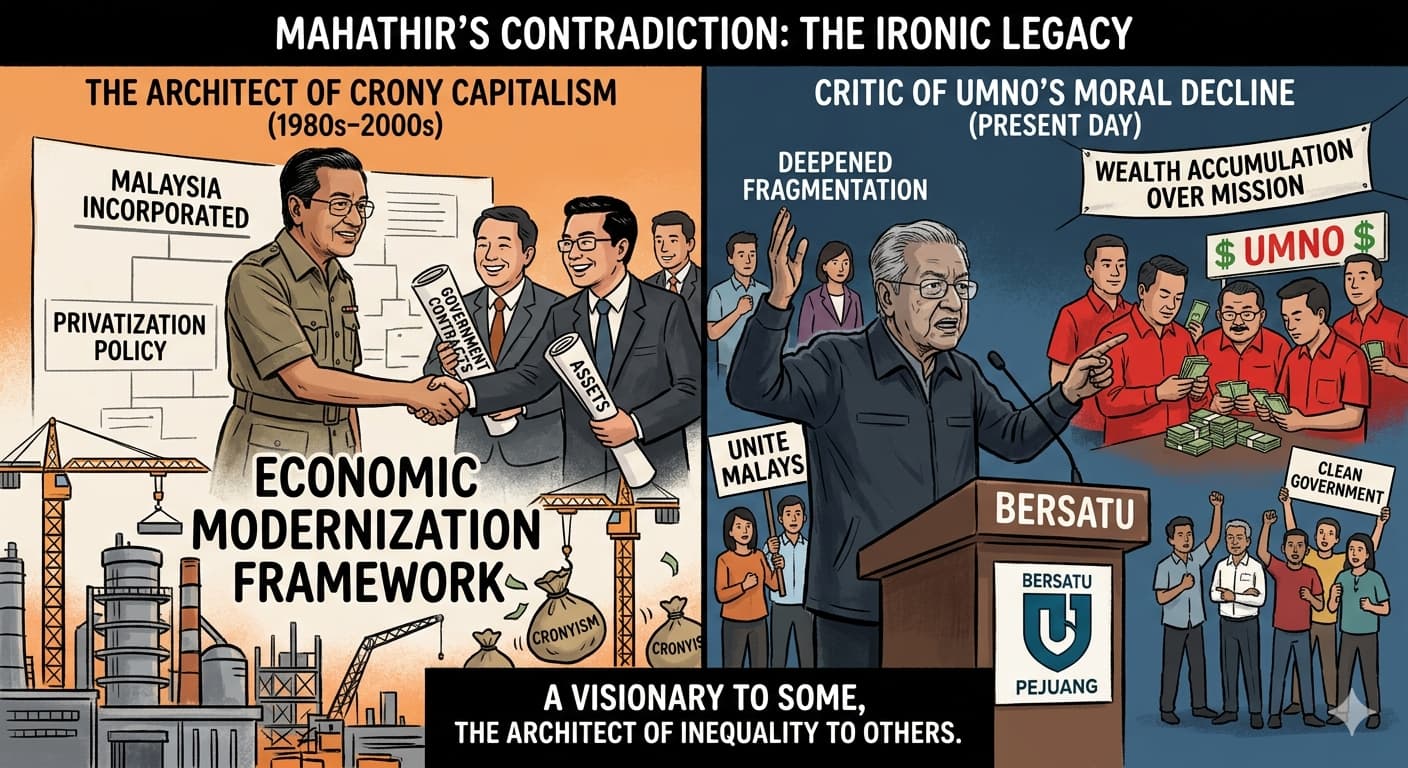
Former prime minister Tun Mahathir Mohamad has once again stepped into the national spotlight - this time denying that he was responsible for divisions among Malays, instead pointing the finger at changes within United Malays National Organisation (UMNO). But his latest remarks have reignited a deeper and more uncomfortable debate: do his current criticisms contradict the very system he helped build?
In his recent statement, Mahathir claimed he left UMNO after it strayed from its original mission, accusing the party of prioritising wealth accumulation over the interests of nation, religion, and race. He further justified the formation of Parti Pribumi Bersatu Malaysia (Bersatu) as an attempt to unite Malays under a cleaner, more principled platform. Yet, history paints a more complex picture - one that undermines his present stance.
Mahathir was the chief architect of the “Malaysia Incorporated” policy, a sweeping wave of privatisation from the 1980s through the early 2000s. The initiative was framed as a bold economic strategy to modernise the country and empower the Malay community. In reality, however, many argue it evolved into a system of crony capitalism - where lucrative government assets and contracts were transferred to politically connected elites rather than fostering broad-based economic upliftment.
Instead of strengthening the economic standing of the wider Bumiputera population, these policies often concentrated wealth among a select group of well-connected individuals and corporations. Government enterprises, once meant to serve public interests, were privatised in ways that prioritised profit maximisation. This shift led to rising costs of services and business operations, ultimately burdening ordinary Malaysians - including the very Malays these policies were meant to uplift.
Critics contend that the seeds of today’s political and economic discontent were sown during this era. Patronage networks flourished, intertwining business interests with political survival. The reliance on privatisation as a tool for economic restructuring gradually morphed into a mechanism for political funding and consolidation of power. In this light, Mahathir’s criticism of UMNO’s alleged obsession with wealth appears less like a revelation - and more like a reflection of a system he once championed.
His assertion that Malay unity was fractured due to UMNO’s deviation also raises questions. While he emphasises unity as the cornerstone of Malay political strength, the emergence of multiple Malay-based parties established by him - including Bersatu, Pejuang and Gerakan Tanah Air (GTA) - has arguably deepened fragmentation rather than resolved it. The fact that Bersatu secured only a modest number of seats in the 14th General Election reveals the difficulty of replacing entrenched political structures.
Mahathir’s call for a “big umbrella” coalition to unify Malays may resonate with some, but sceptics see it as a continuation of old political thinking - centralised control under a singular dominant entity. The irony is hard to ignore: a leader who once consolidated power through economic and political patronage now positions himself as a critic of the very outcomes such a system produced.
Ultimately, Mahathir’s legacy remains deeply polarising. To some, he is a visionary who transformed Malaysia’s economy. To others, he is the architect of structural inequalities and political patronage that continue to haunt the nation.
His latest remarks may attempt to rewrite the narrative - but for many Malaysians, the past is neither forgotten nor easily reconciled.
By: Kpost
Information Source:
Nst , Malaysiakini , Malaysiakini , FocusMalaysia , Newswav , Newswav
Kpost (ckhorsk@gmail.com) is a content creator under the Newswav Creator programme, where you get to express yourself, be a citizen journalist, and at the same time monetize your content & reach millions of users on Newswav. Log in to creator.newswav.com and become a Newswav Creator now!
The User Content (as defined on Newswav Terms of Use) above including the views expressed and media (pictures, videos, citations etc) were submitted & posted by the author. Newswav is solely an aggregation platform that hosts the User Content. If you have any questions about the content, copyright or other issues of the work, please contact creator@newswav.com.