
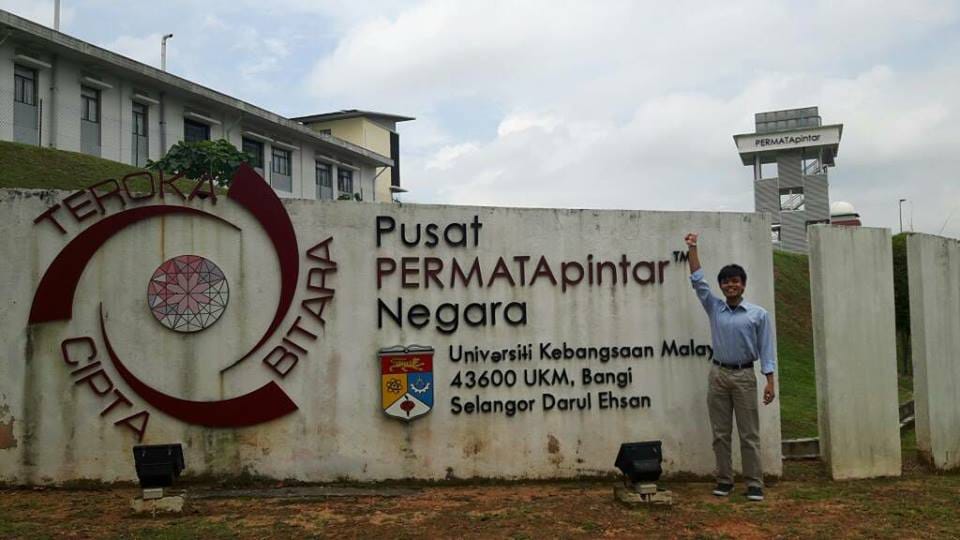
A recent letter published in Free Malaysia Today by a parent of a student in Permata Pintar has reignited an uncomfortable question: is Malaysia failing its brightest children?
The parent, Faiz Hussin, did not merely complain that students in the programme were underperforming in the Sijil Pelajaran Malaysia examinations. His deeper frustration was that some of the country’s most intellectually promising children appear to be trapped in a system that does not know what to do with them.
These are students selected from the top 0.025% of primary school pupils — roughly 100 out of 400,000 children annually.
And yet many reportedly do not end up at institutions such as University of Oxford, University of Cambridge, Stanford University or Massachusetts Institute of Technology.
Instead, many reportedly remain within Universiti Kebangsaan Malaysia itself.
But perhaps the bigger question is this:
What if Malaysia has fundamentally misunderstood what a gifted student actually is?
During my teaching days, I noticed something important.
The students who were truly gifted were not always the most obedient students.
They were often not even the students with the best grades.
They were the students whose minds instinctively moved toward reality itself.
If you tell such a student that “all the colours in the world come from white light,” they do not simply write it down.
They ask:
Why?
And when they see white light passing through a prism and splitting into multiple colours, their curiosity does not stop there.
They begin wondering:
Why is the sky blue?
Is the sky truly blue?
Is sunlight actually yellow?
Or does it only appear yellow because of atmospheric conditions?
Their minds do not stop at the textbook.
They move toward reality.
They investigate.
They test.
They challenge.
That is what genuine giftedness often looks like.
The average student, however, is frequently very different.
Their attention is often directed not toward reality — but toward authority.
They want to know:
“What will be in the exam?”
“What answer does the teacher want?”
“How do I secure the A?”
“How do I avoid upsetting authority figures?”
Their goal is not always understanding.
Their goal is often validation.
And Malaysia’s education system heavily rewards this mindset.
This explains why we sometimes produce straight-A students who struggle to communicate effectively in either English language or Bahasa Malaysia.
Their academic journey was never truly about expressing ideas clearly.
It was about learning how to satisfy institutional requirements.
Passing exams can sometimes become like opening a locked door.
You do not need to understand how the lock works.
You simply need to know where to insert the key and how to turn it.
But what happens when the door changes?
What happens when life presents problems that have no answer scheme?
That is where many high-achieving but system-dependent students struggle.
They mastered one door.
They never understood the mechanism behind doors themselves.
Gifted students often create discomfort within systems because they are harder to control.
Average students often make teachers feel successful because they comply.
They follow instructions.
They seek approval.
They reward institutional authority by validating its importance.
Gifted students often do the opposite.
Their loyalty is not to the teacher.
It is not to the examination board.
It is not even to institutional prestige.
Their loyalty is often to truth.
To understanding.
To discovery.
Under poor educators, this can be mistaken for arrogance, rebellion or indiscipline.
But often it is simply intellectual independence.
And that independence is deeply inconvenient for large institutions.
An institution functions like one giant body.
At the top sits leadership.
For the machine to function efficiently, everyone below must align themselves toward satisfying those above them.
Schools do this.
Universities do this.
Corporations do this.
Governments do this.
This is why institutions often prefer highly competent conformists over deeply original thinkers.
The former preserve systems.
The latter disrupt them.
And that may be the real tragedy behind Permata Pintar.
Its failure may not simply be poor management.
Its failure may reflect a deeper national problem:
Malaysia has created an educational ecosystem exceptionally good at rewarding compliance but deeply uncomfortable with genuine intellectual independence.
A truly gifted student may fail exams.
A truly gifted student may underperform in conventional academic settings.
A truly gifted student may frustrate teachers.
That does not make them failures.
It may simply mean they are optimised for discovery rather than obedience.
After all, even Albert Einstein famously struggled within rigid educational environments that prioritised conformity over imagination.
The purpose of a gifted programme should not be to create better rule-followers.
It should be to create scientists who ask dangerous questions.
Inventors who challenge assumptions.
Writers who rethink civilisation.
Leaders who see beyond institutional limitations.
If our brightest children are being forced back into systems designed for average conformity, then Faiz Hussin may be right.
We are not witnessing the failure of gifted students.
We are witnessing the failure of a nation that does not know how to recognise genius unless it arrives wearing the uniform of obedience.
TheRealNehruism (nehru.sathiamoorthy@gmail.com) is a content creator under the Newswav Creator programme, where you get to express yourself, be a citizen journalist, and at the same time monetize your content & reach millions of users on Newswav. Log in to creator.newswav.com and become a Newswav Creator now!
The User Content (as defined on Newswav Terms of Use) above including the views expressed and media (pictures, videos, citations etc) were submitted & posted by the author. Newswav is solely an aggregation platform that hosts the User Content. If you have any questions about the content, copyright or other issues of the work, please contact creator@newswav.com.