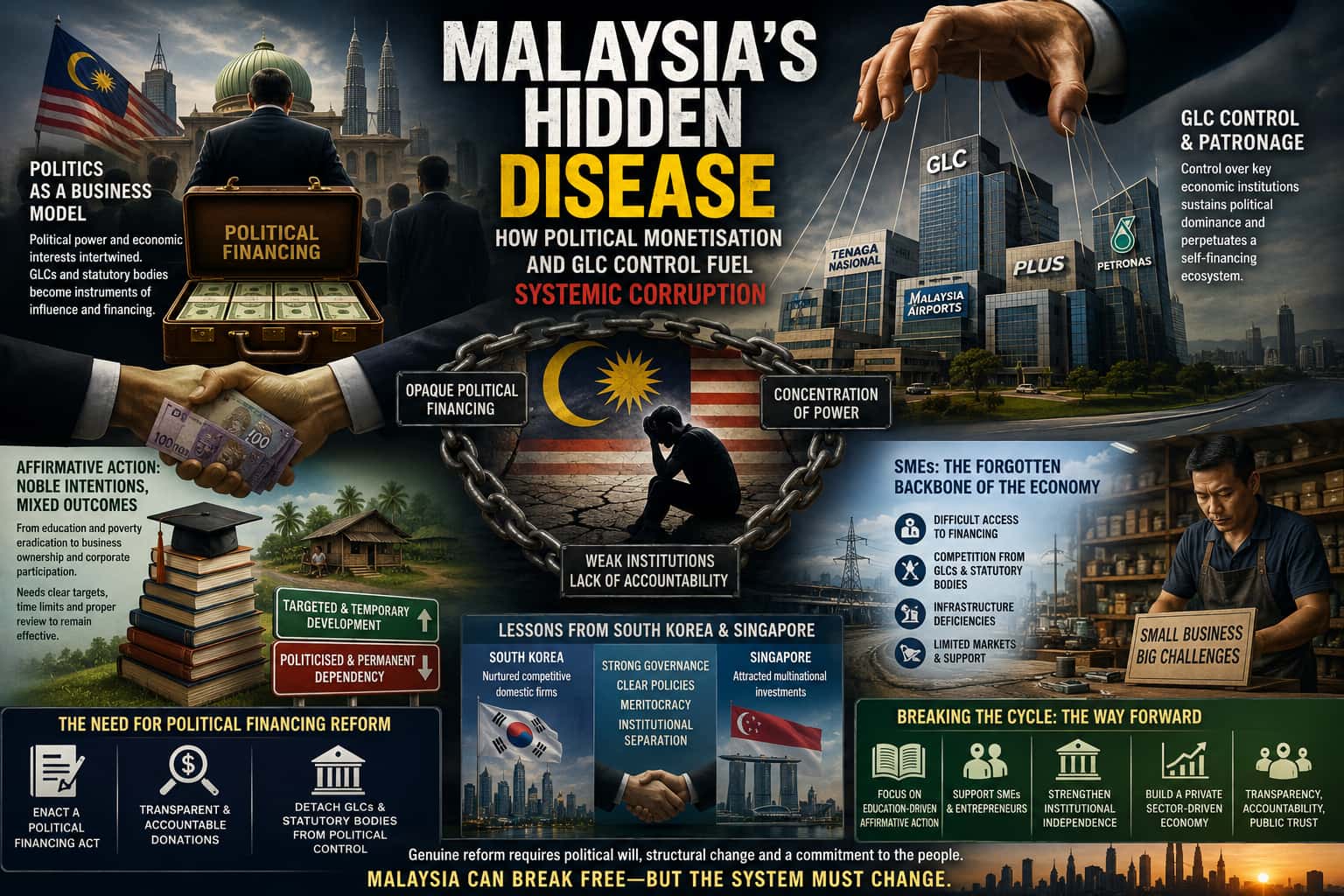
Malaysia's struggle against corruption is often framed around high-profile scandals, rogue politicians, or individual abuses of power.
However, according to Professor Terence Gomez, the real problem runs much deeper. Corruption in Malaysia is not merely about individual misconduct - it is embedded within the very structure of the country's political and economic system.
Speaking on The Gutshot Podcast, Professor Gomez, Professor Emeritus at the University of Malaya and a leading authority on political economy and state-business relations, argued that Malaysia's greatest challenge lies in the "monetisation of politics" - a system where political power and economic interests have become deeply intertwined, creating a cycle that is difficult to break.
Politics as a Business Model
At the heart of the issue is the close relationship between politicians, businesses, and Government-Linked Companies (GLCs). Over the decades, Malaysia has developed a vast ecosystem of GLCs and statutory bodies that control significant portions of the national economy.
According to Gomez, these entities have evolved beyond their original developmental objectives and have increasingly become instruments of political influence and financing. Political parties and leaders are often able to leverage their influence over these institutions to secure resources, appointments, and financial support that help sustain political dominance.
This has effectively transformed politics into a self-financing ecosystem where economic power reinforces political power, and political power protects economic interests.
The problem is compounded by the concentration of authority at the highest levels of government. Historically, prime ministers who simultaneously held the finance portfolio exercised enormous influence over both the political and economic machinery of the country. While administrations have changed over the years - from Tun Mahathir Mohamad and Tun Abdullah Ahmad Badawi to Dato' Seri Najib Razak and Dato' Seri Anwar Ibrahim - the underlying structure has largely remained intact.
The Need for Political Financing Reform
Professor Gomez believes one of the most urgent reforms Malaysia needs is a comprehensive Political Financing Act.
Such legislation would require political donations to be transparent and accountable, reducing the influence of hidden contributors and vested interests. More importantly, it would help sever the unhealthy dependence of political parties on economic institutions under government influence.
He also advocates removing direct political control over GLCs and statutory bodies. Without such reforms, these institutions risk continuing to serve political interests rather than national economic priorities.
Transparency, he argues, is essential if Malaysia hopes to restore public confidence in governance.
Affirmative Action: Noble Intentions, Mixed Outcomes
Another area Gomez scrutinises is Malaysia's affirmative action framework.
Originally introduced under the New Economic Policy (NEP), affirmative action sought to eradicate poverty and improve educational opportunities for disadvantaged Bumiputera communities. The policy emerged in response to socio-economic imbalances and was intended to be temporary.
However, Gomez argues that over time the focus shifted from education and social mobility to business ownership and corporate participation. As the policy became increasingly tied to political narratives, its objectives became blurred.
Rather than functioning as a targeted developmental tool, affirmative action evolved into a permanent political instrument. The absence of clear timelines and measurable outcomes has, in some cases, reduced effectiveness and encouraged dependency instead of competitiveness.
Gomez contends that affirmative action should be periodically reviewed, carefully targeted, and focused on those genuinely in need, regardless of political considerations.
SMEs: The Forgotten Backbone of the Economy
While political attention is often directed toward large corporations and GLCs, Malaysia's economy is overwhelmingly driven by small and medium enterprises (SMEs).
SMEs account for approximately 98.5 percent of businesses in the country, with the majority being micro-enterprises employing fewer than five workers.
Yet many of these businesses struggle to survive.
Access to financing remains a major obstacle, particularly after the consolidation of the banking sector. Commercial banks often view smaller businesses as high-risk borrowers, leaving many entrepreneurs without the capital needed to expand.
Adding to the challenge is the growing presence of GLCs and government-linked entities in commercial sectors where private businesses operate. Instead of acting as facilitators, these institutions sometimes become competitors, placing smaller firms at a disadvantage.
Infrastructure deficiencies, particularly in rural areas, further limit opportunities for growth. Inadequate access to markets, logistics, utilities, and support services continues to hamper entrepreneurship and productivity.
Lessons from South Korea and Singapore
Professor Gomez points to countries such as South Korea and Singapore as examples of alternative development paths.
South Korea focused on nurturing competitive domestic firms capable of becoming global champions, while Singapore concentrated on attracting multinational investments through efficient governance and clear economic policies.
Although each country followed a different model, both maintained stronger institutional separation between politics and economic management than Malaysia has traditionally practised.
The lesson, Gomez argues, is that sustainable economic growth depends on meritocracy, transparency, and effective governance rather than political patronage.
Breaking the Cycle
More than six decades after independence, Malaysia continues to grapple with structural issues that elections alone cannot resolve.
The political transitions of 2008 and 2018 demonstrated that governments can change, but systems often endure. As long as political financing remains opaque and economic institutions remain vulnerable to political influence, genuine reform will remain elusive.
Professor Gomez's analysis serves as a powerful reminder that fighting corruption requires more than prosecuting individuals. It requires dismantling the structures that enable corruption to thrive.
Political financing reform, stronger institutional independence, a renewed focus on education-driven affirmative action, and greater support for SMEs could help Malaysia move toward a more dynamic and equitable future.
Without addressing these systemic flaws, the country risks remaining trapped in a cycle where political survival takes precedence over national development - a cycle that continues to undermine both public trust and economic potential.
By: Kpost
Kpost (ckhorsk@gmail.com) is a content creator under the Newswav Creator programme, where you get to express yourself, be a citizen journalist, and at the same time monetize your content & reach millions of users on Newswav. Log in to creator.newswav.com and become a Newswav Creator now!
The User Content (as defined on Newswav Terms of Use) above including the views expressed and media (pictures, videos, citations etc) were submitted & posted by the author. Newswav is solely an aggregation platform that hosts the User Content. If you have any questions about the content, copyright or other issues of the work, please contact creator@newswav.com.