
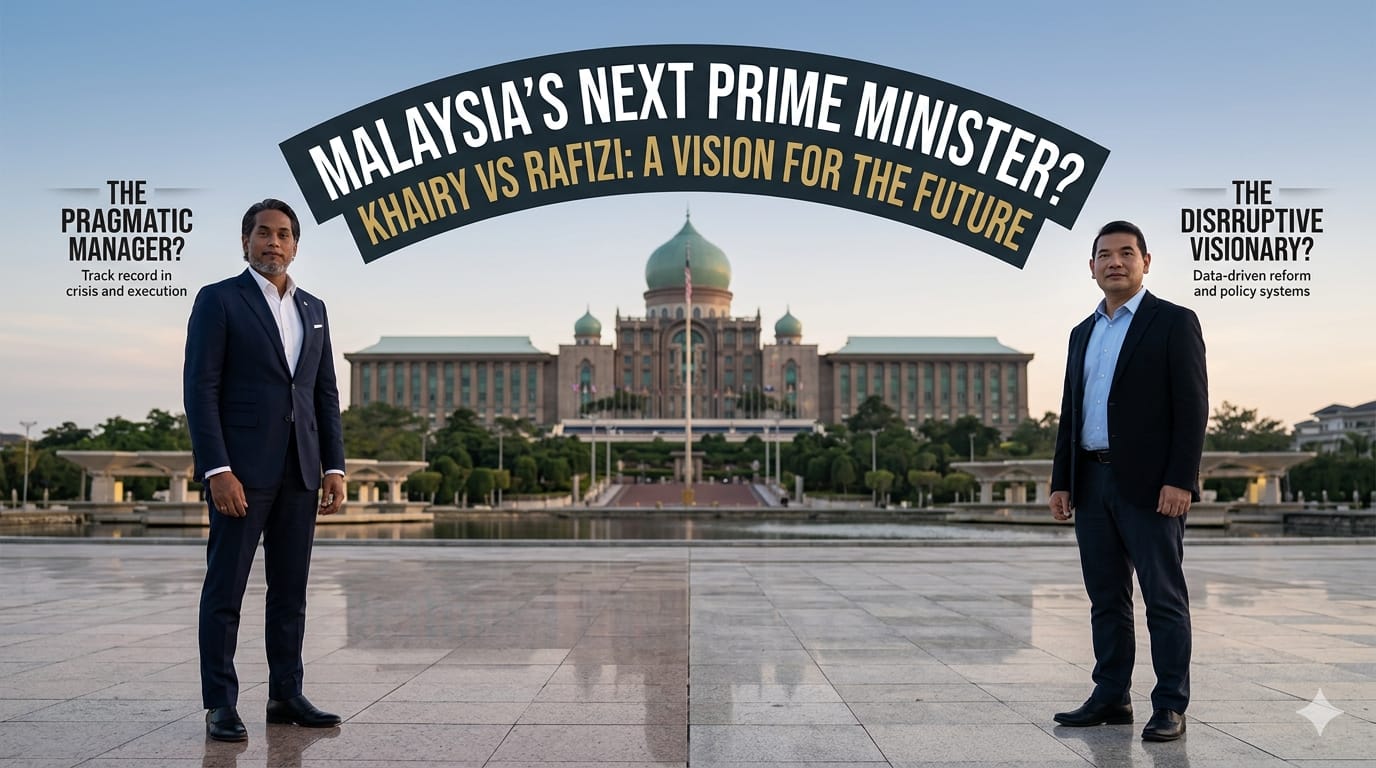
Khairy Jamaluddin says he aspires to become Prime Minister but is not obsessed with it as a “lifelong ambition.”
That sounds mature, measured, statesmanlike.
In Malaysian politics, however, nobody casually says they want to become Prime Minister the way people casually say they want nasi lemak for breakfast.
You do not mention Putrajaya unless the thought has already rented a room in your head.
And suddenly, Malaysia finds itself returning to a question it has quietly debated for years:
If the post-Anwar era eventually arrives, who actually represents the future?
The smooth operator from UMNO’s old machinery?
Or the data-driven disruptor who keeps trying to redesign the machine itself?
In simpler terms:
Does Malaysia want a Manager?
Or a Visionary?
Because Khairy Jamaluddin and Rafizi Ramli may represent the two most important political prototypes of modern Malaysia.
One manages systems. One wants to rebuild them.
And both carry enough baggage to sink an airport conveyor belt.
KJ: The Elite Product Trying to Sound Like the Future
Khairy remains one of the most fascinating contradictions in Malaysian politics.
He speaks the language of moderation. He talks about unity. He understands branding better than most ministers understand their own portfolios.
To many urban Malaysians, especially non-Malays, KJ feels like the “acceptable Malay nationalist” modern, articulate, internationally exposed, less trapped in the old racial script.
But his problem is simple.
Malaysia remembers.
People remember the Fourth Floor Boys. People remember the Bersih period. People remember his defence of Najib during the darkest 1MDB years. People remember how he moved with the political wind often enough to qualify as a human weather vane.
One day reformist. One day establishment loyalist. One day podcaster. Next day back in UMNO.
Even his podcast was called Keluar Sekejap.
Turns out the title was not branding. It was prophecy.
Rafizi: The Man Who Wants to Spreadsheet the Nation
Then there is Rafizi Ramli.
If KJ is political optics, Rafizi is political analytics.
Rafizi approaches politics like a man trying to debug a malfunctioning operating system.
Where KJ sells confidence, Rafizi sells systems.
The difference is important.
KJ speaks like a manager presenting quarterly strategy. Rafizi speaks like an economist who accidentally wandered into politics and never escaped.
His supporters see him as the rare Malaysian politician actually obsessed with policy instead of positioning.
His critics see him as arrogant, technocratic, and occasionally incapable of understanding normal human emotion.
Which, to be fair, is also how many Malaysians describe Excel spreadsheets.
The Saviour Complex Problem
Malaysia has a dangerous habit.
Every few years, the country searches for a political saviour.
Mahathir. Anwar. Muhyiddin. Now perhaps KJ. Perhaps Rafizi.
The public projects hope onto individuals because institutions themselves no longer inspire confidence.
That is why both men attract unusually emotional reactions.
KJ supporters say: “He can modernise UMNO.”
Rafizi supporters say: “He can modernise Malaysia.”
But here is the uncomfortable truth.
No Prime Minister survives Malaysian politics alone.
Not when coalitions are fragile. Not when race still dominates voting behaviour. Not when parties behave like temporary business mergers instead of ideological movements.
The real question is not whether KJ or Rafizi are intelligent.
The real question is whether either man can survive the Palace Wars of Malaysian politics without becoming prisoners of the same system they claim they want to improve.
The Freezer Fiasco vs The Spreadsheet Revolution
To be fair, KJ did deliver sometimes.
During COVID-19, he projected calm in chaos. He communicated clearly. He understood operational management.
But then came the freezer saga.
Ah yes. The legendary RM16.6 million freezer episode.
55 ultra-low-temperature freezers costing around RM70–80K each. Simple Malaysian calculator mathematics: RM4.4 million.
But somehow the final number became RM16.6 million.
At that moment, Malaysians collectively became honorary accountants.
“Bro… where the extra RM12 million go? Did the freezers come with Astro subscription and complimentary massage chair?”
That incident captured KJ perfectly.
Competent enough to execute. But politically burdened by the old UMNO ecosystem of procurement opacity and elite distrust.
Rafizi, meanwhile, suffers the opposite problem.
People trust his technical brain more than they trust his political warmth.
He can explain structural reform. He can map economic leakage. He can build systems.
But can he build emotional connection?
Because Malaysia does not elect economists. It elects storytellers.
Sungai Buloh vs Political Survival
KJ’s defeat in Sungai Buloh changed his political trajectory.
That was supposed to be a winnable seat. Instead, he lost a match many thought was only a warm-up.
After that came podcasting. Fitness content. Political commentary. Soft interviews. National healing conversations.
Some Malaysians enjoyed it.
But many quietly wondered:
Was this reinvention?
Or political waiting room entertainment until UMNO reopened the door?
Rafizi, on the other hand, has rarely suffered direct electoral humiliation.
If anything, his problem has been internal resistance.
Too disruptive for some. Too blunt for others. Too independent for political comfort.
KJ struggles with trust. Rafizi struggles with chemistry.
Who Actually Understands Malaysia?
This is where things become philosophical.
KJ often speaks about Malaysia from above as a strategist, communicator, and elite policy figure.
Rafizi speaks about Malaysia like a frustrated systems engineer trying to stop the machine from catching fire.
But ordinary Malaysians increasingly ask a deeper question:
Do our politicians truly know the real Malaysia?
Not election-stage Malaysia. Not slogan Malaysia. Not TikTok clip Malaysia.
The real Malaysia.
The one dealing with:
- stagnant wages,
- youth frustration,
- brain drain,
- rising housing costs,
- ethnic distrust,
- economic anxiety,
- and a middle-income trap that feels increasingly permanent.
Vietnam is accelerating. Indonesia is expanding. Singapore left the race long ago.
Malaysia sometimes feels like a nation endlessly discussing who should drive the car while the engine itself quietly breaks down.
The 2027 Scenario: Coalition Builder vs Coalition Survivor
Imagine Malaysia in 2027.
Parliament is fractured again. No coalition has clear dominance. East Malaysia becomes kingmaker. Every political party suddenly discovers the importance of “national stability” after election night.
How would KJ govern?
Most likely through negotiation. Networking. Backroom consensus. Elite management. Pragmatic compromise.
He would probably become a Prime Minister skilled at balancing factions.
But balancing factions is not the same as transforming a country.
Rafizi would likely govern differently.
More aggressively. More structurally. More obsessed with systems and measurable outcomes.
But such leaders often create enemies quickly.
Especially in Malaysia, where disrupting patronage networks is treated like vandalising sacred property.
So the final irony may be this:
KJ is more likely to survive Malaysian politics.
Rafizi is more likely to challenge it.
The Final Verdict: Malaysia’s Problem Is Bigger Than Both Men
The truth is uncomfortable.
Malaysia does not merely suffer from a leadership shortage.
It suffers from institutional exhaustion.
The country keeps producing politicians trapped between:
- race politics,
- coalition survival,
- economic stagnation,
- elite networks,
- and public distrust.
KJ represents the polished survivor of the old political order trying to modernise himself.
Rafizi represents the frustrated technocrat trying to modernise the system itself.
One is easier to elect. One may be harder to survive.
And perhaps that is Malaysia’s real tragedy.
The country does not necessarily reject reform.
It simply exhausts reformers until they become part of the machinery they once promised to repair.
So when Malaysians debate KJ versus Rafizi, the real question is not:
“Who should become Prime Minister?”
The real question is:
“Can any Prime Minister still change a system designed to outlast them all?”
Annan Vaithegi crafts politically reflective and socially grounded opinion columns that critically examine leadership, power structures, and the evolving direction of Malaysian governance.
Annan Vaithegi (annanvaithegi@icloud.com) is a content creator under the Newswav Creator programme, where you get to express yourself, be a citizen journalist, and at the same time monetize your content & reach millions of users on Newswav. Log in to creator.newswav.com and become a Newswav Creator now!
The User Content (as defined on Newswav Terms of Use) above including the views expressed and media (pictures, videos, citations etc) were submitted & posted by the author. Newswav is solely an aggregation platform that hosts the User Content. If you have any questions about the content, copyright or other issues of the work, please contact creator@newswav.com.