.jpg)
By Mihar Dias October 2026
I love to be in a situation when satire writes itself. All a columnist needs to do is sit back, light an imaginary cigarette, and admire the work of an anonymous genius on social media.
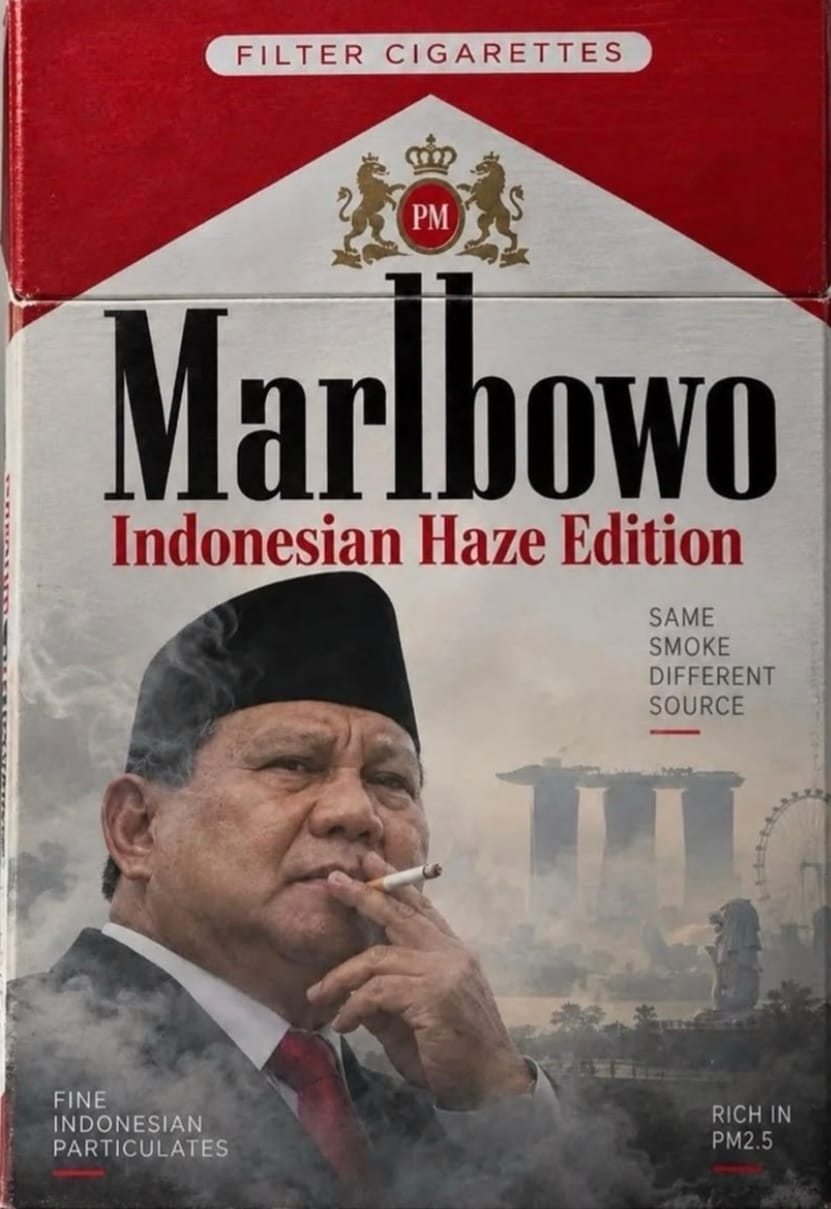
One recent creation is a mock cigarette packet bearing the name Marlbowo, advertised as the “Indonesian Haze Edition”. On the front is Indonesian President Prabowo Subianto, puffing away with the solemnity of a man contemplating the destiny of a nation. Behind him, Singapore’s familiar skyline disappears into a greyish fog, while smoke drifts across the landscape like an unwanted diplomatic communiqué.
The advertising slogan is priceless: “Same smoke, different source.”
Other selling points include “Fine Indonesian Particulates” and “Rich in PM2.5”.
It is, of course, a parody, not an authentic cigarette product or an official statement from Indonesia. Its creator and original source remain unverified. But whoever conceived it deserves a place in the advertising hall of fame, preferably somewhere with excellent ventilation.
The joke works because millions of people in Southeast Asia know precisely what it means to wake up, look outside, and wonder whether the neighbourhood has been relocated inside a charcoal oven.
Malaysia, Singapore and Indonesia have endured the familiar seasonal misery of transboundary haze. The sky turns grey, visibility deteriorates, and people reach for face masks. Outdoor activities become questionable, schools and workplaces worry about air quality, and anyone with respiratory sensitivities has yet another reason to curse the weather.
The sun remains where it always was. It is simply doing business behind a curtain of smoke.
And suddenly, the region acquires a new luxury product: imported air pollution, delivered free of charge.
A PRESIDENTIAL PUFF OF DIPLOMACY
The unfortunate thing about this cigarette advertisement is that it makes a political point without requiring a parliamentary debate, a diplomatic note or a committee of experts.
President Prabowo finds himself on the packet, but the real target is a system that has struggled for decades to prevent fires from turning into an international nuisance.
To be fair, a president does not personally strike every match in a plantation. Nor does every Indonesian have a hand in the burning. Millions of Indonesians suffer from the same pollution, and Indonesia itself bears enormous environmental, health and economic costs.
The real question is whether those responsible for the fires can be identified, prosecuted and made to pay, rather than allowing the public to inhale the consequences while corporations and landowners escape accountability.
Prabowo has publicly threatened to revoke the permits of companies suspected of deliberately setting fires. That is a welcome declaration. But declarations, like cigarette smoke, tend to disappear unless something substantial remains behind.
The proof will be in enforcement: which companies are investigated, whose permits are revoked, what penalties are imposed, and whether the same offenders are allowed to resume business when the skies clear.
A government that can make powerful corporations nervous would be far more impressive than one that merely makes its neighbours sneeze.
ASEAN: THE ASSOCIATION OF ENDLESS SMOKE AND NEGOTIATION?
Malaysia and Singapore are understandably frustrated. Malaysia has had to close schools in several states and federal territories as air pollution deteriorated on October 9. Singapore, meanwhile, has had to monitor worsening conditions during a period when it is preparing for its internationally celebrated Formula One Grand Prix. describes the immediate consequences of the crisis.
Yet ASEAN has spent years discussing transboundary haze. There are agreements, ministerial meetings, task forces and declarations of good intentions. The region even has a goal of becoming haze-free by 2030.
One wonders whether the next ASEAN summit should be held in a room equipped with industrial air purifiers, just in case the delegates need a practical demonstration of the problem.
The diplomatic difficulty is obvious. Indonesia is a sovereign country, and Malaysia cannot simply dispatch firefighters across the border or order Indonesian companies to shut down. ASEAN's preference for consensus and non-interference also makes forceful enforcement difficult.
But sovereignty cannot reasonably mean that the consequences of activities within one country's borders must be endured indefinitely by its neighbours.
If ASEAN can cooperate on trade, investment, tourism and regional security, surely it can do better than exchange polite expressions of concern over air that nobody wants to breathe.
Malaysia should push for more transparent satellite monitoring, credible investigations, corporate accountability and practical cooperation on fire prevention. It should also investigate any Malaysian-linked companies implicated in fires rather than pretending that wrongdoing becomes respectable when committed abroad.
The aim should not be to humiliate Indonesia. It should be to make the next haze season less destructive for everyone.
THE ECONOMICS OF BREATHING
There is another implication that the joke cannot quite capture.
Haze is not merely an inconvenience for people who dislike grey skies. It threatens public health, disrupts education, affects outdoor workers, undermines tourism and places additional pressure on healthcare services. Businesses lose productive hours, flights may be disrupted, and governments must divert resources towards emergency measures.
The costs are spread across millions of people, while the financial benefits of clearing land cheaply may accrue to a much smaller group.
That is an extraordinary business model: privatise the profits, socialise the smoke.
If the companies responsible do not bear the full costs of the damage, there is little incentive to change their behaviour. Prevention, peatland restoration, effective enforcement and meaningful penalties are not environmental luxuries. They are economic necessities.
And the victims are not confined to one nationality. Indonesians breathe the same polluted air as Malaysians and Singaporeans. The haze does not stop at immigration checkpoints to inspect passports.
Nature, unlike politicians, does not recognise diplomatic immunity.
SAME SMOKE, DIFFERENT SOURCE
Perhaps that is why the Marlbowo image is so effective. It reduces a complicated regional crisis to one brilliantly cynical advertising slogan.
“Same smoke, different source.”
The joke is at President Prabowo's expense, but the underlying issue is much bigger than one man. It concerns political will, corporate responsibility and the willingness of governments to confront a problem that returns with depressing regularity.
We should also remember that the image is an unverified social-media parody. Its creator may remain anonymous, and its humour should not be mistaken for evidence of presidential misconduct or an official Indonesian position.
Still, satire has a useful function. It says what diplomatic language often cannot: that patience has limits, and that repeated assurances become ridiculous when the same problem returns year after year.
Perhaps someone should send a copy of this imaginary cigarette packet to the next ASEAN haze meeting. Not as an insult to Indonesia, but as a reminder that the region's leaders have been smoking the same diplomatic rhetoric for far too long.
There is only so much hot air a population can tolerate before it begins to wonder whether its leaders are serious.
And if the smoke continues to drift across our borders, perhaps the region should stop arguing over who lit the cigarette and start ensuring that whoever did is made to put it out.
Otherwise, the next edition of Marlbowo may need a larger packet.
The region's appetite for smoke, after all, appears inexhaustible.
Mihar Dias (mihardias@gmail.com) is a content creator under the Newswav Creator programme, where you get to express yourself, be a citizen journalist, and at the same time monetize your content & reach millions of users on Newswav. Log in to creator.newswav.com and become a Newswav Creator now!
The User Content (as defined on Newswav Terms of Use) above including the views expressed and media (pictures, videos, citations etc) were submitted & posted by the author. Newswav is solely an aggregation platform that hosts the User Content. If you have any questions about the content, copyright or other issues of the work, please contact creator@newswav.com.