
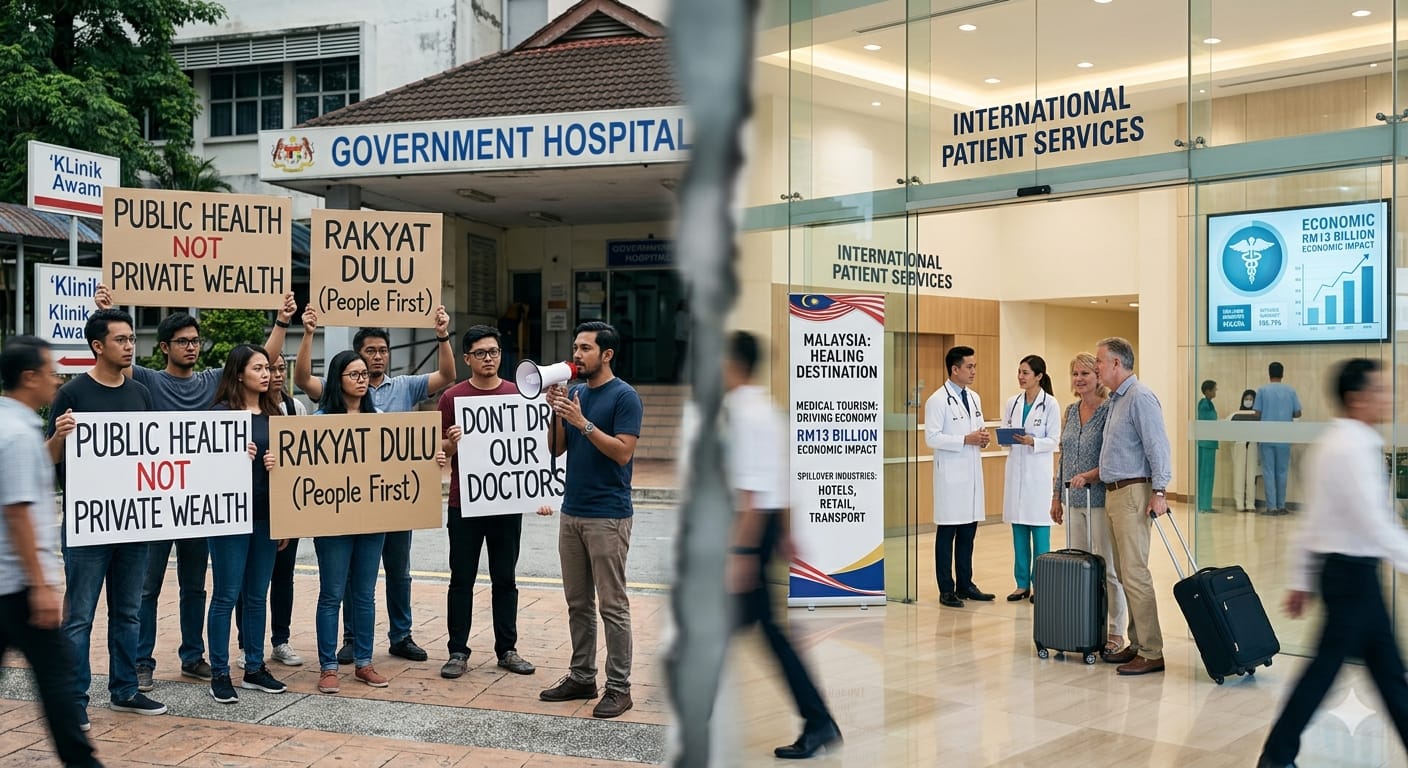
Malaysia’s medical tourism industry has come under sharp criticism from political quarters, but health policy experts and industry leaders are pushing back - arguing that the sector is not a burden on the rakyat, but a powerful engine driving economic growth, job creation, and even talent retention.
At the center of the debate is Parti Sosialis Malaysia (PSM), which recently staged a protest against the upcoming Malaysia Year of Medical Tourism 2026.
The party contends that public resources should not be channelled into promoting private healthcare, warning that such policies risk widening inequality and draining expertise from public hospitals.
However, Suriaghandi Suppiah, CEO of the Malaysia Healthcare Travel Council (MHTC), has firmly rejected this narrative. According to him, medical tourism is far from an elite-driven initiative - it is a broad-based economic contributor that benefits everyday Malaysians.
He explained that for every ringgit spent on medical care, approximately RM4 circulates through the wider economy. This includes spillover spending on hotels, airlines, food services, transportation, and retail. In 2024 alone, the sector generated RM3.34 billion in direct healthcare revenue, with a total economic impact estimated at RM13 billion.
Suriaghandi stressed that these gains are not confined to corporate boardrooms. “This is income that flows directly into the hands of hotel workers, taxi drivers, restaurant operators, and small business owners,” he said, countering claims that the industry disproportionately benefits private hospital shareholders.
A key concern raised by PSM, led by Michael Jeyakumar Devaraj, is the migration of specialists from public to private hospitals due to better pay. This, they argue, has contributed to shortages in critical fields such as oncology and cardiology within the public healthcare system.
Yet Suriaghandi offers a different perspective. He acknowledges the brain drain issue but insists that restricting private healthcare growth is not the solution. Instead, he argues that a thriving medical tourism sector can actually help retain talent within Malaysia.
“Private hospitals invest in advanced technology and infrastructure, allowing Malaysian doctors to practice at international standards without relocating abroad,” he noted. “If we weaken this competitiveness, we risk accelerating the very brain drain we are trying to prevent.”
Supporting this stance is Azrul Mohd Khalib of the Galen Centre for Health and Social Policy, who described medical tourism as a strategic pillar of both economic and healthcare development. He highlighted that the sector brings in foreign revenue, supports job creation, and enhances Malaysia’s global reputation for quality medical care.
He said that Malaysia recorded approximately 1.6 million healthcare travellers in 2024, generating RM2.72 billion in revenue. Importantly, Azrul pointed out that these services are largely paid for by foreign patients, meaning they do not draw from the same pool of taxpayer -funded subsidies as public healthcare.
Still, he cautioned that the government must strike a careful balance. “Medical tourism should complement - not undermine - national healthcare priorities,” he said, stressing the need for policies that ensure local patients are not sidelined and public hospitals remain adequately staffed.
As Malaysia positions itself as a regional healthcare hub, the debate over medical tourism reveals a deeper question: can the nation harness private sector growth without compromising public welfare?
For now, industry leaders insist the answer lies not in rejection - but in smarter integration.
By: Kpost
Information Source:
Kpost (ckhorsk@gmail.com) is a content creator under the Newswav Creator programme, where you get to express yourself, be a citizen journalist, and at the same time monetize your content & reach millions of users on Newswav. Log in to creator.newswav.com and become a Newswav Creator now!
The User Content (as defined on Newswav Terms of Use) above including the views expressed and media (pictures, videos, citations etc) were submitted & posted by the author. Newswav is solely an aggregation platform that hosts the User Content. If you have any questions about the content, copyright or other issues of the work, please contact creator@newswav.com.