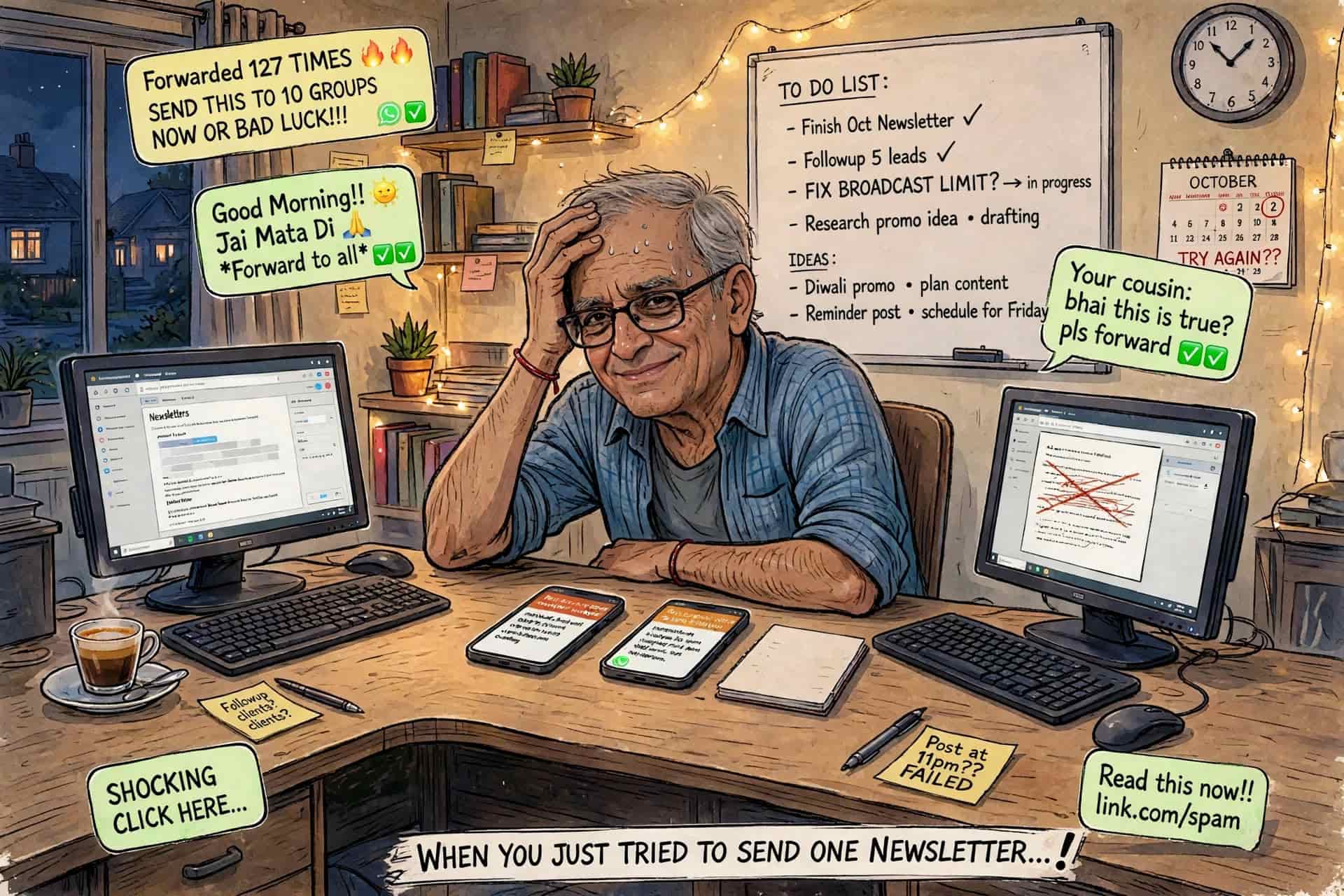
I have a small habit. Whenever a story or an article of mine is published, I send the link to my contacts. Not in groups where people will fight over politics, not as a status that disappears in 24 hours like my neighbor’s gym selfie. I made a broadcast list. Neat, polite, one-way.
For a long time, it worked like a postman who never complained. You press send, and the message quietly lands in everyone's personal chat, as if you had typed it separately for each of them. My readers liked it. I liked it.
This September, I got a little enthusiastic. Thirty-five stories. Some news pieces, some long reads I was proud of. On the thirty-sixth link, WhatsApp stopped me.
A pop-up. Cold, official. "You have reached the maximum number of broadcast messages. You can send more in October."
I stared at my phone. October? What did I do? Did I break some law? I hadn't sent any good morning flowers or fake lottery links. I had only sent my own work.
So I went looking, like any common man does when his free service suddenly puts up a toll gate.
Turns out, I am not alone. WhatsApp, sometime in the middle of last year, decided that people like us were a problem. Or rather, the spammers hiding behind people like us were a problem.
In its beta version, they started testing a new rule: personal accounts can only send 30 to 35 broadcast messages in a month. One per day, if you want to be poetic about it. There is now a little counter hidden in Settings that keeps score, like a strict class teacher marking your attendance.
Once you hit 35, that's it. No more. Your broadcast list goes on a forced vacation till the first of next month.
WhatsApp's logic is simple, and honestly, not entirely unfair. Broadcasts were becoming the new spam highway. Loan offers, lucky draws, "forward this to 10 people or your phone will explode" — all of it was travelling through broadcast. So Meta decided to tighten the tap for everyone.
And what do they want us to do instead? Their official suggestion sounds like a marketing pitch: "Use Status or Channels."
Translation: If you want to talk to many people, don't talk to them directly. Make a Channel. Let people follow you. Post as much as you want there. It's like they are saying, you can still shout, but please go and shout in the stadium we built for you, not in the street.
For a common writer, blogger, small shop owner, teacher sharing notes — this is a bit of a shift. We chose broadcast because it felt personal. A Channel feels like a loudspeaker. Status feels like a sticky note that vanishes. Broadcast felt like knocking on someone's door. Channel feels like putting up a hoarding and hoping they look up while driving.
And if you are a business? Ah, then WhatsApp is even more generous. You get 250 free broadcasts a month. After that, you pay. Of course. Nothing personal, just business.
So am I angry? Not really. A little annoyed, yes. It's that feeling you get when the free water tap in the colony suddenly gets a meter. You understand why they did it — water was being wasted. But you also miss the days when you could just fill your bucket.
The good news is, I am not banned. My account is fine. No one reported me. I just finished my monthly quota, like a mobile data plan. On October 1st, my broadcast list will wake up again, fresh, with 0 out of 35 used.
Until then, I have two options. I can wait like a good citizen, or I can do what WhatsApp wants me to do — start a Channel for my articles, put links on Status, and keep broadcast for only the most important piece.
In a way, WhatsApp just taught me a lesson I should have learned earlier in life: even when you are talking to your own people, about your own work, there is a limit. And once you cross it, you will be told politely, but firmly, to please come back next month.
I Tried to Outsmart WhatsApp, and WhatsApp Outsmarted Me.
After my broadcast list told me politely to come back in October, I did what any desperate common man would do. I thought, fine, you won't let me broadcast. I will do it the old-fashioned way. One by one. Manually. Like a postman who has lost his bicycle but still has to deliver letters.
I have contacts that actually wait for my articles. Not the "good morning" group, the real readers. So I copied my link, pasted, sent. Copied, pasted, and sent. I added a small line too — "New story is out." I felt honest. Hardworking. I thought WhatsApp would appreciate the effort.
Within ten minutes, my phone buzzed. Not with a thank you. With a warning. "Your account is restricted. Messages with links can be identified as spam. This restriction will last for 24 hours. "I stared at it. Spam? Me?
I have spent years trying not to be spam. I don't send lottery tickets, I don't send "forward to 10 people and your wish will come true." I just send a link to a story I stayed up till 2 a.m. to write. And now I am officially labeled as a potential spammer. That is when it hit me — WhatsApp does not see you. It sees your pattern.
And my pattern that evening looked exactly like a scamster's day at work. Same link, same text, sent to 50 people in 15 minutes, many of whom had not even saved my number. To a human, it's a writer sharing his work. To an algorithm, it's a textbook case of bulk messaging.
WhatsApp, sometime this year, had quietly introduced a new security net. If you send too many messages too fast, especially with links, the system temporarily locks your ability to start new chats. It doesn't ban you fully. You can still reply to your wife, your editor, your group. But you cannot start a new conversation. You are put in a corner for 24 hours to think about what you did.
And there is a small, humiliating feature too. If you try to message someone new, it shows you a countdown timer — like a school teacher showing you how many minutes are left in your punishment. The irony is beautiful. In trying to avoid being blocked for using broadcast too much, I got blocked for not using broadcast.
The logic is simple, even if it feels unfair. WhatsApp is fighting a real problem. In India alone, millions of fake loan links, fake job offers, fake news travel exactly the way I was travelling — same link, many contacts, fast speed. So they built a machine that catches speed, not intention. It cannot tell the difference between a journalist and a junk marketer. It just sees velocity.
And links? Links are the biggest red flag. The system is extra allergic to links, because that is how phones get hacked, money gets stolen. So when you send a link manually to dozens of people, you are not just sharing, you are waving a red flag in front of a very nervous bull.
So what did I learn in those 24 hours of forced silence? First, that I am not banned. I am not blacklisted. This is a temporary traffic challan. WhatsApp itself says you don't need to do anything, just wait, and it will lift automatically. If you keep trying to push while restricted, it can stretch to 72 hours. So I sat still.
Second, that the common man with a genuine audience is stuck. Broadcast gives you 35 messages a month. Manual sending gets you flagged as spam. So what is left?
WhatsApp's answer is very clear, almost corporate in its politeness: Make a Channel. Post your links there. Let people follow you. Use Status. Stop knocking on doors one by one. In other words, if you want to talk to many, don't talk personally. Talk from a stage.
Maybe they are right. Maybe broadcast was never meant for writers, shopkeepers, tuition teachers like us. Maybe we stretched a personal feature into a publishing tool and now the tool is stretching back.
After 24 hours, my restriction lifted. I got a small notification, like a parole letter. I could message again.
I didn't. I started a Channel instead.
ENDS
By
Sam Trailerman
Nganasegaran (tapessam@gmail.com) is a content creator under the Newswav Creator programme, where you get to express yourself, be a citizen journalist, and at the same time monetize your content & reach millions of users on Newswav. Log in to creator.newswav.com and become a Newswav Creator now!
The User Content (as defined on Newswav Terms of Use) above including the views expressed and media (pictures, videos, citations etc) were submitted & posted by the author. Newswav is solely an aggregation platform that hosts the User Content. If you have any questions about the content, copyright or other issues of the work, please contact creator@newswav.com.

.jpeg?width=1200&auto=webp&trim=0%2C0%2C0%2C0)