.png)
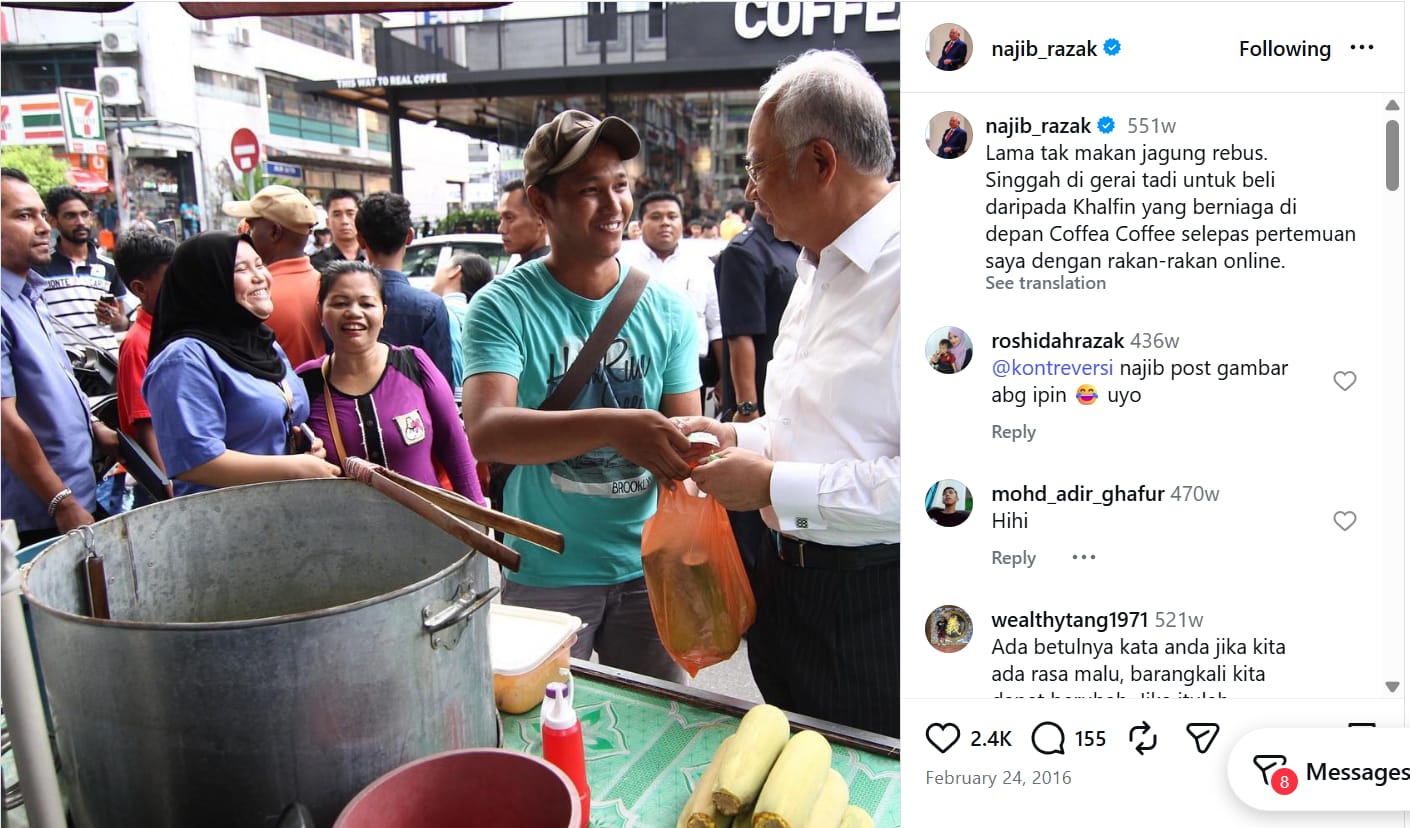
Years ago, I was at a café in Desa Sri Hartamas when word came that then Prime Minister Najib Razak was making a stop nearby to meet ordinary people.
A few people from his entourage came into the café to tell us that the Prime Minister was on his way and that anyone who wanted to meet him could join the crowd outside.
So, naturally, people started making their way out.
There were quite a number of tuition centres in the area, and children from some of them were brought down as well. They were gathered and placed right at the front of the crowd.
It was quite a sight. A group of schoolchildren, excited and waiting to see the Prime Minister. Adults standing behind them, phones already out, waiting for the moment he arrived.
And then Najib arrived.
He got out of his car to cheers. He walked towards the crowd, shaking hands with the children, stopping for photographs, smiling and waving.
And then something happened that has stayed with me all these years.
Suddenly, Najib turned and ran across the road.
His bodyguards looked completely caught off guard for a second before running after him.
The (former) Prime Minister of Malaysia had apparently spotted a roadside stall selling jagung rebus and decided that he wanted some.
He walked up to the stall, bought a few pieces, handed some to the people around him and ate one himself.
And almost immediately, the crowd started taking photographs and videos. Because here was the Prime Minister of the country standing at an ordinary roadside stall, eating jagung.
It was such a ridiculously simple thing. But it was also brilliant.
Because suddenly, he wasn't just the Prime Minister anymore.
He was an ordinary guy eating jagung.
And that photograph told a much bigger story than any speech could - “Look at me. I'm just like you.”
I remember thinking at the time, this man is very good at this. Very good at understanding people, very good at creating a moment, very good at making politics feel personal.
That jagung rebus moment was not a policy announcement. It wasn't a government programme. It wasn't a debate about the economy or a parliamentary speech.
It was just a man buying corn from a roadside stall. But that is exactly the kind of thing people remember.
And perhaps that is part of the answer to a question I have been asking myself lately - what's with the obsession over Najib?
Why, after everything that has happened, do some people still talk about him with such affection?
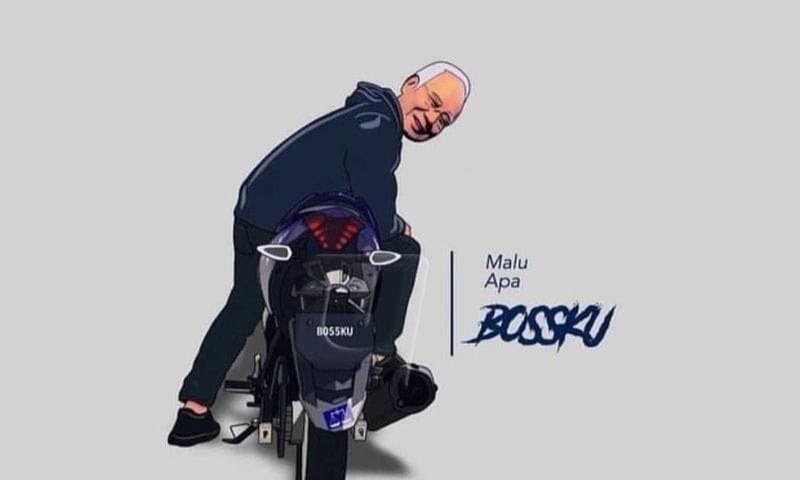
Why do people still call him Bossku and continue to defend him so passionately?
I think we sometimes make the mistake of assuming that people who continue to support Najib must simply be blind to what happened. That they don't know about the court cases, that he was convicted. That they somehow haven't been paying attention.
Maybe some haven't. But I don't think that explains all of them.
Because people are not spreadsheets. We don't remember politicians simply by adding up their achievements and failures in separate columns.
We remember experiences. We remember how someone made us feel. We remember the politician who came to our town and shook our children's hands.
We remember the photograph we took of him eating jagung at a simple roadside stall in our neighbourhood.
That is the part of Najib's political persona that I think is important to understand.
He was very good at establishing an image.
And I don't mean that as a compliment or an accusation. It is simply a political skill.
Some politicians look and behave like politicians. They stand behind podiums. They give speeches. They attend official functions. They talk in formal language.
Najib understood that there was another way to do it. He could make himself accessible, take selfies, engage people online, turn himself into a meme, show up at ordinary places and eat ordinary food.
He could create photographs that made people feel that, despite being Prime Minister, he was still one of them.
And eventually, that image became something much bigger than a political brand.
It became Bossku.
Not "YAB."
Not "Prime Minister."
Not "Datuk Seri."
Bossku.
My boss.
Our boss.
Someone familiar.
Someone you could joke about.
Someone you could take a selfie with.
Someone who didn't seem quite as distant from ordinary Malaysians as politicians usually do.
And once politics becomes personal, it becomes much harder to separate the person from the politics.
Political loyalty
Political loyalty isn't always about agreeing with every single thing a politician has done. Sometimes it is about what that politician represents in your own personal story.
If you received BR1M during a difficult period, you remember BR1M. If a government programme helped your family, you remember that programme. If you felt that your community was finally being noticed, you remember that feeling.
And if you had spent years being told that this man was Bossku, it is not entirely surprising that some people continue to feel personally connected to him.
That doesn't erase what happened. And it doesn't change the findings of the courts. But understanding why people remain emotionally attached to him requires us to acknowledge that these feelings exist.
We don't have to agree with them to understand them. But once you understand them, the loyalty becomes less mysterious.
You can tell someone, "But he was convicted."
And they may hear, "The person you trusted was a bad person."
You can say, "But he abused his position."
And they may hear, "Everything you experienced during his time in government meant nothing."
A person can acknowledge that something wrong happened and still remember something good that happened to them.
Humans are capable of holding contradictory feelings. We do it all the time.
We can love someone and be angry with them.
We can be grateful to someone and still disagree with them.
The problem comes when gratitude becomes a permanent moral discount.
And perhaps this is where we need to grow up as voters.
Stop looking for politicians we can love unconditionally.
They are not our family.
They are people we temporarily give enormous power to. And that power should always come with scrutiny.
We can acknowledge that a government helped us. We can be grateful for a policy. We can even have fond memories of a politician. But none of those things should require us to surrender our ability to question them.
The jagung rebus is an interesting memory. It tells us something about how Najib presented himself. It tells us something about why people found him relatable. It tells us something about his political instincts.
But it doesn't tell us everything about the man.
And perhaps that is the lesson we should take from the whole Najib phenomenon.
A politician can be very good at making you feel that he is one of you - but that doesn't make him one of you.
He is still a politician.
And perhaps we should learn to separate the man who made us feel good from the public official whose actions we still have a responsibility to scrutinise.
Because gratitude is human.
But accountability is democratic.
And we need both.
Fa Abdul (fa.abdul.penang@gmail.com) is a content creator under the Newswav Creator programme, where you get to express yourself, be a citizen journalist, and at the same time monetize your content & reach millions of users on Newswav. Log in to creator.newswav.com and become a Newswav Creator now!
The User Content (as defined on Newswav Terms of Use) above including the views expressed and media (pictures, videos, citations etc) were submitted & posted by the author. Newswav is solely an aggregation platform that hosts the User Content. If you have any questions about the content, copyright or other issues of the work, please contact creator@newswav.com.