

As Negeri Sembilan heads towards the ballot box on August 1, the election campaign has increasingly become a numbers game.
50,000 quality jobs.
RM100 million for affordable housing.
20,000 homes.
25,000 homes.
Add education funds, trader assistance, welfare schemes, infrastructure projects and investment targets, and suddenly Negeri Sembilan appears to be standing at the entrance of an economic boom.
If every manifesto promise materialises exactly as advertised, the state may soon face a different problem: not unemployment, but a shortage of people to fill all those jobs and houses.
But elections are not auctions where the biggest number automatically wins.
For voters struggling with wages, rent, mortgages, groceries and job security, the real question is simpler:
Are these credible economic blueprints, or election sweeteners designed to win votes?
The Jobs Race: Big Numbers, Bigger Questions
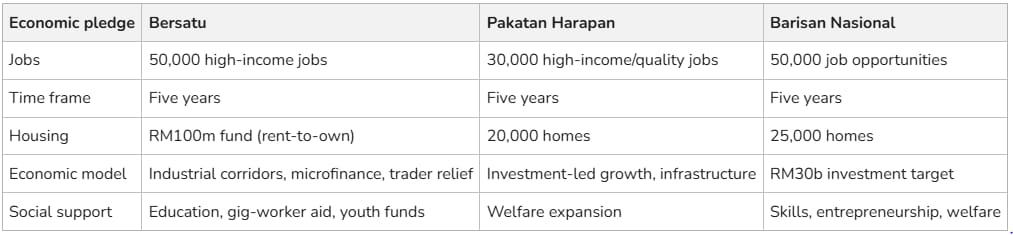
PH has pledged 30,000 high-income jobs and 20,000 homes, BN promises 50,000 jobs and 25,000 housing units, while Bersatu offers 50,000 high-income jobs and a RM100 million housing fund among broader pledges.
On paper, Negeri Sembilan looks like it is competing in an economic Olympics.
But voters are increasingly sceptical. Many now describe these figures as “numbers plucked from the air” ambitious claims with unclear grounding in real economic capacity.
Bersatu’s 50,000 jobs translate to roughly 10,000 jobs per year. PH’s 30,000 equals about 6,000 annually. Neither is impossible given Negeri Sembilan’s proximity to the Klang Valley, industrial zones in Seremban and Nilai, and the Vision Valley 2.0 corridor.
BN strengthens its case by linking its 50,000 jobs to a RM30 billion investment target.
But the key question remains unanswered across all parties:
What exactly is a “high-income job”?
Is it RM3,000? RM5,000? RM8,000? Or simply a political label that shifts depending on campaign needs?
Without wage benchmarks, sector breakdowns and investor commitments, job targets risk becoming statistical theatre rather than economic planning.
As one voter observation puts it bluntly: “Do not throw AI, EV and semiconductors like slogans. Show the plan, not the fantasy.”
Housing: Three Models, One Reality Check
Housing is where the manifestos diverge most clearly.
PH offers 20,000 affordable homes.
BN offers 25,000 housing units.
Bersatu proposes a RM100 million fund with a rent-to-own mechanism.
At first glance, PH and BN appear more concrete. But Bersatu’s model is structurally different it focuses on financing rather than construction.
Rent-to-own schemes can help lower-income families who struggle with upfront deposits and loan eligibility. In theory, it is a flexible and potentially sustainable model.
But the unanswered questions are critical:
- How many households can RM100 million realistically support?
- Will the fund revolve or be one-off?
- What is the monthly repayment structure?
- Will land be provided by the state?
- Will private developers participate?
Without these details, even well-intentioned ideas risk being dismissed as politically convenient rather than economically grounded.
Meanwhile, PH and BN must also clarify their housing promises. Where will these homes be built? What defines “affordable”? And how much subsidy is actually involved?
Because in Malaysia, “affordable housing” often becomes unaffordable in practice.
The Politics of Over-Promise
A growing sentiment among voters is fatigue.
Manifestos, regardless of party, are increasingly viewed with suspicion. Many now argue that promises are routinely made during campaigns and quietly adjusted after elections.
The phrase “over-promised, under-delivered” has become a common critique of Malaysian politics.
This scepticism is not baseless. It is shaped by repeated cycles where ambitious pledges were later constrained by fiscal realities, administrative limits or shifting priorities.
Some voters go further, asking a direct question:
Where is the money coming from?
That question becomes even more important when viewed against Negeri Sembilan’s fiscal position.
The state’s 2026 budget stands at RM640 million, with RM150 million allocated for development and a projected RM30 million deficit. Against this backdrop, even a single RM100 million fund represents a major commitment.
This does not make the proposal impossible but it demands transparency. Is it state-funded, federally supported, privately leveraged, or structured as a revolving mechanism?
Without clarity, promises risk becoming political intentions rather than executable plans.
Bersatu’s Economic Shift
Bersatu’s manifesto also signals a shift away from identity-heavy campaigning toward economic messaging.
Alongside its job and housing pledges, it proposes a RM25 million education fund, gig-worker assistance, start-up grants, and a RM50 monthly transport subsidy for selected students. It also includes relief measures for small traders, such as rental exemptions and fee reductions.
Supporters see this as practical, targeted assistance. Critics view it as election-season incentives designed to soften voter sentiment.
Still, the direction is notable: voters are increasingly less interested in identity politics and more focused on cost of living, wages and opportunity.
These are not ethnic issues.
They are household issues.
And households vote.
The Budget Reality Check
All three coalitions must eventually confront the same constraint: money.
Negeri Sembilan’s fiscal capacity is limited. Development spending is finite. Even attracting RM30 billion in investment requires infrastructure, incentives and administrative support.
A manifesto must therefore answer three basic questions:
How much? Who pays? By when?
Without these answers, promises remain aspirations.
Bersatu’s RM100 million fund alone equals a significant portion of the state’s development budget. PH and BN’s housing targets also require substantial financial backing.
None of these are impossible but all require detailed execution plans, not just headline figures.
What Voters Should Really Ask
Political messaging often assumes voters respond to scale. Bigger numbers, bigger impact.
But experienced voters are beginning to ask more difficult questions:
- What industries will actually create these jobs?
- What salaries will they pay?
- Where will the housing be built?
- Who qualifies for assistance?
- What happens if targets are not met?
These questions matter more than campaign slogans.
Because after elections, families still face rent, school fees, transport costs and job insecurity.
Beyond Manifestos
PH carries the burden of incumbency and must defend its record alongside its promises. BN relies on its long governance history in the state. Bersatu positions itself as an alternative but must prove it can deliver beyond rhetoric.
No party gets a free pass.
Elections should be contests of ideas, not competitions in numerical exaggeration.
There is nothing wrong with ambition. But ambition without explanation becomes speculation.
The Final Test
Negeri Sembilan voters should not simply ask which manifesto is most generous.
They should ask which is most realistic.
If a party promises 50,000 jobs, ask how and where they will be created.
If it promises 25,000 homes, ask who will build them and at what price.
If it promises a RM100 million fund, ask where the money comes from and how many people it will actually help.
Because Negeri Sembilan does not operate on an unlimited budget.
And governance is not measured by announcements, but by delivery.
Conclusion: Numbers vs Reality
This election has already seen enough identity politics and rhetorical battles.
If parties want to compete on jobs, housing, investment and income, that is a healthier direction.
But they must bring more than slogans.
They must bring calculations.
Because when the flags come down and the speeches end, Negeri Sembilan families will still be left with the same realities: mortgages, wages, education costs and uncertain futures.
A manifesto should not only tell voters what they want to hear.
It should tell them what can actually be delivered.
And perhaps that is the real test on August 1:
Not who promises the biggest future.
But who can actually build it.
“Numbers win headlines. Delivery wins livelihoods. Before giving politicians our votes, perhaps we should first ask them to show us the receipt.” - Annan Vaithegi
Annan Vaithegi (annanvaithegi@icloud.com) is a content creator under the Newswav Creator programme, where you get to express yourself, be a citizen journalist, and at the same time monetize your content & reach millions of users on Newswav. Log in to creator.newswav.com and become a Newswav Creator now!
The User Content (as defined on Newswav Terms of Use) above including the views expressed and media (pictures, videos, citations etc) were submitted & posted by the author. Newswav is solely an aggregation platform that hosts the User Content. If you have any questions about the content, copyright or other issues of the work, please contact creator@newswav.com.
