
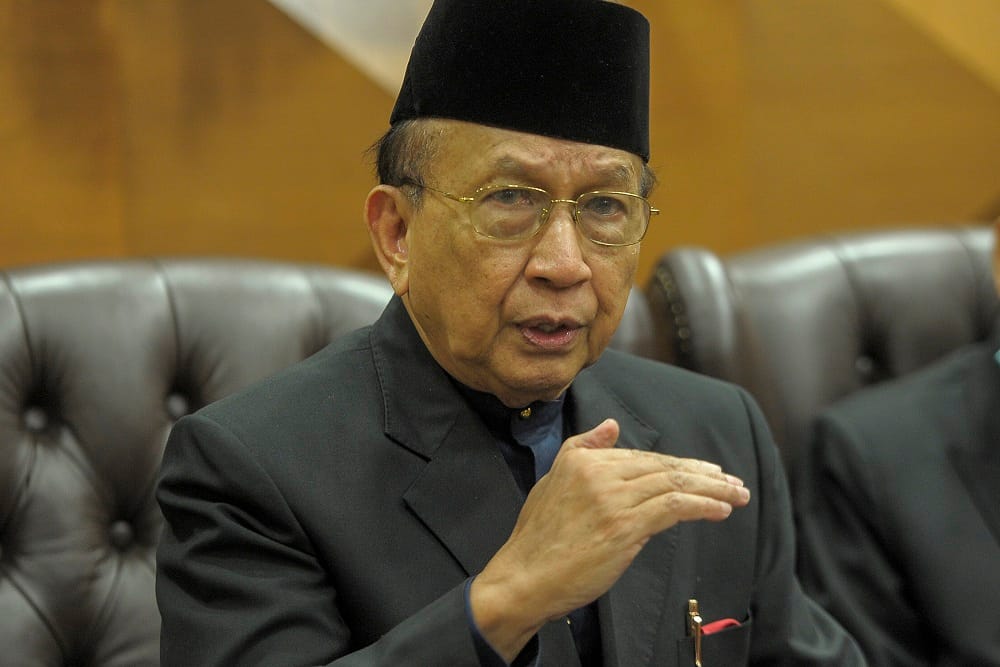
In moments of constitutional uncertainty, societies instinctively look for voices of authority—figures who possess not only experience, but also an intimate understanding of the traditions and laws that underpin the state. In the unfolding crisis within the royal house of Negeri Sembilan, one such voice many have been waiting to hear is that of Rais Yatim.
A former Menteri Besar of the state, a cabinet minister, and a long-time scholar of Adat Perpatih, Rais carries both political and cultural authority. And now, he has spoken.
His position is clear—at least on the surface.
Rais is of the view that the actions of the Undang Yang Empat in attempting to remove the Yang di-Pertuan Besar, Tuanku Muhriz Tuanku Munawir, are lawful. As he put it plainly: “The action of the Undang Yang Empat to remove the Yang di-Pertuan Besar of Negeri Sembilan from the throne… is valid.”
The basis for this, he argues, lies within Article 10 of the Undang-Undang Tubuh Kerajaan Negeri Sembilan 1959. The Undang of Sungai Ujong, Jelebu, Rembau, and Johol, he explains, “have the right to remove the Yang di-Pertuan Besar from the throne.”
But Rais does not suggest that this power is absolute or arbitrary. There are conditions—two, to be precise. “First, there must be a complete report, and second, the offences must be listed.” Only then, he says, can the process proceed with formal documentation, seals, and the Menteri Besar acting as a witness.
And yet, even as he affirms the legality of the Undangs’ actions, Rais urges restraint. This is not merely a legal matter—it is an issue of adat, dignity, and continuity. He cautions that the crisis “must be resolved gently so as not to tarnish the customs or the reputation of any party.”
Here, his language becomes almost philosophical, even poetic: “In custom, there is also the saying ‘push the blade, pull the blade,’ but what has been cut can still be rejoined… this should not be done as a ‘single cut that severs everything,’ because ‘flowing water cannot be cut apart.’”
In other words, what has been broken can still be mended—if handled with care.
But this is where the problem begins.
For all its depth and cultural sensitivity, Rais Yatim’s intervention may not resolve the crisis. In fact, it may deepen it.
Because once we accept his central premise—that those who elect can also dethrone—an uncomfortable question emerges: where does this principle stop?
If the Undang Yang Empat can remove a ruler against his will, then what of other offices born from election or appointment?
Can a Prime Minister be removed not through parliamentary processes, but by those who initially supported his rise? Could a Menteri Besar, a Chief Minister, or even senior institutional figures like judges or army chiefs be dismissed simply because the body that elevated them has withdrawn support?
And what of the Yang di-Pertuan Agong himself—elected by the Conference of Rulers? If precedent is set here, does it open the door, however theoretically, to similar actions at the federal level?
Rais himself underscores a crucial point: “The Yang di-Pertuan Besar cannot exist without the Undang Yang Empat.” The ruler, in this framework, is inseparable from those who elect him.
But if that relationship is interpreted as conditional—revocable at will—then the very nature of authority begins to shift. It becomes less a matter of constitutional stability, and more a question of sustained consent.
That is a dangerous ambiguity.
Complicating matters further is Rais’s assertion that the dismissal of Undang Sungai Ujong, Mubarak Dohak, was itself invalid. He is unequivocal: “That decision is neither final nor valid due to the absence of sufficient conditions.”
He argues that the Dewan Keadilan dan Undang (DKU) does not possess the authority to remove an Undang, and that due process—rooted in the traditional structures of adat—was not followed. “Dismissal cannot be carried out by the KDU… it is only an advisory body.”
This introduces yet another layer of uncertainty. If one Undang’s position is itself disputed, then can the collective decision of the Undang Yang Empat be considered valid in the first place?
What we are left with is not clarity, but a web of competing legitimacies—constitutional law, customary practice, political authority, and personal interpretation.
Rais Yatim calls this what it is: “one of the most difficult constitutional crises in Negeri Sembilan.”
And he may be right.
But his analysis, while authoritative, does not close the debate. Instead, it expands it—forcing us to confront deeper questions about power, legitimacy, and the fragile balance between tradition and modern governance.
In the end, Rais offers a path forward: return to the Dewan Keadilan dan Undang, deliberate, reconcile, and seek a lunak resolution. Failing that, he predicts the inevitable—“I believe it will reach the courts.”
The courts may yet decide.
But even if they do, the larger questions raised by this crisis—and sharpened by Rais Yatim’s intervention—will not disappear so easily.
Because this is no longer just about a throne in Negeri Sembilan.
It is about the very idea of who holds power—and who has the right to take it away.
TheRealNehruism (nehru.sathiamoorthy@gmail.com) is a content creator under the Newswav Creator programme, where you get to express yourself, be a citizen journalist, and at the same time monetize your content & reach millions of users on Newswav. Log in to creator.newswav.com and become a Newswav Creator now!
The User Content (as defined on Newswav Terms of Use) above including the views expressed and media (pictures, videos, citations etc) were submitted & posted by the author. Newswav is solely an aggregation platform that hosts the User Content. If you have any questions about the content, copyright or other issues of the work, please contact creator@newswav.com.