
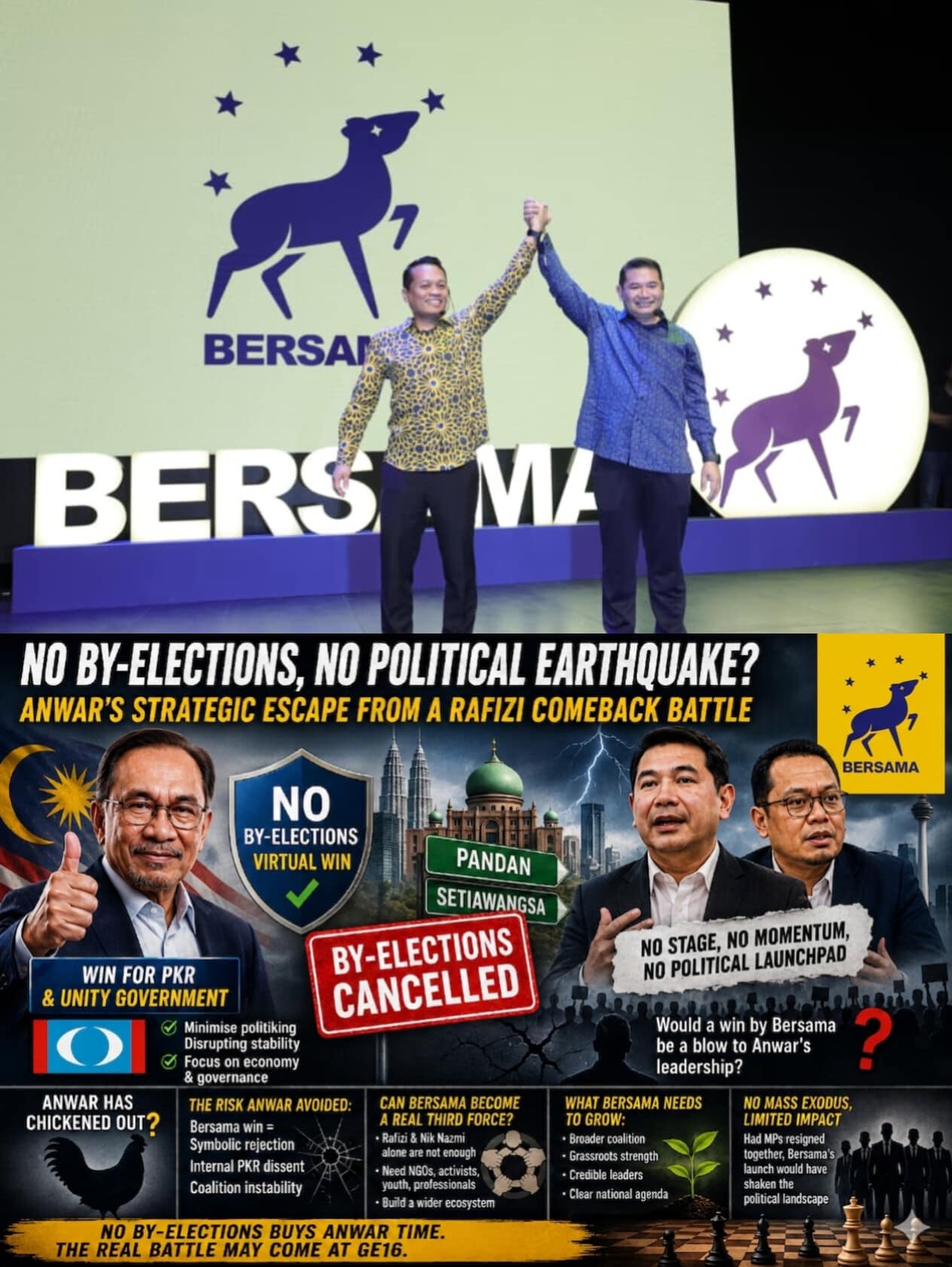
The Election Commission’s decision not to hold by-elections for the vacant parliamentary seats of Pandan and Setiawangsa may appear administrative on the surface, but politically, it is a virtual victory for Parti Keadilan Rakyat and the Unity Government led by Dato' Seri Anwar Ibrahim.
The move effectively prevents what could have become one of the most explosive political contests in recent Malaysian history. With the resignations of Dato' Seri Rafizi Ramli and Nik Nazmi Nik Ahmad from PKR before taking over Parti Bersama Malaysia, by-elections would have transformed into a referendum on Anwar’s leadership, government stability, and the future direction of reform politics in Malaysia.
Instead, the absence of by-elections has denied Rafizi the political stage he desperately needed.
Had the contests proceeded, both Pandan and Setiawangsa would likely have become high-voltage battlegrounds dominated by personality politics, media attention, and emotional narratives surrounding Rafizi’s reformist image. Regardless of whether Bersama could realistically seize the seats, the campaign momentum alone might have reignited Rafizi’s national influence and provided a launchpad for his new political movement.
For the Unity Government, avoiding such a scenario minimises unnecessary politicking at a time when economic management, subsidy rationalisation, and governance challenges remain sensitive issues. Continuous political drama through by-elections risks distracting ministries, destabilising coalition relations, and fuelling public perception that the government is more focused on survival than administration.
At the same time, this strategic move will undoubtedly be perceived as Anwar having “chickened out” politically.
The perception now emerging is that if Rafizi and Nik Nazmi had managed to defend their seats under the Bersama banner, it would have delivered a devastating symbolic blow to Anwar’s already fragile political standing. Such victories could have emboldened internal dissent within PKR while signalling that reformist grassroots support was drifting away from the prime minister.
Even a narrow Bersama victory would have triggered intense speculation about fractures inside the Unity Government and potentially accelerated factional instability within PKR itself.
Still, the larger question remains whether Parti Bersama Malaysia can genuinely evolve into a credible third force in Malaysian politics.
Depending solely on Rafizi and Nik Nazmi will not be enough.
Malaysia’s political history has repeatedly shown that personality-centric parties struggle to survive once initial hype fades. Bersama cannot merely rely on Rafizi’s intellectual branding, debate skills, or social media appeal. To become a sustainable national force, the party must build a broader ecosystem involving like-minded NGOs, civil society activists, youth movements, policy professionals, and respected influential personalities capable of expanding its reach beyond urban reformist circles.
Without a wider coalition of credible figures, Bersama risks becoming another temporary splinter movement fuelled more by dissatisfaction than organisational strength.
Its challenge is even greater because Malaysian voters today are increasingly pragmatic. Many may admire Rafizi’s courage or technocratic style, but admiration alone does not automatically translate into nationwide electoral machinery, grassroots mobilisation, or long-term political endurance.
In fact, the impact of Bersama’s launch would have been far more dramatic had MPs aligned with Rafizi inside PKR resigned collectively and joined the new party from the very beginning. Such a coordinated exodus could have created the perception of a genuine reformist uprising capable of reshaping Malaysian politics.
Instead, the absence of a large-scale crossover makes Bersama’s emergence appear cautious rather than revolutionary.
For now, the cancellation of by-elections has bought Anwar valuable political breathing space while simultaneously slowing Rafizi’s momentum. But beneath the surface calm, the political rivalry between former allies may only be entering its opening chapter.
The next general election may ultimately become the real battlefield in determining whether Bersama can truly reshape Malaysia’s political future - or simply become another short-lived political experiment.
By: Kpost
Information Source:
Kpost (ckhorsk@gmail.com) is a content creator under the Newswav Creator programme, where you get to express yourself, be a citizen journalist, and at the same time monetize your content & reach millions of users on Newswav. Log in to creator.newswav.com and become a Newswav Creator now!
The User Content (as defined on Newswav Terms of Use) above including the views expressed and media (pictures, videos, citations etc) were submitted & posted by the author. Newswav is solely an aggregation platform that hosts the User Content. If you have any questions about the content, copyright or other issues of the work, please contact creator@newswav.com.