
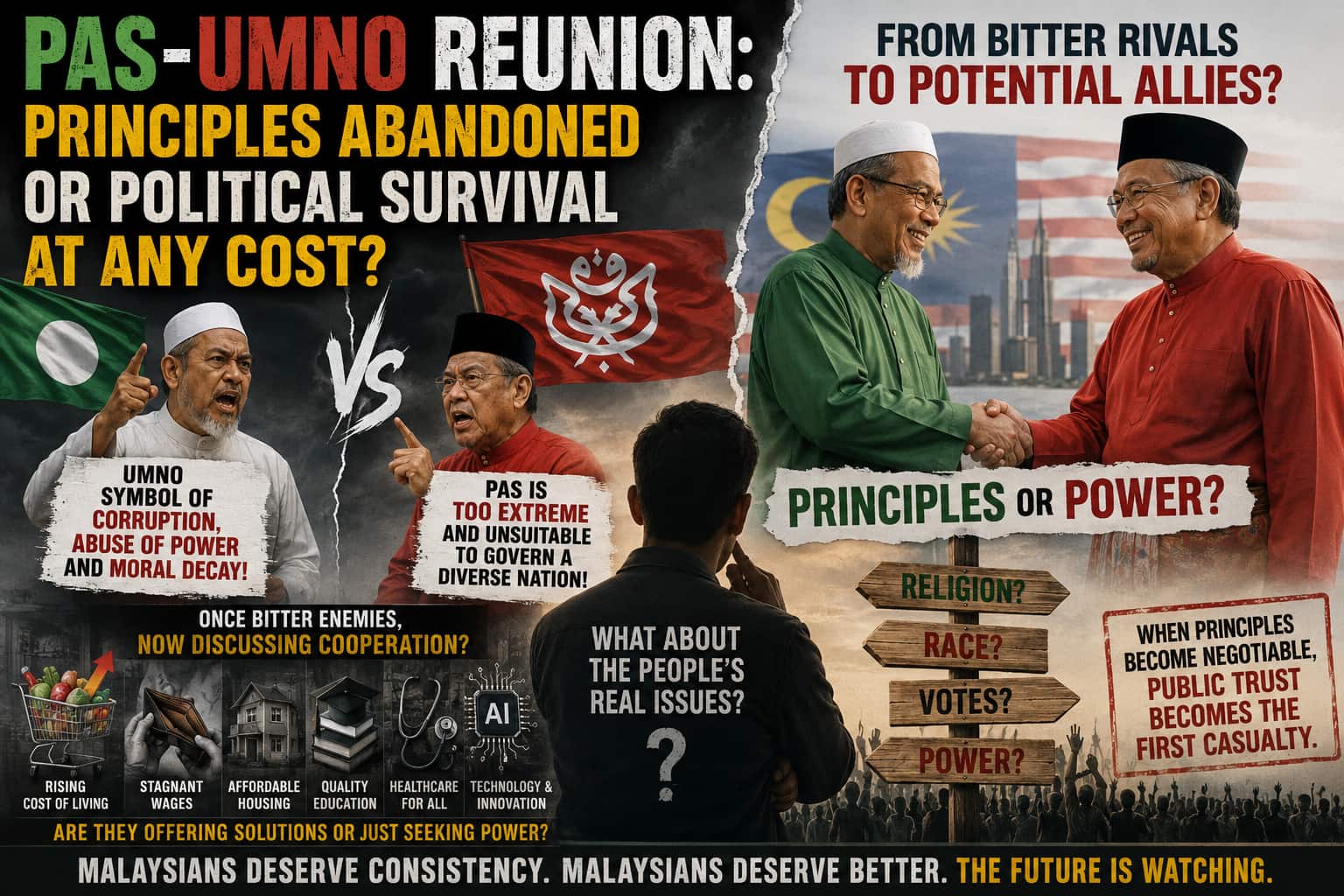
For decades, PAS and UMNO stood on opposite sides of Malaysia's political divide, trading accusations, attacking each other's credibility, and presenting themselves as fundamentally incompatible alternatives.
Speaking on her podcast channel, lawyer and activist Siti Kasim argued that PAS repeatedly portrayed UMNO as a symbol of corruption, abuse of power, and moral decay, while UMNO warned Malaysians that PAS was too extreme and unsuitable to govern a diverse, multiracial nation.
Today, however, discussions of possible electoral cooperation between the two parties have raised an uncomfortable question: Were those years of political attacks based on genuine principles, or were they merely tools in the pursuit of power?
The prospect of PAS and UMNO working together in future elections, particularly in states such as Johor and Negeri Sembilan, has sparked renewed debate about political consistency and credibility. If UMNO was once described as a corrupt party that damaged the nation, what has changed? Has UMNO suddenly become clean, or has PAS quietly abandoned the criticisms it spent years promoting? Likewise, if PAS was once portrayed by UMNO leaders as an extremist force that could divide society, why is it now considered an acceptable political partner?
Such questions strike at the heart of a broader issue in Malaysian politics: the widening gap between political rhetoric and political reality.
PAS has often claimed to champion principled Islamic governance. However, many would argue that principles should remain constant regardless of political circumstances. When former enemies suddenly become allies as elections approach, many voters naturally question whether ideology is being sacrificed for electoral advantage. If principles can be adjusted according to political necessity, are they truly principles at all?
The issue becomes even more significant when viewed from Johor's political landscape. Johor has traditionally been regarded as a moderate and pragmatic state, with voters often placing greater emphasis on economic growth, employment opportunities, investment, and development. In the 2022 Johor state election, Perikatan Nasional achieved only limited success, highlighting the challenges PAS faces in expanding its influence independently within the state.
At the same time, UMNO is not immune from accusations of political convenience. The party spent years warning Malaysians about PAS's religious conservatism and its potential impact on a multicultural society. By opening the door to cooperation today, UMNO risks appearing equally willing to set aside long-held positions for political survival.
Beyond the political calculations lies a larger concern. Malaysians are increasingly focused on issues that directly affect their daily lives: rising living costs, stagnant wages, affordable housing, quality education, healthcare, technological advancement, and economic competitiveness. Younger voters, in particular, are looking for policies that address the future rather than endless debates over race, religion, and political rivalries.
Johor, with its strategic position bordering Singapore and its role as a major investment hub, requires forward-looking leadership capable of navigating challenges in artificial intelligence, digital transformation, industrial innovation, and global competition. Many voters may therefore ask whether renewed PAS-UMNO cooperation offers a compelling vision for the future or merely represents another chapter in Malaysia's long history of political realignments.
This reality has led some observers to suggest that PAS's willingness to cooperate with UMNO may reflect electoral necessity rather than ideological compatibility. Siti argues that if PAS genuinely believes its support base is growing nationwide, it should be prepared to contest independently rather than seek assistance from a party it once condemned. According to her, PAS uses religion while UMNO appeals to racial sentiments to influence voters, and both ultimately seek political power. She contends that this proposed alliance is not about shared principles but about securing votes and gaining power to form the government.
Ultimately, the debate is not simply about PAS or UMNO. It is about whether Malaysian politics can move beyond alliances built on convenience and towards a culture grounded in transparency, consistency, and genuine public service. If former enemies can become partners overnight, the public should question their credibility.
After all, when political principles become negotiable, public trust often becomes the first casualty.
By: Kpost
Information Source:
Youtube/SitiKasim , Malaysiakini , Fmt
Kpost (ckhorsk@gmail.com) is a content creator under the Newswav Creator programme, where you get to express yourself, be a citizen journalist, and at the same time monetize your content & reach millions of users on Newswav. Log in to creator.newswav.com and become a Newswav Creator now!
The User Content (as defined on Newswav Terms of Use) above including the views expressed and media (pictures, videos, citations etc) were submitted & posted by the author. Newswav is solely an aggregation platform that hosts the User Content. If you have any questions about the content, copyright or other issues of the work, please contact creator@newswav.com.
