

Why does it appear that PM Anwar and DAP are “tripping over one another” as they try to address the raging uproar over the BUDI95 subsidy?
There was a buzz in the country recently when vocal DAP lawmaker Lim Lip Eng publicly reminded the government that income bracket labels do not necessarily reflect a person’s actual financial circumstances. The popular Kepong MP then went on to stress that any plan to remove the full fuel subsidy for those in the so-called T20 high-income group must be supported by a sound and effective mechanism.
However, to many ordinary citizens, wouldn't it come across as “gross” that those who can afford to buy posh cars and own high-end properties – both locally and overseas – are still allowed to enjoy subsidies intended for the poorer ones?
Moreover, some detractors would also argue that the withdrawal of subsidies will not greatly affect the pockets and the “lifestyles” of those in the T20 group as their immense wealth and multiple income streams will ensure they are always insulated from economic shocks.
Aren't “subsidies” meant to be a form of financial help?
Nevertheless, in the real world, is the “T20” label truly a badge of honor – or is it more of an albatross around the neck? In any case, how would you evaluate whether a person is really “super rich” or is just an unfortunate bloke from the M40 group – unfairly trapped in the same T20 category due to erroneous classification? Shouldn't other variables also be taken into account apart from declared income?
Realistically, can the monthly expenses and disposable income of those who reside in “high cost” urban centres such as the Klang Valley, Johor Bahru and Penang be compared to those in provincial townships such as Kota Bharu or Kangar?
But why all the focus on the “wealthy" T20 group in the petrol subsidy controversy?
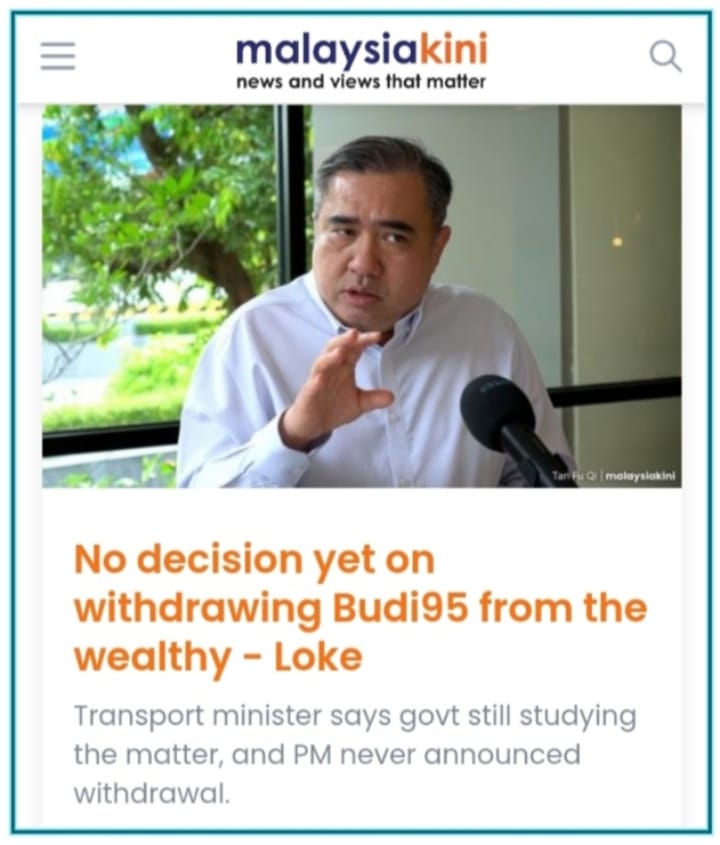
Screenshot of news headline and image from Malaysiakini dated 12 May 2026.
The truth is, with RON95 having climbed to above RM4 per litre, while the subsidised price stays at RM1.99, isn't the government essentially paying for half of every Malaysian's tank – which works out to a jaw dropping RM4 billion a month?
Naturally, this would beg the question: aren't there other pragmatic options available to the government to stop this financial haemorrhage without triggering a national uprising?
First and foremost, if removal of the subsidy to the “T20” category is one of the primary measures being contemplated – as it could translate to substantial savings – then should it not be “redefined” to reflect the reality on the ground?
In fact, some would suggest that only those who earn say RM300,000 per annum and above should be categorized as "top" wealthy. In other words, those earning RM25,000 and above per month should not be eligible at all for the petrol subsidy. It may not please everyone but wouldn't that be a fairer threshold?
Porsche vs Perodua?
Secondly, there are also some who will argue that fuel subsidy eligibility should be linked to the price/value or engine capacity of the vehicle. For example, those who can afford to buy luxury cars costing more than say RM300k should not be eligible for subsidized fuel. To illustrate the point, is it fair that the wealthy owner of a Porsche Cayenne is also eligible to enjoy the same fuel subsidy as the B40 owner of a Perodua Axia?
Thirdly, many countries have already started raising the petrol price due to the US-Iran conflict. Likewise, shouldn't the PH-led administration here also “take the bull by the horns” and reduce the subsidy in stages so that it wouldn't cause a shock and spark an immediate spike in inflation.
Perhaps, it can start off by raising the subsidized petrol price to say RM2.20 from the current RM1.99? In this way, wouldn't the government be able to gradually cut down its burgeoning subsidy bill? Moreover, wouldn't such a gradual reduction also be more palatable than reducing the monthly quota to lower than the current 200 litres?
With the government “bleeding” around RM4 billion monthly – for how long more can the BUDI95 subsidy be sustainable in its current form?
Unsurprisingly, like many other issues in this country, the fuel subsidy saga is also inextricably tied to politics. That should explain why PMX and his Madani government appear to be in a real bind because they are unable to keep their promises – more so in what may well turn out to be a “do or die” election year.
Likewise, DAP also appears to be on tanterhooks because a big chunk of its voter base comes from the disputed T20 category? Wouldn't it stand to lose most should the government decide to withdraw the subsidy from this group?
In that regard, their apprehension may be understandable as the topic of petrol price is a “highly combustible” issue with the electorate – especially in a country where car ownership has been indirectly encouraged, thanks in no small part to the grandiose plans and policies of some past administrations.
As it stands, the Madani government's hesitancy to act decisively on this explosive issue seems to boil down to a singular fear: that taking any drastic, unpopular action could prove “suicidal” at the ballot box. Still, by dragging its feet, haven't PM Anwar and PH already lost crucial ground to their political foes in the BUDI95 petrol subsidy war?
Main information source: Malaysiakini and Auto Buzz.
JK Joseph (jtkingsworld@gmail.com) is a content creator under the Newswav Creator programme, where you get to express yourself, be a citizen journalist, and at the same time monetize your content & reach millions of users on Newswav. Log in to creator.newswav.com and become a Newswav Creator now!
The User Content (as defined on Newswav Terms of Use) above including the views expressed and media (pictures, videos, citations etc) were submitted & posted by the author. Newswav is solely an aggregation platform that hosts the User Content. If you have any questions about the content, copyright or other issues of the work, please contact creator@newswav.com.
