.jpg)
By Mihar Dias May 2026
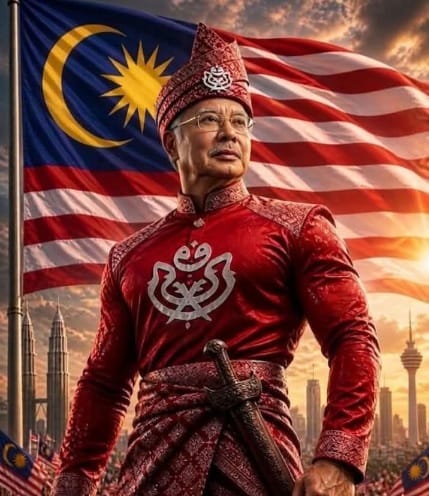
There is something almost operatic about the image now making its rounds online: a resplendent, almost mythologised Najib Razak, clad in regal crimson, keris at his side, standing before a billowing Jalur Gemilang as though he had personally stitched it at dawn. https://www.facebook.com/share/p/17RrBq6yHW/
Behind him, the Kuala Lumpur skyline glows with the kind of golden-hour optimism usually reserved for tourism brochures and election manifestos. (AI of course!)
And then, of course, the caption lands with all the subtlety of a marching band: “Hanya Dato Seri Najib sahaja yg mampu naikkan UMNO semula buat masa ni.” Only Najib can save UMNO now.
Ah yes, salvation. Malaysian politics’ most overused plot device.
One has to admire the audacity of it all. Not the image—it is clearly the work of someone who thinks history is best remembered through filters and dramatic lighting—but the narrative it attempts to revive. The idea that a party’s future lies not in reinvention, reform, or even a modest bout of self-reflection, but in the resurrection of a familiar face, polished anew like an heirloom that everyone quietly agrees is slightly… tarnished.
This is not nostalgia. Nostalgia at least has the decency to admit it is looking backward. This is something else entirely: a kind of political time-loop where yesterday’s answers are endlessly repackaged as tomorrow’s solutions.
UMNO, once the immovable pillar of Malaysian politics, now finds itself in the peculiar position of being both exhausted and stubbornly resistant to rest. Its supporters—some, not all—seem caught between acknowledging the need for change and clinging to the comforting mythology of strongman revival. And so we get images like this: heroic, defiant, almost cinematic. Politics, reimagined as folklore.
But folklore has a habit of simplifying inconvenient details. It edits. It airbrushes. It chooses which chapters to remember and which to quietly misplace.
The inconvenient question, of course, is this: if a party can only imagine its future through the lens of its past, what does that say about its present?
Because strength in politics is not measured by how convincingly one can recreate an old poster with better graphics. It is measured by the ability to adapt, to build new leadership, to confront uncomfortable truths without needing a nostalgic soundtrack playing in the background.
The image suggests certainty. The caption declares inevitability. Reality, however, tends to be far less accommodating.
Perhaps the most telling detail is not the keris, or the flag, or even the carefully sculpted posture of leadership. It is the underlying assumption that political revival is a one-man performance. That institutions, ideas, and accountability can all be conveniently outsourced to a single figure—preferably one already familiar, already tested, already… known.
It is a seductive idea. It is also, historically speaking, a rather risky one.
Because when politics becomes theatre, the audience may applaud the performance—but they still have to live with the consequences after the curtains fall.
Mihar Dias (mihardias@gmail.com) is a content creator under the Newswav Creator programme, where you get to express yourself, be a citizen journalist, and at the same time monetize your content & reach millions of users on Newswav. Log in to creator.newswav.com and become a Newswav Creator now!
The User Content (as defined on Newswav Terms of Use) above including the views expressed and media (pictures, videos, citations etc) were submitted & posted by the author. Newswav is solely an aggregation platform that hosts the User Content. If you have any questions about the content, copyright or other issues of the work, please contact creator@newswav.com.