
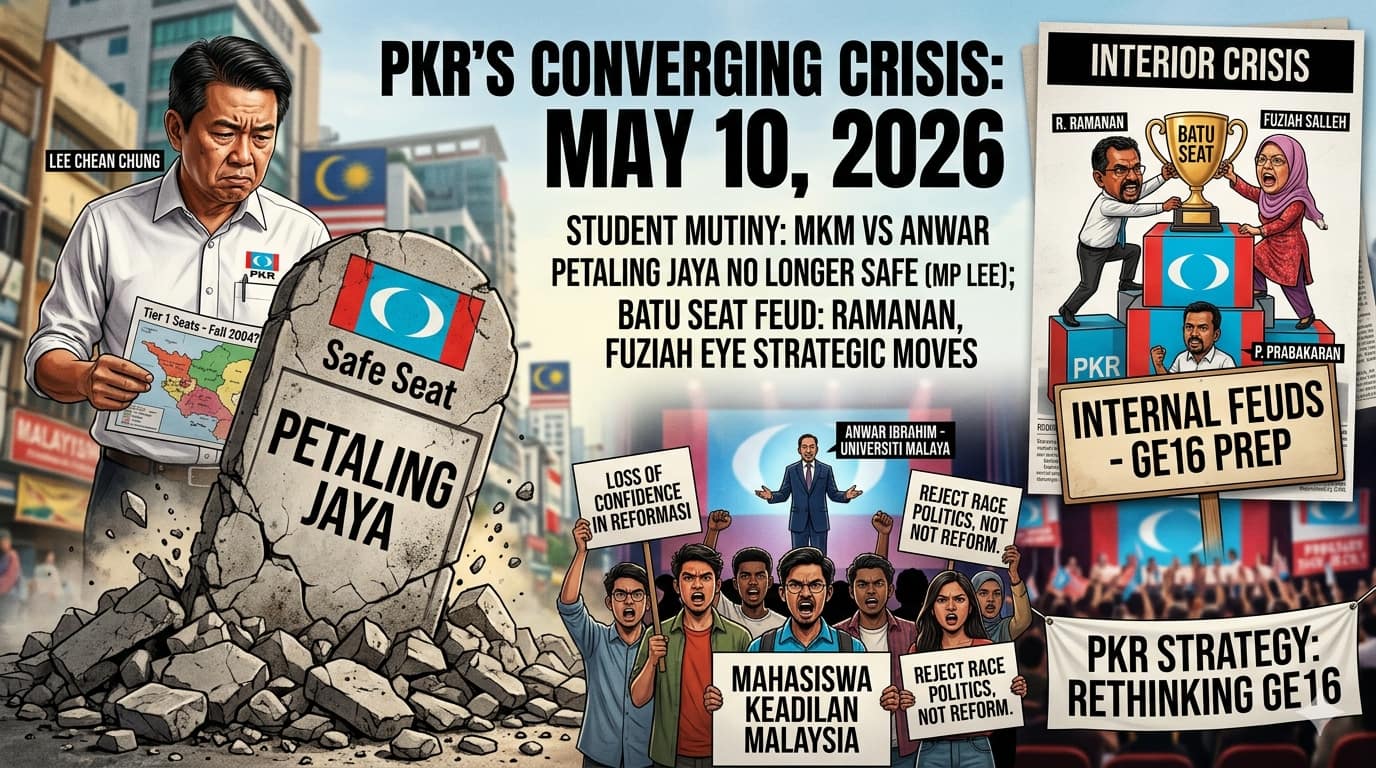
PKR faces a high-stakes crisis as internal rivalries and crumbling urban strongholds threaten its grip on GE16. Visual created Gemini prompt by Annan Vaithegi
"A political movement begins to unravel not when its enemies attack from outside, but when its own supporters stop believing from within."
PKR's political landscape is entering a dangerous new phase ahead of the 16th General Election (GE16). What once appeared to be isolated murmurs of dissatisfaction inside Parti Keadilan Rakyat (PKR) is now evolving into something far more serious: a visible crisis of confidence spreading simultaneously among students, urban voters, party insiders, and even elected representatives.
The events unfolding around PKR over the past week do not look like ordinary political turbulence. They resemble the early warning signs of a party slowly losing control of its own narrative.
The latest developments paint a troubling picture.
PKR’s student wing, Mahasiswa Keadilan Malaysia (MKM), became the center of controversy after claims emerged expressing a “loss of confidence” in Prime Minister Anwar Ibrahim’s leadership and reformist direction. Although the statement was quickly denied by the movement’s secretary-general, the damage had already been done.
In politics, denials matter less than perception.
The very existence of such public confusion within a youth movement tied to PKR reveals something deeper than a communications problem. It reflects a widening disconnect between the ideals of Reformasi and the realities of governing under the Madani administration.
For decades, Anwar Ibrahim and PKR positioned themselves as the moral alternative to the excesses of old Malaysian politics. Reformasi was not merely a slogan. It was a movement built on sacrifice, institutional reform, accountability, judicial independence, multiracial inclusion, and the promise that politics could be conducted differently.
That is why the frustration emerging from younger supporters matters.
Student movements in Malaysia have historically functioned as political weather vanes. From the university activism of the 1970s to the Reformasi generation of the late 1990s, student voices often reflect emotional undercurrents before they become national political waves.
Today, many younger Malaysians no longer appear angry merely at opposition parties. Increasingly, they appear disillusioned with the very reform movement they once defended.
The public reactions surrounding the MKM controversy illustrate this vividly. Some commentators described PKR as “imploding.” Others mocked the party as “Parti Keluarga Reformati,” accusing it of drifting toward dynasty politics. More strikingly, many comments did not come from traditional political enemies alone. Several appeared to come from former supporters expressing disappointment rather than ideological hostility.
That distinction matters.
Political opponents can be fought. Disillusioned supporters are far harder to recover.
The anxiety inside PKR became even more visible when Petaling Jaya MP Lee Chean Chung warned that even urban strongholds traditionally viewed as “safe seats” may no longer be secure for Pakatan Harapan.
That statement alone would have been unthinkable just a few years ago.
Petaling Jaya has long symbolised the intellectual and urban backbone of the Reformasi movement a constituency associated with middle-class reform-minded voters, civil society activism, and multiracial support for institutional change. When a PKR lawmaker openly warns that even such constituencies are vulnerable, it signals that the party’s internal polling may be painting a far darker picture than its public messaging suggests.
Lee’s remarks also carried echoes of 2004 the election where opposition parties were overwhelmed by a wave of public optimism toward a new prime minister promising reform.
Ironically, PKR now risks becoming the victim of the same political phenomenon it once benefited from: voter fatigue with unmet expectations.
The danger for PKR is not simply that it may lose Malay votes to Perikatan Nasional or UMNO. The greater threat may be the silent erosion of enthusiasm among urban moderate voters who once viewed PKR as the vehicle for systemic reform.
In politics, disappointment is often more dangerous than anger.
Angry voters may still show up to vote against you. Disillusioned voters may simply stay home.
That growing nervousness may also explain the increasingly visible internal manoeuvring over parliamentary seats.
Reports that deputy minister R. Ramanan and PKR secretary-general Fuziah Salleh are eyeing the Batu parliamentary seat ahead of GE16 have intensified perceptions that senior party leaders are searching for politically safer terrain.
Batu is not just another constituency. It is politically symbolic.
With its mixed urban demographics and history of unpredictable contests, Batu has long been treated as a testing ground for the strength of PKR’s multiracial appeal. Yet the current speculation surrounding the seat has transformed it into a metaphor for a deeper party crisis.
If senior leaders are perceived to be abandoning their existing constituencies in favour of “strategic” urban seats, the message received by voters is damaging: even PKR’s own leaders may no longer feel confident about defending the ground beneath them.
The perception of “seat-shopping” is politically toxic during periods of declining public trust.
Many grassroots supporters increasingly ask a simple question: if leaders truly served their constituencies well, why search for safer seats at all?
The controversy also risks alienating incumbents such as Batu MP P. Prabakaran, whose supporters argue that local service and grassroots connection should matter more than internal political hierarchy.
At a time when PKR needs unity, the optics instead suggest internal competition.
This is what makes the current political climate especially dangerous for the party. PKR is now fighting multiple battles simultaneously:
- A credibility battle with reform-minded voters.
- A trust battle with minorities frustrated over racial and religious controversies.
- A narrative battle against accusations of hypocrisy.
- And an internal positioning battle ahead of GE16.
Against this backdrop, Anwar Ibrahim’s recent speech at Universiti Malaya becomes politically significant.
In urging firmness on racial and religious matters to be “tempered with respect,” the prime minister appeared to be attempting a delicate balancing act. On one hand, he sought to reassure Malay-Muslim audiences that the government remains firm on sensitive issues. On the other, he attempted to calm growing anxieties among minorities and younger urban voters who increasingly perceive selective enforcement and inconsistent rhetoric.
But the challenge facing Anwar is no longer merely about messaging.
It is about credibility.
Critics point out that speeches about moderation arrive only after months of public anger over issues involving temples, racial rhetoric, religious provocateurs, and inconsistent enforcement perceptions. For many voters, especially minorities who once strongly backed Pakatan Harapan, the issue is no longer whether the government says the right things.
The issue is whether they still believe them.
This is the uncomfortable contradiction now confronting PKR.
The Madani government continues to speak the language of reform, moderation, and unity. Yet many supporters increasingly feel they are witnessing the return of old political instincts: racial balancing, selective pragmatism, internal patronage politics, and leadership protection.
That perception fair or unfair is politically devastating for a party built entirely on the moral authority of Reformasi.
The problem for PKR is not simply opposition attacks.
It is that the party is beginning to sound unfamiliar even to people who once defended it passionately.
That is why the reactions from the ground should not be dismissed merely as online noise. Beneath the sarcasm, anger, and political exaggeration lies a more serious warning: many voters no longer feel emotionally connected to the movement that once inspired them.
And politics without emotional connection becomes purely transactional.
This does not automatically mean PKR is heading toward electoral collapse. Malaysian politics remains fluid. Opposition coalitions remain fragmented. Fear of political instability and extremism may still push many voters back toward the unity government during GE16.
But the warning signs are unmistakable.
When student wings publicly appear divided, when MPs warn safe seats are no longer safe, when leaders are seen scrambling for strategic constituencies, and when reformist supporters begin questioning whether Reformasi itself still exists the crisis is no longer external.
It is internal.
The greatest threat to PKR ahead of GE16 may not be Perikatan Nasional, UMNO, or any opposition alliance.
It may be the growing perception that the party no longer fully recognises the movement it once claimed to represent.
And history shows that political parties rarely collapse in a single dramatic moment. More often, they slowly weaken from accumulated contradictions until one election finally exposes how fragile the structure had already become.
PKR once rose by convincing Malaysians that a different political future was possible.
GE16 may determine whether Malaysians still believe that promise or whether Reformasi itself has become another chapter of political nostalgia.
Annan Vaithegi writes opinion columns on governance, political reform, electoral trends, and the evolving psychology of Malaysian politics. His work examines how public trust, leadership credibility, and institutional contradictions shape the nation’s democratic future.
Annan Vaithegi (annanvaithegi@icloud.com) is a content creator under the Newswav Creator programme, where you get to express yourself, be a citizen journalist, and at the same time monetize your content & reach millions of users on Newswav. Log in to creator.newswav.com and become a Newswav Creator now!
The User Content (as defined on Newswav Terms of Use) above including the views expressed and media (pictures, videos, citations etc) were submitted & posted by the author. Newswav is solely an aggregation platform that hosts the User Content. If you have any questions about the content, copyright or other issues of the work, please contact creator@newswav.com.