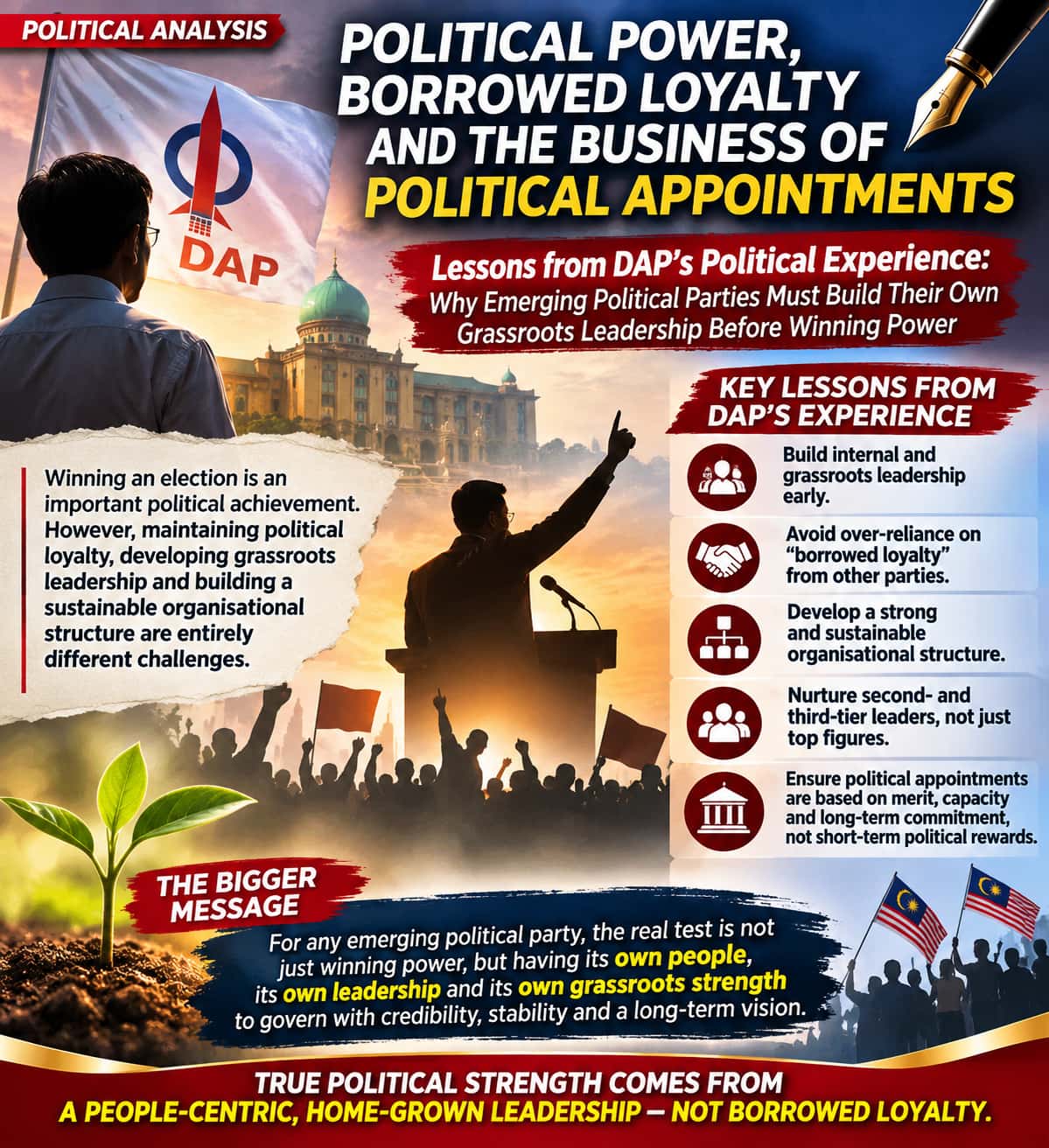
Why Political Parties Must Build Their Own Grassroots Leadership
Lessons from the political experience of PKR, DAP and AMANAH: Why emerging political parties must build their own grassroots leadership before winning power
Political Analysis & Commentary
By Sandra Segaran Arumugam
Winning an election is an important political achievement. However, maintaining political loyalty, developing grassroots leadership and establishing a sustainable organisational structure are entirely different challenges.
One important lesson that emerging political organisations should examine is the experience of Pakatan Harapan (PH) following the 14th General Election (GE14) in 2018, when the coalition successfully captured Putrajaya and formed the Federal Government.
PH had a significant opportunity to strengthen its organisational foundation, recruit new members, develop future leaders and empower its existing grassroots supporters.
However, an important question deserves serious consideration:
Did the parties within the coalition sufficiently invest in developing their own grassroots leadership, or did they become increasingly dependent on external political personalities and individuals from different political backgrounds to fill important representative positions?
What about AMANAH? How successful has the party been in recruiting young Malay leaders and developing its own Malay grassroots leadership, particularly given its political positioning as a party representing Malay interests?
Did it make sufficient efforts to build its own organisational strength, or did it become overly dependent on the existing grassroots machinery of DAP?
These are important questions that deserve examination, particularly among political organisations aspiring to form the next government.
1. Borrowed political loyalty is not a sustainable strategy
One of the challenges political parties face after winning elections is the temptation to bring individuals from other political organisations into important representative and government positions.
Such appointments may provide immediate political convenience, particularly when a party does not have enough experienced personnel within its own organisation.
However, political convenience should never replace long-term organisational planning.
Individuals who come from different political backgrounds may have different political loyalties, personal ambitions and organisational commitments.
They may serve during favourable political circumstances, but what happens when the party loses power?
Will they continue standing with the party, or will they return to their original political organisations?
This is a fundamental question political leaders must consider before making important appointments.
Political loyalty cannot simply be assumed because someone accepts a position under a particular government.
A party must distinguish between individuals who genuinely believe in its political struggle and those who see political appointments as opportunities for personal advancement.
2. When political power arrives, business interests will also arrive
There is another important political reality that leadership must understand.
Once a political party wins an election and becomes part of the government, it inevitably attracts attention from influential individuals, particularly businessmen and financially powerful personalities.
Many will suddenly become interested in joining the party.
Some may offer financial contributions, sponsorships, resources and other forms of assistance to demonstrate their support and loyalty.
Financial contributions can certainly help political organisations, and businessmen have every right to participate in politics.
However, political leadership must be careful not to confuse financial strength with genuine political commitment.
Money can demonstrate financial capacity, but it cannot automatically demonstrate political sincerity.
There is a danger when political organisations begin giving greater recognition to individuals because of their financial influence rather than their contributions, commitment and understanding of the party's political struggle.
A person who has spent years building the party at grassroots level should not automatically be overlooked in favour of someone who arrives after an electoral victory with substantial financial resources.
This is where political leadership must demonstrate wisdom, discipline and integrity.
Political positions must not become rewards for financial contributions, personal connections or newly acquired political influence.
Otherwise, the party risks creating a culture where members begin believing that money and connections are more valuable than loyalty, hard work and genuine commitment.
3. My political experience in DAP: A lesson worth sharing
Having been involved in DAP for almost 18 years, I have had the opportunity to observe political developments, organisational challenges and the importance of grassroots commitment.
Following the leadership era of the veteran Tan Sri Lim Kit Siang and the late Mr Karpal Singh, I personally observed significant changes in the party's political direction and organisational approach.
When Lim Kit Siang handed over leadership to the next generation, including Anthony Loke, Liew Chin Tong, Teo Nie Ching and other emerging leaders, the party entered a different phase of political leadership.
Based on my personal observations, the new leadership appeared more focused on maintaining public confidence in the party's direction and ensuring that its political positions received public acceptance.
However, an important question remains:
How much room is available for members and individuals who hold different opinions from the party leadership?
Does the organisation provide sufficient space for internal debate, constructive criticism and alternative viewpoints?
My intention in sharing these observations is not to undermine any political organisation. Rather, it is to highlight important lessons that emerging political parties should seriously consider.
A political party cannot build a sustainable future merely by attracting influential individuals after winning elections.
It must continuously recruit, train and develop its own members.
When grassroots members are overlooked while external personalities receive opportunities, the organisation risks weakening its internal structure.
Eventually, when political circumstances change or electoral defeats occur, some individuals who previously benefited from political appointments may choose to return to their original political organisations.
The party is then left to face the consequences of not having sufficiently developed its own leadership talent.
This is why internal recruitment and leadership development must never be neglected.
4. Recent electoral experiences should become political warning signs
The electoral experiences in Sabah, Johor, Negeri Sembilan and Melaka should encourage established and emerging political organisations to examine their strategies carefully.
These elections provide important opportunities to reflect on grassroots engagement, candidate selection, organisational loyalty, coalition management and the relationship between party leadership and ordinary supporters.
Electoral outcomes are influenced by multiple factors. Therefore, it would be simplistic to attribute every political setback to one organisational weakness.
However, political parties must have the courage to examine whether their existing strategies are genuinely strengthening their grassroots machinery.
Winning government positions does not necessarily mean that a party has successfully built a strong political organisation.
Likewise, attracting prominent personalities does not automatically translate into grassroots confidence.
The real test comes when political circumstances become difficult.
Do members remain committed?
Do elected representatives continue supporting the organisation?
Does the party still possess capable leaders who understand its struggles and political principles?
These are the questions that determine long-term political survival.
5. A valuable lesson for new parties such as WARISAN, BERSAMA, PEJUANG and other emerging political organisations
The experience of the PH coalition should become an important lesson for Warisan, Bersama, Pejuang and other political organisations preparing for future electoral opportunities.
The objective should not be to wait until winning an election before identifying suitable representatives.
Recruitment, leadership development and grassroots empowerment must begin immediately.
Political parties should continuously strengthen their membership, identify capable individuals and prepare future leaders from within their own organisational structures.
This does not mean rejecting experienced individuals who join from other political backgrounds.
Every political organisation should remain open to capable individuals who genuinely believe in its objectives and principles.
However, there must be a clear distinction between welcoming new members and depending excessively on borrowed political networks.
External experience is valuable, but internal leadership development is essential.
A party must have the confidence to promote its own capable members rather than continuously searching outside for individuals to represent it.
Most importantly, the leadership should establish transparent criteria for political appointments, taking into consideration:
- Long-term commitment to the party: Demonstrating loyalty and dedication to the organisation.
- Grassroots contributions: Active participation in party activities and community engagement.
- Leadership capabilities and professional qualifications: Possessing the ability and expertise to carry out responsibilities effectively.
- Understanding of the party's political direction: Demonstrating a clear understanding of the organisation's principles, objectives and policies.
- Willingness to remain committed during difficult political circumstances: Standing with the party even when political positions and privileges are no longer available.
These principles will help create a stronger, more dependable and sustainable leadership structure.
6. Minority representation must be meaningful
Another important consideration is ensuring that grassroots leadership development includes all communities.
Political unity, including unity within the Muslim community, may be an important political objective.
Nevertheless, minority communities must not be overlooked in the process of building a broader political organisation.
Their contributions, commitment and participation should be recognised through meaningful opportunities for representation and leadership.
Minority communities should not be regarded merely as additional votes during election campaigns.
They must be recognised as genuine partners in building the organisation and shaping its political future.
A political party seeking national acceptance must demonstrate that its commitment to inclusiveness goes beyond electoral promises.
Political representation should reflect genuine participation, shared responsibilities and equal opportunities within the organisation.
7. Prepare before political opportunities arrive
Political organisations should never wait until they win an election to start looking for people to fill important positions.
By then, it may already be too late to build genuine organisational loyalty.
The recruitment of members, identification of future leaders and development of capable representatives must be continuous processes.
When political opportunities arise, the party should already have a pool of qualified, experienced and committed individuals ready to serve.
There is an old saying:
"Do not prepare an umbrella only after the rain starts."
Similarly, do not start searching for loyal members and future leaders only after winning political power.
Preparation must come before opportunity.
Conclusion: Do not allow political power to replace political principles
The experiences of political parties that have entered government provide valuable lessons for emerging political organisations.
Political victories can bring positions, influence, financial attention and new political personalities. However, they cannot automatically create organisational loyalty.
A party that depends excessively on external political personalities and financial influence may enjoy short-term advantages, but it risks facing long-term organisational weaknesses.
The real strength of a political organisation is not determined by how many prominent individuals or wealthy businessmen it can attract after winning an election.
It is determined by how many committed members it has developed before winning one.
For political organisations, the message is simple:
Build your own grassroots machinery. Recruit your own committed members. Develop your own future leaders. Recognise those who have struggled with the party. Establish transparent appointment principles and never allow financial influence to become a substitute for political commitment.
Welcome experienced individuals from other political backgrounds, but never allow external recruitment to replace internal leadership development.
Political positions may be temporary. Financial influence may disappear. Political alliances may change. Individuals may return to their original political organisations.
But a strong grassroots foundation built on genuine commitment is what keeps a political party alive.
Remember:
Those who build the party during difficult times should not become strangers when the party finally enjoys political success.
A political party must build its own leaders before it builds its government.
Author's perspective
This article represents a political analysis and commentary informed by personal political experience, observations and reflections on organisational development.
The observations concerning individual political organisations and their leadership approaches are presented as political perspectives for discussion. They should be distinguished from independently verified institutional findings.
The objective is not to discredit any political party or individual, but to encourage stronger grassroots development, responsible political leadership, organisational accountability and sustainable political participation.
Sandara Segaran (chandransandran71@gmail.com) is a content creator under the Newswav Creator programme, where you get to express yourself, be a citizen journalist, and at the same time monetize your content & reach millions of users on Newswav. Log in to creator.newswav.com and become a Newswav Creator now!
The User Content (as defined on Newswav Terms of Use) above including the views expressed and media (pictures, videos, citations etc) were submitted & posted by the author. Newswav is solely an aggregation platform that hosts the User Content. If you have any questions about the content, copyright or other issues of the work, please contact creator@newswav.com.