

Are Sarawakians generally fed up with the hypocrisy prevalent in West Malaysia, where a growing number of politicians and ordinary people, seem to implicitly condone corruption, yet unabashedly condemn anything to do with pigs – even labelling pork eaters as filthy?
Recently, Willie Mongin, a Sarawakian MP from the state's ruling GPS party, had lashed out at those who posted snide remarks about people who consume pork in this country.
Clearly taking umbrage at the slurs, Willie, a native Dayak, had retorted in parliament that while his people eat pork, they are not the ones disproportionately involved in bribery, drug abuse, or high-level corruption.
He further emphasized that many in his community do not engage in illegal or immoral activities; therefore, he called on all parties to respect the dietary preference of the country's diverse ethnic groups.
For context, it was reported that some netizens had posted derogatory comments describing pork as “smelly” and ridiculing those who consume it. In fact, some online conversations went as far as linking pork consumption to being uncivilized – and even implying that those who eat it may be less moral!
Shockingly, according to one social media post (which reportedly is no longer accessible) a netizen had even remarked: “Pigs are smelly. Imagine how smelly people who consume such stinky items must be!”

Didn't the Sarawakian MP do the right thing by rebutting such racially and culturally insensitive remarks?
For the record, the controversy erupted after Selangor ruler Sultan Sharafuddin Idris Shah had earlier voiced strong opposition to the proposed setting up of a large scale, export-oriented pig farming hub in Tanjong Sepat, Kuala Langat – and its eventual relocation to Bukit Tagar in 2030.
Quite rightly, His Majesty had cited river pollution, foul odour, social harmony, and governance concerns; however, it would appear that several parties became emboldened by it and had started to spin it out of context – and with racial undertones, at that!
In that regard, what some observers may ask is: Wasn't Willie's call a timely rejection of the toxic and hypocritical political culture prevalent in the Peninsula? Indeed, if those detractors were truly morally upright, why were they “closing their eyes” to the systemic corruption in this country involving high profile politicians?
To his credit, while referencing the controversy surrounding the pig farm project in Selangor, the Sarawakian politician clarified that he also opposed such large-scale pig farms being located in unsuitable areas.
He then went on to urge Malaysians to respect cultural food choices and not link food preferences to morality or cultural values, saying such attitudes undermine harmony in Malaysia’s multiracial society.
To underscore his point, Willie further compared pork to local fermented condiments like budu and belacan, which according to him, may emit strong odours but are respected (and cherished) as part of Malaysia’s diverse culinary heritage.
Why is the spirit of unity and mutual respect missing in West Malaysia?
Interestingly, Abdul Karim Rahman, a senior Sarawak minister, had pointed out that pigs are God's creations and that calling them keji (lowly), might go against the Almighty; however, he added that there was no need to turn the issue into racial polemics!
Meanwhile, it was reported that several PAS leaders, led by its vocal information chief Ahmad Fadhli Shaari, had recently visited pig farms in the Tanjung Sepat area to personally assess the operational methods used there.
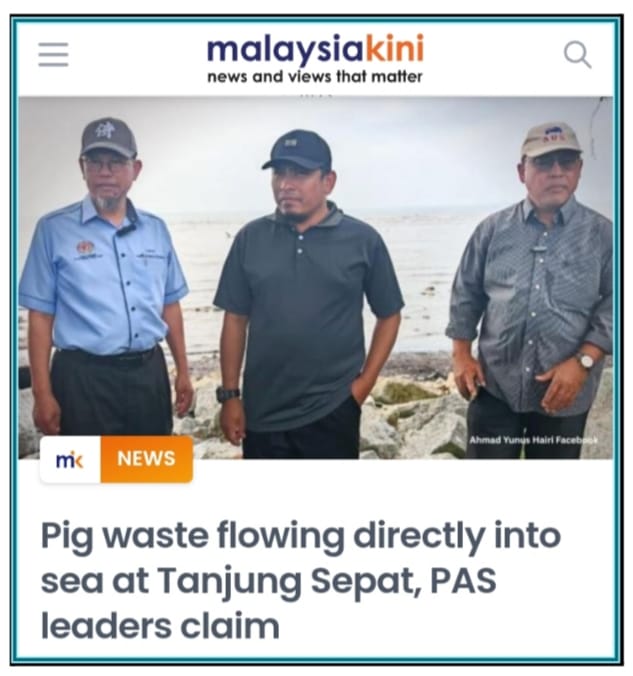
Unsurprisingly, they alleged that the pig waste from the farms there was being channelled directly into the Straits of Malacca, with sewage management either not implemented or inadequate; nevertheless, it is unclear if their findings have been verified with the relevant local authorities.
While there is justification in calling for environmentally cleaner pig farming practices in this country, could there be a deeper issue at play? Were some parties attempting to “amplify” the sensitivities of the majority group here at the expense of the legitimate interests and livelihoods of the minorities – and in the process, spark yet another unwanted ethnic flashpoint?
In fact, to many, it would seem that the controversy may be symptomatic of the deepening prejudices within Malaysia's plural society, where even dietary customs are now coming under attack on social media. So what will be next?
In closing, with neither the DAP nor MCA bold enough to wade into this highly combustible topic, it has been left to a lone, candid East Malaysian lawmaker to provide a much-needed reality check. The truth is, instead of labelling the food choice of other communities here as “dirty”, shouldn't those critics descend from their moral high ground and condemn something that is far filthier in the eyes of the law – corruption?
Main information source: Dayak Daily, TRP, Malaysiakini, Scoop, Focus Malaysia and The Borneo Post.
JK Joseph (jtkingsworld@gmail.com) is a content creator under the Newswav Creator programme, where you get to express yourself, be a citizen journalist, and at the same time monetize your content & reach millions of users on Newswav. Log in to creator.newswav.com and become a Newswav Creator now!
The User Content (as defined on Newswav Terms of Use) above including the views expressed and media (pictures, videos, citations etc) were submitted & posted by the author. Newswav is solely an aggregation platform that hosts the User Content. If you have any questions about the content, copyright or other issues of the work, please contact creator@newswav.com.