
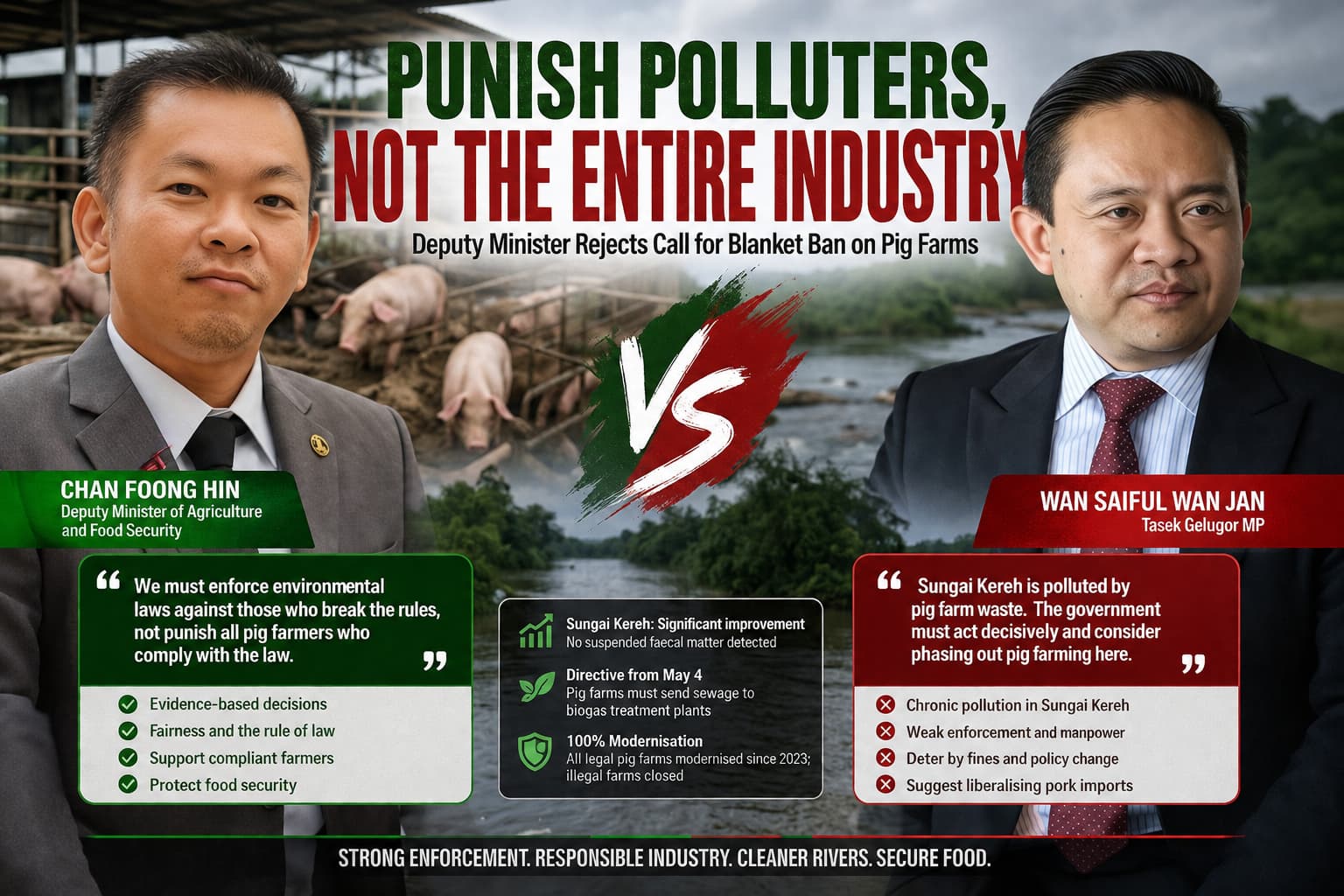
The government should enforce environmental laws against irresponsible pig farm operators instead of shutting down the entire industry, Deputy Agriculture and Food Security Minister Chan Foong Hin has said, rejecting calls for a blanket ban on pig farming over pollution concerns in Penang.
Responding to Tasek Gelugor MP Wan Saiful Wan Jan's proposal to close all pig farming activities in his constituency, Chan argued that policy decisions must be guided by evidence, fairness and the rule of law rather than public sentiment or political rhetoric.
According to Chan, it would be unjust to punish legally compliant pig farms because of the actions of a minority of operators that violate environmental regulations.
"Do we want to penalise an entire industry simply because of the transgressions of a few?" he questioned in a Facebook statement.
He also challenged the logic behind closing the entire pig farming sector, asking whether every livestock industry should similarly be shut down whenever pollution cases occur.
Chan stressed that the government's responsibility is to ensure strict compliance with environmental laws instead of denying legitimate businesses the right to continue operating.
The exchange followed Wan Saiful's remarks during a Parliament Special Chambers session recently, where he claimed Sungai Kereh has been suffering from chronic pollution caused by untreated waste and industrial effluent allegedly discharged from pig farms in Kampung Selamat.
According to Wan Saiful, the pollution has affected nearby communities and livelihoods, while enforcement efforts have remained weak due to overlapping responsibilities among government agencies.
He claimed that the Department of Environment (DOE) had indicated the issue fell outside its jurisdiction because it involved livestock waste, while the Penang Department of Veterinary Services admitted it lacked sufficient manpower to effectively monitor pig farms.
Wan Saiful highlighted that only three enforcement officers were tasked with overseeing a vast farming area, forcing them to operate under hazardous conditions, including exposure to ammonia gas and encounters with venomous snakes.
He further argued that the relatively small fines imposed on offenders were insufficient to deter multimillion-ringgit pig farm operators from breaching environmental regulations.
As a long-term solution, Wan Saiful suggested that Malaysia gradually liberalise pork imports to maintain domestic supply while phasing out the local pig farming industry. He cited the government's past promotion of kenaf cultivation as an alternative for tobacco farmers as an example of economic transition.
However, Chan rejected the comparison, pointing out that Malaysia had never abolished tobacco cultivation despite the industry's decline.
He questioned why pig farming should be treated differently, noting that it remains an important component of the country's food supply chain.
The deputy minister also disputed claims that the environmental situation remained unchanged.
He revealed that weekly monitoring of Sungai Kereh showed significant improvements, with suspended faecal matter no longer detected and the river no longer appearing black and murky as it had previously.
Chan attributed the recovery to a directive implemented on May 4 requiring pig farms to transport their sewage waste to a biogas treatment facility for proper treatment instead of discharging it into the environment.
He also highlighted that Penang had achieved a 100 percent modernisation rate for all legal pig farms since 2023, while illegal farms had already been shut down.
While acknowledging that environmental enforcement must remain firm, Chan maintained that action should focus on operators who break the law rather than compliant businesses that have invested in meeting regulatory requirements.
He concluded that democratic debate over environmental protection is important, but warned that policymaking must remain grounded in facts, evidence and the principles of justice rather than perception or political rhetoric.
The differing positions reflect a broader policy debate over how Malaysia should balance environmental protection with food security and the rights of lawful businesses.
While there appears to be consensus that pollution must be addressed decisively, the disagreement centres on whether stronger enforcement against offenders is sufficient or whether more sweeping measures against the industry are warranted.
By: Kpost
Information Source:
Kpost (ckhorsk@gmail.com) is a content creator under the Newswav Creator programme, where you get to express yourself, be a citizen journalist, and at the same time monetize your content & reach millions of users on Newswav. Log in to creator.newswav.com and become a Newswav Creator now!
The User Content (as defined on Newswav Terms of Use) above including the views expressed and media (pictures, videos, citations etc) were submitted & posted by the author. Newswav is solely an aggregation platform that hosts the User Content. If you have any questions about the content, copyright or other issues of the work, please contact creator@newswav.com.
