
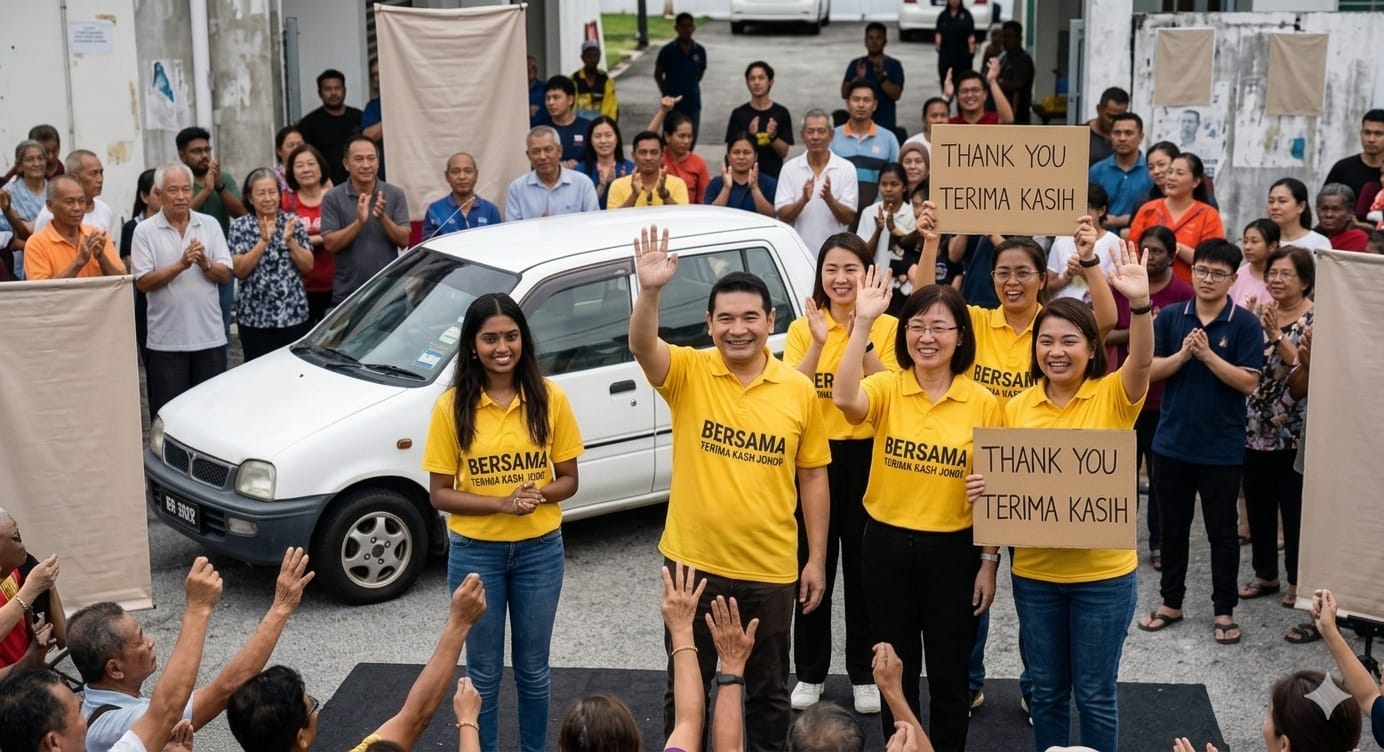
Johor was never just about winning or losing. It became a lesson in timing, symbolism, and the political cost of hesitation.
Politics has always rewarded courage, but history teaches us something even more profound: courage alone is never enough. Timing often determines whether an idea becomes a revolution or simply another chapter in political history. The crushing defeat of Parti Bersama Malaysia (Bersama) in the 2026 Johor state election, where all 15 candidates lost their deposits barely 52 days after the party's birth, has prompted many commentators to write Rafizi Ramli's political obituary. That would be a mistake. Johor should not be remembered merely as an electoral defeat, but as a lesson about leadership, symbolism, public trust, and the unforgiving nature of Malaysian politics.
The larger question is not why Bersama lost, but why a politician who once captivated an entire nation could not transfer that same energy to his new movement. That is the paradox worth examining.
The Rafizi Who Educated Malaysia
Before he became a minister, Rafizi Ramli became something much rarer in Malaysian politics an educator. At a time when political speeches were often filled with slogans and emotional rhetoric, Rafizi introduced something different by transforming complicated financial scandals, economic policies, and government contracts into language that ordinary Malaysians could understand.
His expose of the National Feedlot Corporation (NFC) scandal forever remembered through the phrase “cows in condos” was more than a political attack; it educated Malaysians on how public funds could be abused while ordinary citizens struggled with rising living costs. He consistently argued that corruption was not an abstract moral issue, but one that directly affected people's lives through stagnant wages, higher living costs, poorer public services, and shrinking opportunities. In doing so, he made governance personal, economics understandable, and accountability something people could relate to.
His economic presentations frequently challenged Malaysia's dependence on cheap labour, arguing that businesses could no longer compete by suppressing salaries. Instead, he advocated for productivity-driven wage growth, believing that a stronger economy required better-paid workers rather than permanently low labour costs. Even his political opponents often acknowledged his ability to debate with discipline and facts. Whether discussing economics or public policy, Rafizi rarely relied on emotional attacks. His exchanges with PAS leaders, including Bachok MP Mohd Syahir Che Sulaiman, demonstrated that political disagreement could remain professional, evidence-based, and intellectually rigorous. Many PAS supporters disagreed with his conclusions, yet still respected the clarity of his arguments.
At the peak of his influence, Rafizi did not merely attract supporters he elevated political discourse.
When Citizens Became the Campaign
Perhaps Rafizi's greatest political achievement was not winning elections, but inspiring participation. Thousands of ordinary Malaysians who had never held party positions voluntarily became ambassadors for change. Young people spent their evenings producing explainer videos, infographics, podcasts, short documentaries, and creative social media content to explain economic issues and expose corruption.
Some of these videos attracted millions of views, and many creators received no payment. They simply believed that Malaysia deserved better governance. This was never merely a PKR campaign; it became an organic citizen movement. People were not promoting personalities, but hope. That kind of political energy cannot be purchased it must be earned.
Why Couldn't Bersama Capture That Magic?
This is where Johor forces uncomfortable reflection. If Rafizi possessed such extraordinary communication skills, why did Bersama fail to ignite the same excitement? The easy answer is that the party was only fifty-two days old, and while that is true, it is incomplete.
Long before Bersama was officially launched, it was already evident that Rafizi's relationship with the government and PKR had deteriorated. His frustrations with internal decision-making, policy implementation, and political compromises had become increasingly visible. Many of the reforms he championed appeared to lose momentum inside government, and ideas that once inspired the public seemed trapped within bureaucratic walls and political calculations.
If a leader genuinely believes he can no longer fulfil the promises that brought him into office, an inevitable question follows: should he remain inside the system or walk away from it completely? That question brings us to what may have been Rafizi's greatest missed political opportunity.
The Passenger or the Missile?
Politics is often driven as much by symbolism as by policy. Imagine if the sequence had been different if, the very next day after resigning as Economy Minister, Rafizi had also resigned from PKR. Such a move would have sent a powerful message to voters and forced deeper reflection about the realities within the party and government.
If the ministry's work was meant to serve the people, and if he believed in those policies, why walk away so completely? And if he chose to do so, what would that reveal about the level of support he was receiving within the party? If the party that brought him into power could not support the reforms he was trying to implement, then what was the point of remaining inside? Would staying make him effective, or would it only make him a passenger in a system he no longer believed in?
Imagine him standing before the nation and declaring that if meaningful change could not be delivered from within, he would not pretend otherwise. Such a moment would not just be a resignation it would be a statement. It would force the public to think, encourage both supporters and critics to question what was happening behind the scenes, and educate voters about the realities of governance, where policies depend not only on ideas but also on political will, internal support, and institutional resistance.
Such a move would create a powerful narrative not just a man on a mission, but a man who becomes the missile. A leader willing to sacrifice position, party, and certainty to prove that principles are not negotiable. While this would not guarantee electoral victory, it would create impact, curiosity, and conversation often the first sparks of transformation. In politics, perception matters, sometimes even more than policy.
When Timing Dilutes Momentum
Instead, the transition unfolded gradually. The resignation from Cabinet came first, followed later by the separation from PKR, and then the formation of Bersama. As a result, the message became less explosive and more complicated. While supporters understood the sequence, many ordinary voters did not.
By the time Bersama entered the Johor election, it was asking voters to place their trust in a party that had existed for less than two months, competing against organisations that had spent decades building branches, local leaders, volunteers, and community relationships. No amount of brilliant speeches could compensate for organisational infancy, and no amount of social media engagement could replace years of grassroots work. The Johor electorate was not necessarily rejecting Rafizi; it was questioning whether Bersama was ready and those are two very different questions.
Malaysia's Hardest Currency
The Johor election revealed something deeper than the failure of a new political party it showed that trust has become Malaysia's rarest political currency. Malaysians once believed Reformasi would transform institutions, that accountability would become the norm, and that political culture would fundamentally change. While some progress occurred, many expectations remained unfulfilled.
This collective experience has reshaped voter psychology. Every new political movement now begins its journey carrying the weight of previous disappointments. This challenge is not unique to Bersama; it would confront any party promising a fresh start. Johor was therefore never simply a contest between parties it was a contest between hope and memory, and in this case, memory prevailed.
The Lonely Road to Political Renewal
History reminds us that DAP did not become a major political force overnight. Leaders such as Karpal Singh, Lim Kit Siang, and P. Patto endured detention under the ISA, Operasi Lalang, relentless political attacks, and decades of electoral struggle before the party became part of the federal government. Even today, DAP continues to face accusations of being a racist party despite consistently presenting itself as a multiracial party committed to constitutional democracy.
PKR's journey was equally difficult. Born out of Reformasi in 1998, it spent years fighting from the opposition before eventually reaching Putrajaya. No serious political movement in Malaysia has travelled a smooth road, and perhaps Bersama is only beginning that journey or perhaps Johor will remain its defining moment. Only time will answer that question.
One lesson, however, is already clear: winning a nation requires more than intelligence, integrity, and brilliant communication it requires impeccable timing. In politics, conviction earns respect and sacrifice earns credibility, but history remembers those who understand that even the most powerful missile can lose its impact if it is launched too late.
"Political history is rarely written by those who seek comfort. It is written by those willing to walk the lonely road, endure defeat, and keep moving until conviction finally meets its moment." - Annan Vaithegi
Annan Vaithegi (annanvaithegi@icloud.com) is a content creator under the Newswav Creator programme, where you get to express yourself, be a citizen journalist, and at the same time monetize your content & reach millions of users on Newswav. Log in to creator.newswav.com and become a Newswav Creator now!
The User Content (as defined on Newswav Terms of Use) above including the views expressed and media (pictures, videos, citations etc) were submitted & posted by the author. Newswav is solely an aggregation platform that hosts the User Content. If you have any questions about the content, copyright or other issues of the work, please contact creator@newswav.com.