
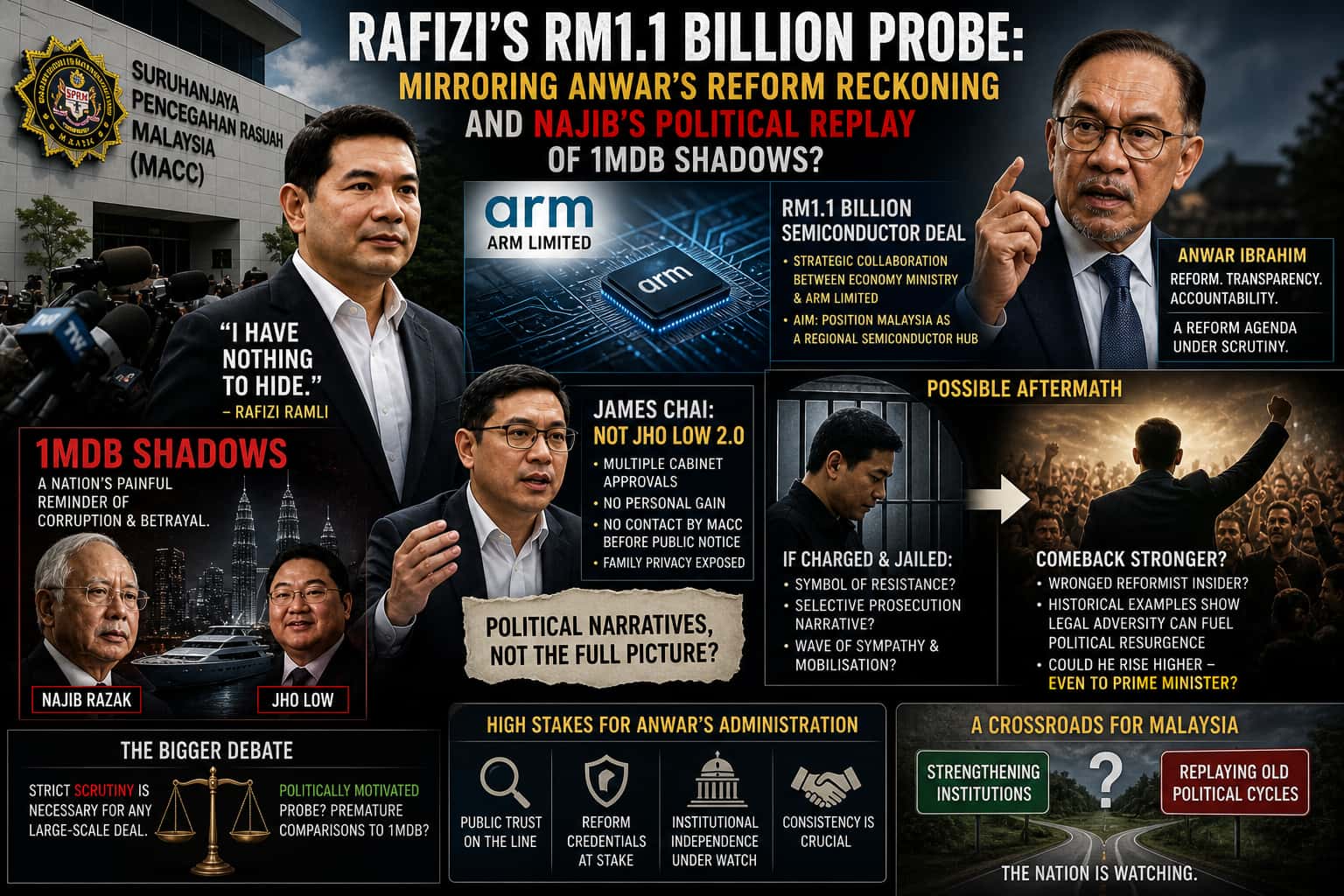
Malaysia’s reform narrative is once again under intense scrutiny as Dato' Seri Rafizi Ramli steps into the spotlight - this time not as a whistleblower or policy architect, but as the subject of a high-profile investigation.
His appearance at the Malaysian Anti-Corruption Commission (MACC) on May 4, 2026, over an alleged RM1.1 billion semiconductor-related deal has triggered a wider political debate: is this a genuine institutional accountability exercise, or the beginning of a politically charged storyline that echoes the country’s 1MDB-era controversies?
Rafizi arrived at the MACC headquarters in Putrajaya projecting calm confidence. He maintained that he had “nothing to hide” and opted to give his statement without legal counsel, signalling readiness to face any outcome, including possible prosecution. The gesture was widely interpreted as an attempt to reinforce transparency amid rising political temperature.
At the centre of the probe is a strategic collaboration involving Malaysia’s Economy Ministry and UK-based semiconductor giant ARM Limited. The agreement is designed to accelerate Malaysia’s ambition of becoming a regional semiconductor hub, granting access to advanced chip design technology while anchoring ARM’s regional presence in Southeast Asia.
However, the situation intensified after MACC chief commissioner Azam Baki confirmed that investigators are probing possible abuse of power and fraudulent elements linked to the semiconductor agreement announced in 2024.
Former aide James Chai has strongly rejected allegations of wrongdoing. He dismissed online comparisons branding him a “Jho Low 2.0,” referring to fugitive financier Jho Low, calling such claims misleading and politically charged. Chai insists the agreement underwent multiple layers of scrutiny, including Cabinet-level approvals following engagements involving Prime Minister Dato' Seri Anwar Ibrahim and ARM executives.
He further argues that the narrative surrounding the case has been distorted by speculation, including claims that he personally profited from the deal or stood to gain future corporate positions. Chai has also raised concerns over investigative handling, alleging that he was not directly contacted before MACC issued public notices seeking his whereabouts, and that personal details were exposed in the process.
The controversy has now expanded beyond governance questions into a broader debate about narrative framing, political perception, and institutional conduct.
On one side, critics argue that any large-scale government-linked agreement must withstand strict scrutiny, especially given Malaysia’s historical baggage with mega-scandals. On the other, supporters of Rafizi and the reformist bloc view the probe as potentially political motivated, warning against premature comparisons to the 1MDB scandal involving Najib Razak and Jho Low. Furthermore, Rafizi is not the main powerful actor calling the shots, unlike Najib, who was making bold decisions as the prime minister, finance minister, and 1MDB advisor.
The parallels may be politically tempting - but structurally, the cases remain fundamentally different at this stage. Unlike the opaque offshore financial architecture that defined 1MDB, the ARM collaboration appears to have proceeded through formal government channels, though questions remain over execution and oversight.
For the administration of Anwar Ibrahim, the stakes are significant. His government came to power on a platform of institutional reform, transparency, and accountability. Any perception of inconsistency - or political interference in enforcement agencies - risks weakening public trust in that reform agenda.
Yet perhaps the most politically sensitive dimension lies not in the technicalities of the deal, but in its possible aftermath.
If the investigation escalates into formal charges - and especially if it results in conviction - the political consequences could extend far beyond the courtroom. In Malaysia’s highly polarised environment, such an outcome could transform Rafizi from a reformist technocrat into a symbol of political persecution in the eyes of his supporters.
In such a highly polarised environment, incarceration could transform him from an embattled political figure into a symbol of resistance for his supporters. Within Malaysia’s reformist and urban voter base, perceptions of “selective prosecution” have historically been politically potent. If a significant portion of the public interprets the case as politically motivated rather than purely legal in nature, it could trigger a wave of sympathy and mobilisation.
Under that scenario, Rafizi could emerge from imprisonment with an even stronger political brand - including historical examples such as Anwar Ibrahim - have leveraged legal adversity into renewed public support. His narrative would likely shift from technocrat and policy reformer to that of a “wronged reformist insider,” which could energise grassroots networks within his supporters and beyond.
Within reform-oriented and urban voter segments, perceptions of selective prosecution have historically carried strong mobilisation power. If public sentiment aligns with that narrative, it could trigger sustained political support even in adversity - reshaping his standing within party dynamics over the long term.
However, such a trajectory is far from guaranteed. Whether legal trouble translates into political resurgence would depend on the strength of evidence, institutional credibility of the MACC process, and broader public confidence in the government’s anti-corruption drive.
In the most extreme interpretation, if public sentiment strongly aligns behind him, it could even reshape political dynamics and position him as a future prime minister. Equally, if the case is widely viewed as substantiated and legally sound, it could significantly weaken his political influence.
Ultimately, the RM1.1 billion probe sits at a delicate intersection of law, politics, and perception. It may either reinforce Malaysia’s reform credentials under Anwar Ibrahim - or deepen longstanding suspicions that high-profile corruption investigations remain inseparable from political contestation.
For now, the country watches closely as a familiar question resurfaces in a new form: is this the strengthening of institutions, or the repetition of old political cycles under a new narrative?
By: Kpost
Information Source:
Kpost (ckhorsk@gmail.com) is a content creator under the Newswav Creator programme, where you get to express yourself, be a citizen journalist, and at the same time monetize your content & reach millions of users on Newswav. Log in to creator.newswav.com and become a Newswav Creator now!
The User Content (as defined on Newswav Terms of Use) above including the views expressed and media (pictures, videos, citations etc) were submitted & posted by the author. Newswav is solely an aggregation platform that hosts the User Content. If you have any questions about the content, copyright or other issues of the work, please contact creator@newswav.com.