
For decades, political parties in Malaysia have treated parliamentary and state constituencies in Kuala Lumpur and Selangor like personal playgrounds. Every election follows the same insulting script: a major coalition handpicks a high-ranking bureaucrat or party loyalist, "parachutes" them into a local Klang Valley neighborhood, wins the seat on the back of empty promises, and immediately vanishes back into their elite, gated communities.
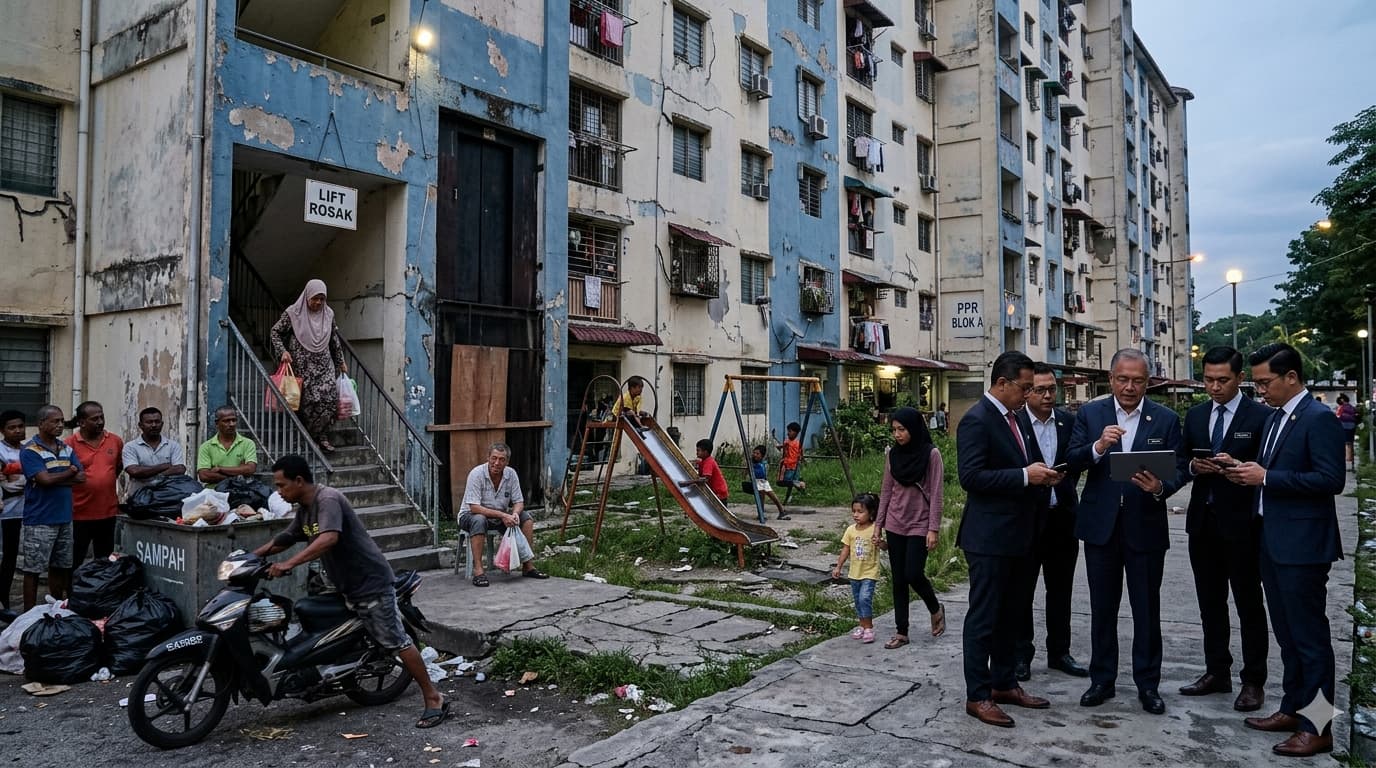
Once the campaign banners come down, the brutal reality of the working class remains completely untouched. Go to any PPR flat or dense lower-M40 housing block under the jurisdiction of Dewan Bandaraya Kuala Lumpur (DBKL) or the Majlis Bandaraya Petaling Jaya (MBPJ). The daily struggle is suffocating. Lifts are perpetually broken, effectively trapping elderly residents upstairs. Multi-storey car parks remain mythical campaign promises, forcing hardworking citizens to end exhausting 12-hour shifts by spending hours desperately fighting for unsafe, pitch-black, and technically illegal parking slots on the roadside. Where are the elected MPs and ADUNs when these daily crises unfold? They are busy playing high-level federal politics, entirely insulated from the ground.
This is precisely why Rafizi Ramli’s new political venture, Parti Bersama Malaysia (Bersama), stands at a critical historical crossroads.
Moving Beyond the "Reformasi" Illusion
The Klang Valley electorate is deeply, fundamentally exhausted. We were promised a glorious era of Reformasi and a fiercely clean government. Instead, the realities of coalition politics have left a bitter taste. We have watched in absolute dismay as major wrongdoings are swept under the carpet, neutralized by a convenient parade of DNAAs (Discharge Not Amounting to an Acquittal) and NFAs (No Further Action) just to keep a fragile political alliance alive. The mainstream establishment has compromised away its moral authority.
If Bersama wants to avoid being dismissed as just another elitist, app-driven "third force" for tech-savvy middle-class urbanites, it must smash the old political playbook. Right now, Bersama is utilizing an unconventional, open-application process to recruit candidates. But a flashy smartphone app will not fix a decaying flat or secure a parking lot. To truly capture the hearts of the B40 and lower-M40 communities, Rafizi must use this platform to recruit true local champions who actually live in the chaos.
The Selective Blindness of DBKL and MBPJ
A parachuted politician does not understand how local city councils systematically fail everyday citizens because they do not have to live with the consequences. Under the Street, Drainage and Building Act 1974 (Act 133), DBKL and MBPJ have a strict, statutory obligation to maintain public safety, clear obstructions, and ensure structural integrity. Yet, these mega-councils demonstrate a form of selective blindness: they will aggressively summon a desperate PPR resident for double-parking at midnight, but they look the other way when it comes to fixing the broken, dark streetlights and security failures that make those very parking zones a magnet for vehicle theft and vandalism.
Furthermore, when residents complain about broken lifts, crumbling stairwells, or hazardous structures, current MPs lazily hide behind the Strata Management Act 2013 (Act 757). They claim that because maintenance fees dry up, these disasters are a "private Joint Management Body (JMB) issue" that the government cannot touch. This is a coward's cop-out. A true local MP, chosen from the ground, would aggressively pressure the Ministry of Housing and Local Government (KPKT) to rewrite these laws. They would fight to ensure the federal government directly subsidizes heavy infrastructure safety upgrades for low-income high-rises, instead of leaving broke JMBs to manage structural decay.
We do not need more corporate CEOs, slick lawyers, or recycled career politicians who cannot empathize with a working-class lifestyle. We need local community leaders and resident association heads who have spent years fighting DBKL or MBPJ for basic human dignity.
From "Third Force" to the "Main Force"
Political analysts are already predicting that Bersama will merely act as a vote-splitter. But they are missing the bigger picture. If Bersama boldly hands the power back to the grassroots by fielding untainted, ground-level local candidates who belong to the constituency, public support will shift dramatically.
Malaysians are not looking for another savior or a "messiah" at the top. They are looking for direct accountability at the bottom. Because DBKL and Selangor councillors are politically appointed rather than elected by the residents, they answer to party bosses instead of the single mother living on the 14th floor of a broken PPR flat.
By becoming the only party that trusts ordinary, clean, and fresh local citizens to lead their own communities, Bersama will transcend the label of a minor "third force." They can trigger a genuine democratic awakening that positions them as Malaysia’s main political force. It is time to end the era of elite political tourism. If Bersama wants to reset the nation, it must start by giving the ground back to the people who walk on it every day.
A Direct Challenge to Rafizi Ramli
So here is a direct challenge to Rafizi Ramli: Step out of the comfortable, air-conditioned corporate halls of Petaling Jaya. Put down the smartphone app, step away from the PowerPoint slides, and stop preaching to the converted middle class.
If you truly want to prove that Bersama is a revolutionary movement for ordinary Malaysians, bring your next Yang Berhenti Malaysia (YBM) public forum directly into the trenches. Hold your next townhall at the open-air concrete blocks of PPR Lembah Subang, PPR Taman Medan, or PPR Desaria. Go sit with the working class in the decaying high-rises of Klang, or look at the infrastructure failures hiding just behind the administrative glitter of Putrajaya.
Come to these flats at midnight. Watch residents fight for parking spaces, navigate pitch-black stairwells, and carry groceries up fifteen flights of stairs because the lifts are out of service. There are only two lifts in the building: one is kept on standby for Bomba use, while the other breaks down so frequently that residents can never rely on it. Then look these hardworking citizens in the eye and tell them that Bersama's next election candidates will be chosen from among them from their corridors, their resident associations, and their community. Trust local people to fix their own communities, Rafizi, or admit that Bersama is just another political startup selling tech-driven promises while the grassroots it claims to represent are left struggling in the dark.
This is why Bersama's candidate selection process may ultimately matter more than any speech, podcast, or political rally.
If it fills its ranks with the same familiar elite figures, then it becomes merely another political vehicle.
But if it genuinely empowers respected local community leaders, resident association heads, social workers, and grassroots problem-solvers, it could begin changing how representation works in Malaysia.
The public is no longer looking for political messiahs or another app, platform, dashboard, manifesto, or carefully crafted slogan. They are looking for someone who will answer the phone when the lift breaks down, fix the streetlights before a tragedy happens, and take responsibility instead of passing blame. Malaysia does not suffer from a shortage of politicians; it suffers from a surplus of people seeking power and a shortage of people willing to serve. If Bersama truly wants to be different, it must stop recruiting stars who can win headlines and start empowering neighbours who have already earned trust. Because in the end, voters will not remember who gave the best speech, launched the smartest app, or dominated the latest podcast. They will remember who fixed the lift, cleaned the drains, made the neighbourhood safer, and showed up when nobody else did. Politics is not measured by promises made from a stage it is measured by whether ordinary people can live with dignity when the banners come down.
Annan Vaithegi writes sharp and thoughtful columns on Malaysian politics, power struggles, reform, and the voice of the rakyat.
Annan Vaithegi (annanvaithegi@icloud.com) is a content creator under the Newswav Creator programme, where you get to express yourself, be a citizen journalist, and at the same time monetize your content & reach millions of users on Newswav. Log in to creator.newswav.com and become a Newswav Creator now!
The User Content (as defined on Newswav Terms of Use) above including the views expressed and media (pictures, videos, citations etc) were submitted & posted by the author. Newswav is solely an aggregation platform that hosts the User Content. If you have any questions about the content, copyright or other issues of the work, please contact creator@newswav.com.