
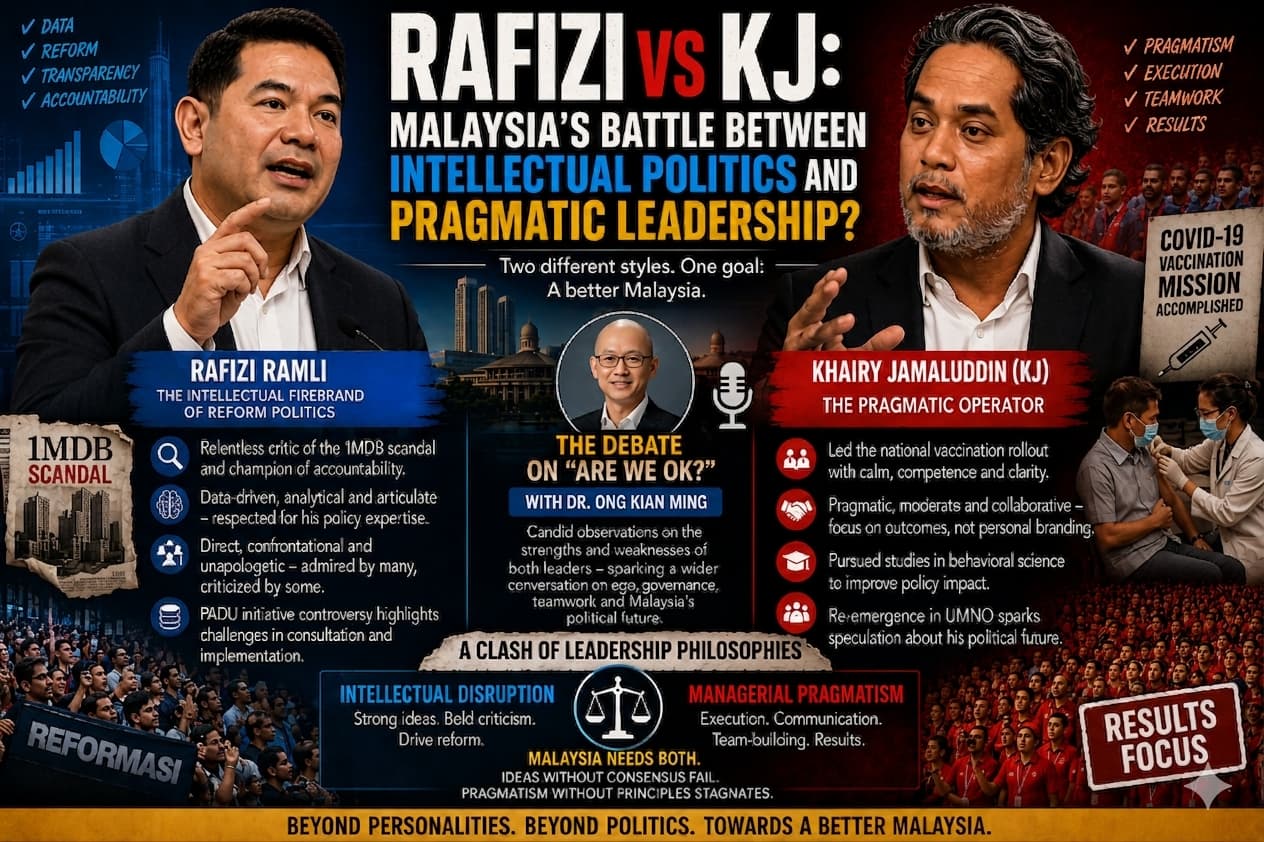
Malaysia’s political arena has never lacked larger-than-life personalities, but few figures spark as much debate as Dato' Seri Rafizi Ramli and Khairy Jamaluddin.
One is celebrated as a relentless political strategist and policy thinker, while the other is widely regarded as a pragmatic operator capable of delivering results on the ground. Their contrasting styles have increasingly become a reflection of the broader dilemma facing Malaysian politics today: should leadership revolve around intellectual dominance or collaborative execution?
The debate recently gained renewed attention through the podcast "Are We Ok?" hosted by Dr. Ong Kian Ming, where the former deputy minister shared candid observations on the strengths and weaknesses of both leaders. The discussion opened a wider conversation about ego, governance, teamwork, and the future direction of Malaysia’s political leadership.
Rafizi Ramli: The Intellectual Firebrand of Reform Politics
Few politicians in Malaysia can claim the kind of political impact Rafizi has had during his years in opposition. Together with Tony Pua, Rafizi became one of the loudest and most aggressive critics of the infamous 1MDB scandal, helping shape public perception against the former Barisan Nasional administration.
Rafizi built his image as a fearless technocrat - data-driven, articulate, and highly analytical. Supporters view him as a rare Malaysian politician willing to confront difficult truths, even when politically inconvenient. His speeches and policy presentations often project an image of mastery over economic and governance issues, making him particularly popular among urban and educated voters.
However, that same confidence has also generated criticism.
Within political circles, especially among some leaders from Democratic Action Party (DAP), Rafizi is sometimes perceived as someone who believes he is the smartest person in the room. While intellectual confidence can inspire supporters, critics argue it may also alienate allies and complicate coalition politics.
Malaysia’s coalition government relies heavily on compromise and consensus-building among parties with different ideologies. In such an environment, leadership requires not only intelligence but also humility and diplomacy. Some observers believe Rafizi’s direct and confrontational style occasionally undermines collaboration, particularly when criticisms appear aimed not only at the opposition but also at allies and leaders within the government, including Dato' Seri Anwar Ibrahim.
The controversy surrounding the PADU database initiative further highlighted these concerns. Although the initiative aimed to improve targeted subsidies and national data collection, critics questioned its implementation process, citing insufficient consultation and technical weaknesses. The episode reinforced perceptions that ambitious policy ideas alone are not enough without strong stakeholder engagement and institutional coordination.
Khairy Jamaluddin: The Pragmatic Operator?
In contrast, Khairy embodies a markedly different style of political leadership.
Often referred to simply as “KJ,” the podcast remarked that the former health minister has cultivated a reputation as a hardworking and adaptable leader capable of balancing elite policymaking with grassroots politics. His performance during the COVID-19 pandemic significantly boosted public perception, particularly during the national vaccination rollout, where many Malaysians viewed him as calm, competent, and results-oriented.
Unlike Rafizi’s often combative political style, Khairy tends to project pragmatism and moderation. He is frequently seen as someone willing to listen, engage experts, and work collectively toward outcomes rather than personal political branding.
Ong also noted that KJ’s willingness to continuously improve himself. His pursuit of studies in behavioral science during his political career reflected an interest in understanding how policy affects human behavior - an approach many considered practical rather than ideological.
His recent re-emergence within UMNO circles has reignited speculation over his long-term political future. Many younger and moderate voters still see him as one of the few leaders capable of modernizing the party’s image while appealing beyond traditional political bases.
A Clash of Leadership Philosophies
The contrast between Rafizi and Khairy ultimately reflects two competing visions of leadership in Malaysia.
Rafizi symbolizes intellectual disruption - a leader who believes strong ideas and bold criticism can drive reform. Khairy, meanwhile, represents managerial pragmatism - focusing on execution, communication, team-building, and results-driven leadership
Neither approach is inherently perfect.
Malaysia’s political history shows that brilliant ideas without political consensus often fail, while excessive pragmatism without strong principles can lead to stagnation. The challenge for the country lies in finding leaders capable of combining both qualities: intellectual rigor and emotional intelligence, policy ambition and political inclusiveness.
As Malaysia continues navigating economic uncertainty, racial sensitivities, institutional reforms, and global competition, the country’s next generation of leaders will likely be judged not only by how smart they are, but also by how effectively they can unite people behind a shared national vision.
The Rafizi-Khairy comparison is therefore more than just a personality contest. It is a reflection of Malaysia’s ongoing search for leadership that can move beyond political theatrics and deliver meaningful progress for the nation.
By: Kpost
Information Source:
Kpost (ckhorsk@gmail.com) is a content creator under the Newswav Creator programme, where you get to express yourself, be a citizen journalist, and at the same time monetize your content & reach millions of users on Newswav. Log in to creator.newswav.com and become a Newswav Creator now!
The User Content (as defined on Newswav Terms of Use) above including the views expressed and media (pictures, videos, citations etc) were submitted & posted by the author. Newswav is solely an aggregation platform that hosts the User Content. If you have any questions about the content, copyright or other issues of the work, please contact creator@newswav.com.

