
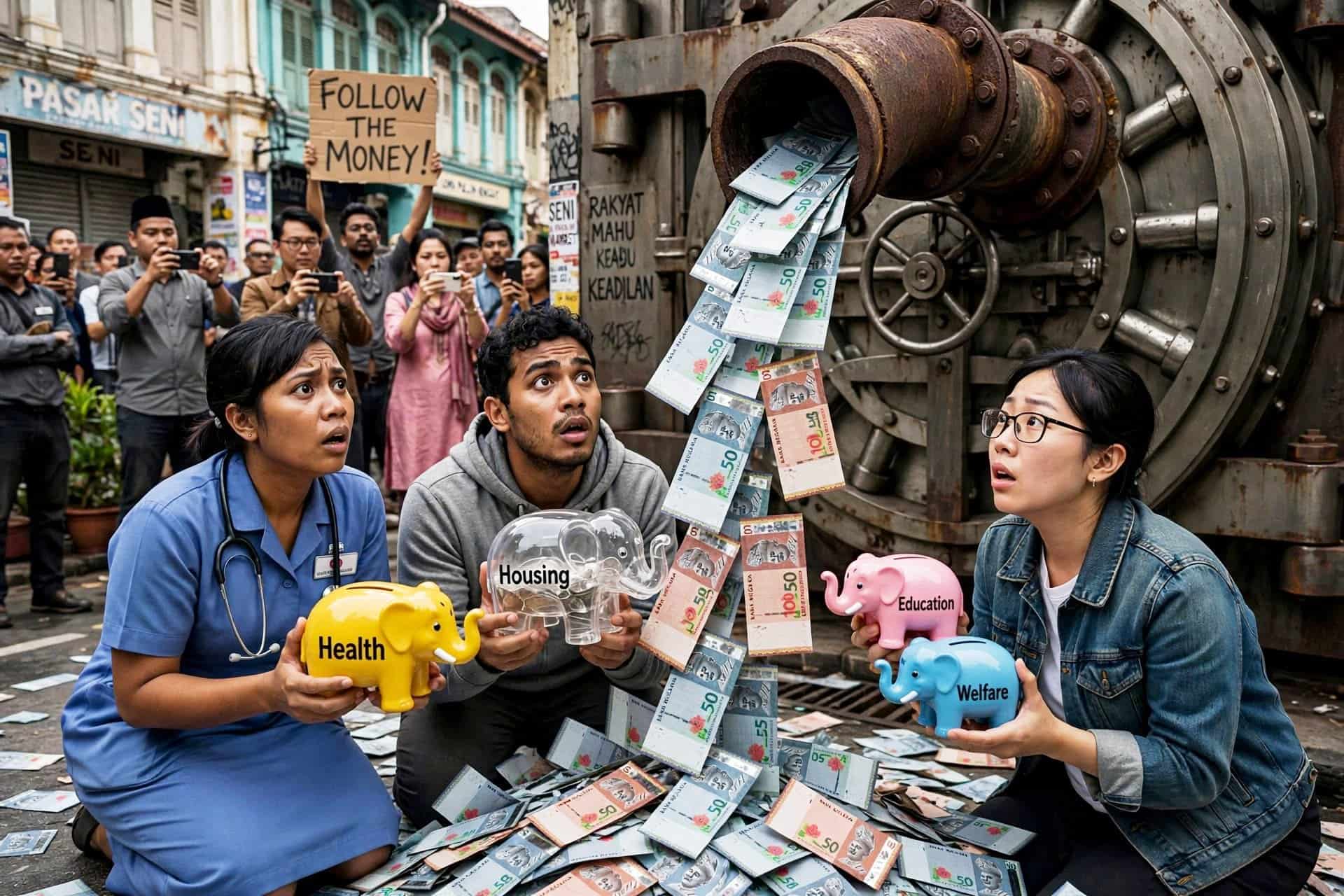
If you have ever lost your wallet and blamed it on the sofa, congratulations. You are now qualified to run a Government-Linked Company in Malaysia.
This week, Dr. Lim Teck Ghee, economic historian, former UN regional adviser, and one of the few people in this country who still does math in public, looked at Budget 2027 and said something so radical it almost sounded rude.
He said: cut 10% of the operating budgets of GLCs and statutory bodies. Take the savings. Put it into healthcare, housing, and social welfare.
That’s it. That was the radical idea. Take money from places that lose it, and give it to places that need it. In Malaysia, this counts as revolutionary thinking.
Let’s set the stage. Budget 2027, announced on Oct 9, has a federal operating expenditure of RM376.84 billion. That’s up 3.8% from RM363.06 billion last year. We are spending more to run the same house, and the roof is still leaking.
And boy, does it leak. Dr. Lim estimates that abuses, leakages and mismanagement in public procurement cost this country between RM40 billion and RM60 billion annually. Read that again slowly. RM40 to 60 billion. Every year. Gone.
Procurement is about 40% of government spending, upwards of RM150 billion a year. It is, in Dr. Lim’s words, the sector most heavily hit by systemic financial loss and corrupt practices. Which is a very polite, UN way of saying this is where the buffet is.
RM60 billion is not a rounding error. RM60 billion could build you a whole new public hospital system, fix every PPR flat in the Klang Valley, and still have enough left to give every Malaysian a decent MySalam card that actually works. Instead, we use it to buy traffic cones at RM200 each and hold three-day retreats in Langkawi to discuss integrity.
And then there are the stars of our show. The GLCs. The 500+ sub-entities. Five hundred.
Nobody actually knows all 500 names. There is no official scroll. It’s like Pokemon, but all the Pokemon are property arms and catering subsidiaries you never knew existed. We have seven parents — Khazanah, PNB, EPF, KWAP, MOF Inc, LTAT, Tabung Haji — and they have children, and those children have children. By the time you get to the bottom, you have a company that manages the parking lot of a building owned by a hotel owned by a plantation owned by a fund that was supposed to protect the army’s retirement.
Dr. Lim’s point was simple: there are overlapping functions. Which is academic speak for “why do we have 17 companies doing the same thing badly?” Streamline them, he said. Improve transparency. Reduce hidden subsidies and bailouts for underperforming state-linked corporations.
Hidden subsidies and bailouts. Now that’s a phrase that should be on our tourism brochures.
Let me give you the Hall of Fame. Ranked by losses, biggest at the top, because we Malaysians love a ranking.
At number one, the undisputed heavyweight champion of disappearing money: 1MDB. Officially a Ministry of Finance company. US$4.2 billion in debt, misuse and theft. That’s roughly RM18 billion at today’s exchange rate. It is the only GLC that managed to lose money in Hollywood, in yachts, and in the US Department of Justice simultaneously. It turned the phrase “Government-Linked Company” into “Government Losing Concern” and meant it literally.
Number two: Tabung Haji. The pilgrims’ fund. The institution that is supposed to take good Muslims to Mecca in a financially prudent way. How did it do? It incurred losses every year from 2014 to 2017 while happily declaring hibah — dividends — to make it look profitable. The hole got so big the government had to issue RM10.2 billion in sukuk through a rescue vehicle called Urusharta Jamaah, plus another RM2.6 billion in impairments that TH had to swallow itself. Total damage: around RM13 billion.
Number three: Sapura Energy. The pride of PNB, the oil and gas giant that was supposed to make us an oil services superpower. Debts: RM10 billion owed to local banks. Maybank, which PNB owns half of, is exposed. EPF is exposed. Ten thousand jobs at risk. The market calls it PN17. The rest of us call it “another one”.
Number four: FELDA. The land scheme for the rural poor that became a vehicle for the urban rich. Accumulated losses: RM6.2 billion. Socialised, of course. When GLCs win, the board gets bonuses. When they lose, you and I get to pay.
Number five: Malaysia Airlines. Oh, MAS. My old friend. The airline that has been restructured more times than a nasi lemak recipe. Last profit: RM237 million in 2010. Then RM2.52 billion loss in 2011 — the largest in its history. RM433 million losses in 2012. RM1.17 billion loss in 2013. Then MH370 and MH17 happened, and we all felt the national grief, and the airline lost another RM443 million in just one quarter. Khazanah, which owns 70%, privatized it in 2014 for about US$430 million to buy out minorities, and analysts at the time said it was losing RM1 million a day, and would continue to lose RM1 billion a year. It is still flying. We still love it. It still loses money. It is a relationship.
Number six and seven: Boustead Holdings and Proton. Boustead, under LTAT — the armed forces fund with billions in impairments. Proton, after decades of protection and billions in losses, had to sell 49.9% to China’s Geely to stay alive. We now buy back our national car with a Chinese engine and pretend it’s still national.
Add it all up and you get the cumulative bailout figure whispered in East Asia Forum papers: up to RM85 billion over the years. RM85 billion. You could fund the entire health budget for three years with that.
And this is why Dr. Lim’s 10% cut sounds so offensive to some people. Because what he is really saying is: “What’s clear is that some of these foundations have long needed overhauling, if not replacement.” That’s a direct quote. He also said the Finance Ministry emphasized continuity with foundations laid by previous budgets. Translation: we are building a new floor on a house whose foundation is already infested with termites, and we call it Madani.
He also touched on personal income tax. He said we have a moderately progressive structure on paper, but its ability to reduce wealth inequality is weaker than many regional peers. On paper, we are progressive. In practice, the guy who owns three GLC vendor companies pays less effective tax than the nurse in HKL.
So what’s the fix? Dr. Lim is not asking for a revolution. He is asking for a haircut. Ten percent. Take 10% from the 500-headed hydra that can’t decide if it’s a hotel group, a palm oil company, or a parking operator. Put it into hospitals where people wait six months for a knee scan. Put it into housing where young couples earning RM5k can’t afford a 700 sq ft box in Cheras. Put it into social welfare before we have to start a Tabung for everything.
It’s not complicated. But in Malaysia, simple things are complicated because complicated things make money for simple people.
If we save even half of that RM40-60 billion leakage, that’s RM20-30 billion. That’s more than the entire proposed GLC cut. That’s free money we are currently gifting to the procurement ecosystem — the consultants, the middlemen, the Ali-Baba, the “my cousin can supply” gang.
So here’s my tongue-in-cheek proposal: let’s make the procurement system a GLC too. List it. Call it Perolehan Nasional Berhad. Then we can bail it out next year and act surprised all over again.
Or, we can do what Dr. Lim suggests. Cut 10%. Streamline the 500. Stop pretending every statutory body needs a subsidiary that needs a sub-subsidiary. Prove that reform is not just a word we put in budget speeches because it tests well in focus groups.
Because at RM376.84 billion a year just to operate, we cannot afford to keep losing RM60 billion in the sofa.
We checked. The wallet is not there.
ENDS
By
Sam Trailerman
Nganasegaran (tapessam@gmail.com) is a content creator under the Newswav Creator programme, where you get to express yourself, be a citizen journalist, and at the same time monetize your content & reach millions of users on Newswav. Log in to creator.newswav.com and become a Newswav Creator now!
The User Content (as defined on Newswav Terms of Use) above including the views expressed and media (pictures, videos, citations etc) were submitted & posted by the author. Newswav is solely an aggregation platform that hosts the User Content. If you have any questions about the content, copyright or other issues of the work, please contact creator@newswav.com.