.jpg)
Mihar Dias February 2026
There is something almost laughable and tragic about the idea of roti canai — flaky, humble, golden with a hint of char — being suddenly promoted into Malaysia’s latest social class battlefield. For decades it has been the great unifier: breakfast of the rich, supper of the poor, emergency food of students before exams and comfort food of politicians pretending to be “close to the rakyat”.
Then along comes one visiting philosopher of cuisine who apparently looked at a plate of roti canai and saw… caste. https://newswav.com/A2602_yXZLq8?s=A_hlj9jlx&language=en
According to the viral account, roti canai is now officially “low caste food”, once eaten by slaves, made from cheap flour, and therefore unworthy of refined human consumption. Thosai, meanwhile, has apparently been upgraded into aristocratic cuisine. https://newswav.com/A2602_yXZLq8?s=A_hlj9jlx&language=en
One can almost hear Marie Antoinette whispering from Versailles:
“If they have no brioche, let them eat thosai.”
History has always had a strange habit of elites attaching social status to what people eat. In 18th century France, the aristocracy dined on elaborate pastries while peasants struggled for bread — until hunger eventually decided that guillotines were more filling than cake.
In Victorian England, white bread was for the rich, brown bread for the poor. Today, ironically, whole grain bread is sold at triple the price and marketed as “artisan”. The poor always seem to eat what the rich will only appreciate a century later.
Now, in modern Malaysia — a country that proudly mixes nasi lemak with cappuccino foam art — we are being invited to import an ancient caste system and sprinkle it generously over our breakfast plates.
Roti canai for slaves.
Thosai for nobles.
Penang laksa presumably for confused diners who don’t want to be judged.
What’s next?
Teh tarik as “working class beverage”?
Kopi O as “peasant brew”?
Avocado toast as “food of the enlightened elite”?
The backlash online was swift and deliciously Malaysian.
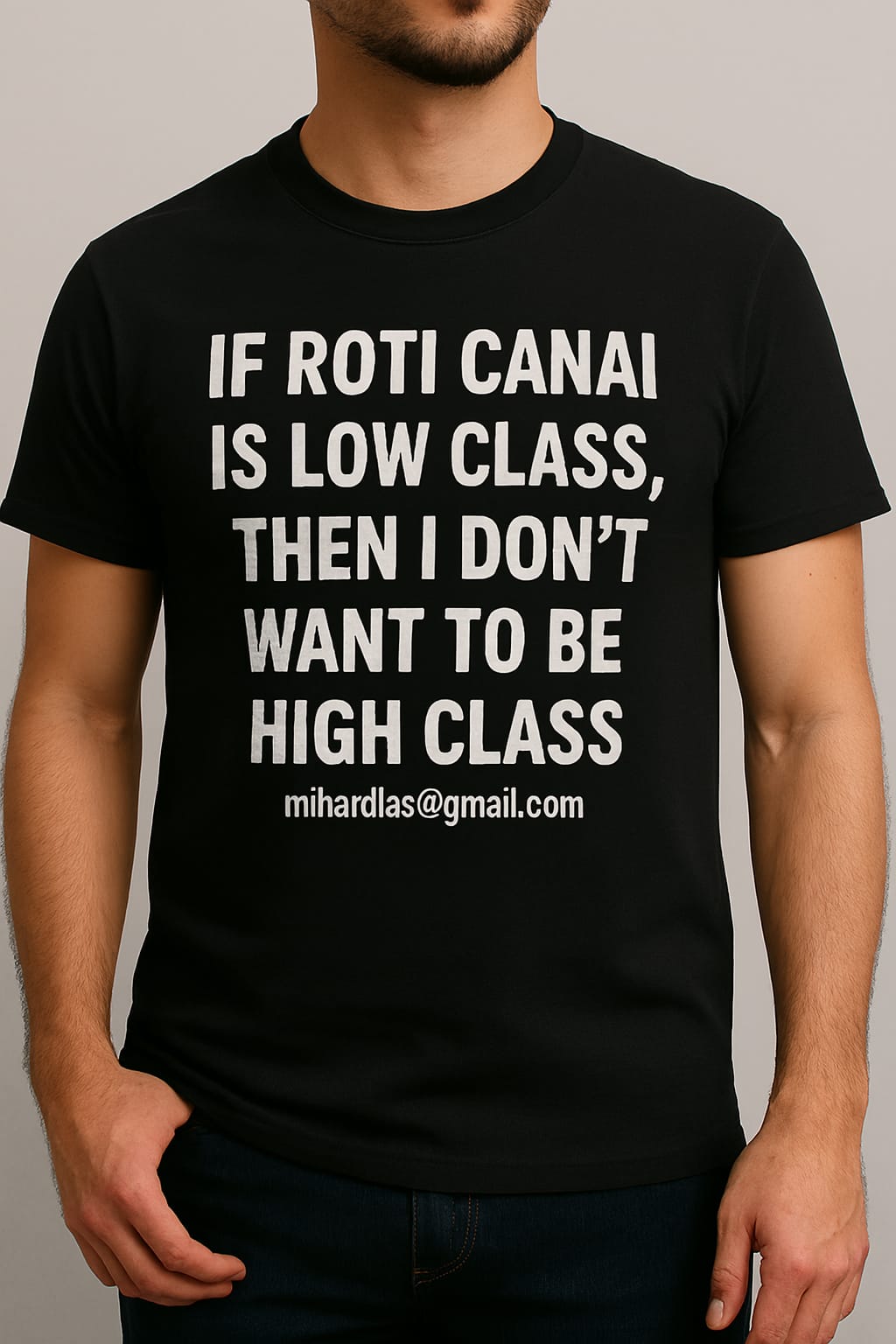
“If roti canai is low class, then I don’t want to be high class.” https://newswav.com/A2602_yXZLq8?s=A_hlj9jlx&language=en
That line alone deserves to be printed on a T-shirt, perhaps sold next to the mamak stall.
Many Malaysians rightly pointed out that caste discrimination is like an old virus — ugly, divisive and best kept quarantined. Our society, imperfect as it is, has generally agreed on one sacred principle: food belongs to everyone.
In Malaysia, the only hierarchy that exists around roti canai is:
Plain < telur < cheese < banjir.
And even that can start arguments.
What makes this episode both funny and worrying is how easily some people still cling to outdated social ladders. If food made from flour is “low quality”, then most of human civilisation owes an apology to bread, noodles, pizza, croissants and probably half of Europe.
More importantly, roti canai is not a symbol of poverty — it is a symbol of shared culture. It came from Indian Muslim influences, was embraced by Malays, Chinese, foreigners, tourists and anyone with functioning taste buds.
It is eaten by CEOs in suits and labourers in flip-flops, sometimes at the same plastic table.
That is Malaysia in edible form.
Trying to assign caste to it is like trying to rank rain — everyone gets wet eventually.
The sad irony is that while some societies spent centuries trying to break free from rigid class systems, others still carry it proudly like an heirloom teapot — chipped, outdated and never useful.
Marie Antoinette didn’t actually say “let them eat cake” (historians argue about that), but the phrase survived because it captured something real: the dangerous disconnect between elitism and ordinary life.
Today, we don’t storm palaces over pastries.
We storm comment sections.
But the message remains the same: when you look down on what ordinary people eat, you are not showing sophistication — you are advertising ignorance.
So to anyone tempted to rank Malaysians by their breakfast choices, here’s a local proverb update:
“Tell me what you eat, and I’ll tell you if you’re hungry.”
Not your caste.
Not your class.
Just hungry.
And in this country, when hunger strikes, roti canai answers.
Low caste?
No.
High satisfaction.
And that, thankfully, is still equal opportunity.
Mihar Dias (mihardias@gmail.com) is a content creator under the Newswav Creator programme, where you get to express yourself, be a citizen journalist, and at the same time monetize your content & reach millions of users on Newswav. Log in to creator.newswav.com and become a Newswav Creator now!
The User Content (as defined on Newswav Terms of Use) above including the views expressed and media (pictures, videos, citations etc) were submitted & posted by the author. Newswav is solely an aggregation platform that hosts the User Content. If you have any questions about the content, copyright or other issues of the work, please contact creator@newswav.com.