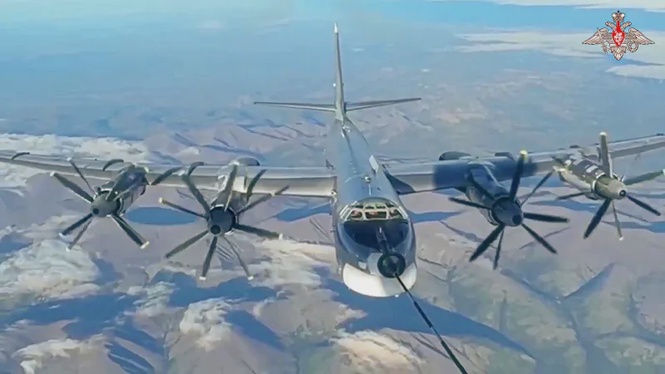
Two Russian bombers that flew through the narrow gap between Taiwan and Japan's Yonaguni Island on November 17 were most likely acting in support of China, and may even have been flying in concert with Chinese bombers, rather than carrying out a purely Russian mission. The flight came while Chinese warships were still returning from a large exercise in the Western Pacific, and two days before the leaders of the United States, China and Russia met in Shenzhen during the Asia-Pacific Economic Cooperation (APEC) summit.
Read together, the bomber flight and the naval drills before it say a good deal about how Beijing applies pressure around Taiwan, and about how often that pressure is misread.
Russian Bombers Threaded The Gap Between Taiwan And Yonaguni
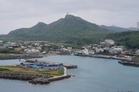
Shortly after 4 a.m. on November 17, the two Russian bombers entered Japanese airspace near Fukuoka Prefecture in southwestern Japan, one after the other, and Japan's Air Self-Defense Force scrambled fighter jets. The bombers then turned south and deliberately crossed the airspace between Taiwan's main island and Yonaguni, Japan's westernmost inhabited island, before flying on toward Vietnam.
While inside Taiwan's air defense identification zone east of the island, the bombers kept a steady distance from Taiwan's territorial airspace. Because the flight came one day before the APEC leaders' meeting opened and two days before the three leaders met, it set off a wave of speculation abroad.
Moscow Lined Up With Beijing Against Japan
The route is the clearest clue. After leaving Japanese airspace, the bombers could have flown south along many paths. Choosing to pass between Yonaguni and Taiwan was most likely meant as a show of support for Beijing, whose relations with Tokyo have grown steadily more tense.
A series of Japanese moves has angered China. Tokyo and Manila announced that they would negotiate a boundary for the exclusive economic zone (EEZ) waters east of Taiwan, and Japan has deepened its strategic cooperation with the Philippines. In late October, Japan and the United States staged Keen Sword 27, a large joint exercise that covered areas including Yonaguni and was plainly designed with China as the notional enemy. Beijing has already answered with several rounds of military displays in the seas and skies around the Senkaku Islands, which Taiwan calls Diaoyutai and China calls Diaoyu, as well as around Okinawa's main island and Yonaguni.
Chinese Drones And Bombers Were Southeast Of Taiwan Too
The Russians were not alone in that corner of the sky. Starting on November 16, one or two Chinese military drones circled through the night in the airspace southeast of Taiwan and stayed until around noon on November 17. More notably, Chinese bombers entered the same airspace shortly after 6 a.m. on November 17, at a time and place that may have overlapped with the Russian bombers' passage.
If the Chinese and Russian bombers did meet up southeast of Taiwan, the operation was not a unilateral Russian move but a joint Chinese and Russian show of force. It may even have been the first time bombers from the two countries have operated together in the airspace east of Taiwan since they began their joint strategic air patrols.
Joint China Russia Bomber Patrols Have Become Routine
China and Russia flew their first joint strategic air patrol with bombers on July 23, 2019. The patrols have since become a regular fixture, usually held twice a year, and their range has stretched from the Sea of Japan, the East China Sea and the Bering Sea into the Western Pacific.
The most recent precedent is telling. In late May, Japan and the Philippines announced talks to delimit the EEZ waters east of Taiwan, drawing a sharp protest from Beijing and several Chinese shows of force near Okinawa and Yonaguni. On June 27, during their 11th joint strategic air patrol, China and Russia each sent two bombers, which met over the East China Sea. Escorted by two Russian Tu-142 patrol aircraft and four Chinese J-16 fighters, they flew through the Miyako Strait into the Pacific for a long-range joint flight before turning back. The whole design strongly suggested that Moscow supports Beijing's claim to jurisdiction over the EEZ waters east of Taiwan and is prepared to join it in pressuring Tokyo.
If Chinese and Russian bombers did operate together southeast of Taiwan on the morning of November 17, the aim was most likely twofold, ahead of the three-way leaders' meeting on the afternoon of November 19. The first was to pressure Japan jointly by patrolling the sensitive airspace southeast of Taiwan and south of Yonaguni. The second was to show that China and Russia will keep up close strategic cooperation on Western Pacific security, strengthening both Beijing's and Moscow's hands in the talks.
A Hundred Chinese Ships At Sea Is China's Normal
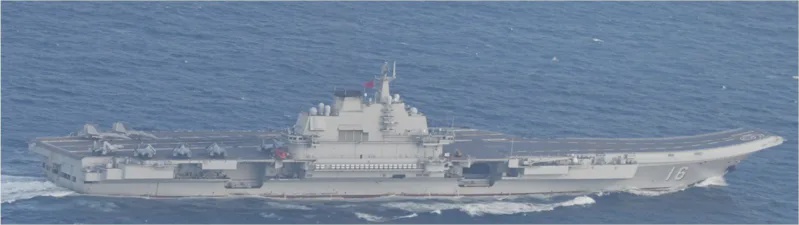
The bomber flight capped weeks of attention on China's navy. On November 3, Joseph Wu, secretary-general of Taiwan's National Security Council, released a chart showing that the Chinese navy and coast guard had deployed more than 100 vessels across the Western Pacific. Near the Philippine Sea, formations from all three of the Chinese navy's main fleets, the East Sea, South Sea and North Sea fleets, joined the Liaoning carrier strike group. China's third aircraft carrier, the Fujian, was spotted leaving the Sanya naval base on Hainan Island and sailing east on November 2. Late on November 12, Wu said the number of ships had fallen, but the fleet formations and the Liaoning group were still operating east of the Philippines.
Some foreign scholars and think tanks pointed out that Beijing has usually announced and named its large drills around Taiwan, and read this unusually quiet operation as an attempt to normalize the threat that Taiwan can be isolated at any time. Some foreign media, citing intelligence analysts, said that leaving drills unnamed and unannounced lets Beijing keep up military pressure while softening the diplomatic backlash.
Both readings, the "more than 100 ships" and the "unnamed drill," rest on misunderstandings.
China's navy operates roughly 300 to 400 vessels, counting combat, logistics and auxiliary ships, and its coast guard has another 150 to 200 ships of more than 1,000 tons, for a combined total of about 450 to 600. In peacetime, naval forces broadly follow a "rule of thirds": a third in port for maintenance, a third in training and a third deployed on duty. By that measure, about 100 Chinese navy and coast guard ships deployed at any one time across the Bohai Sea, the Yellow Sea, the East China Sea, the Taiwan Strait, the South China Sea and the Western Pacific is normal and calls for no overreaction. Tsai Ming-yen, director-general of Taiwan's National Security Bureau, said on July 6 that Chinese navy and coast guard deployments in the East China Sea, the Taiwan Strait and the South China Sea have always numbered about 100 ships. What matters is whether those ships are doing anything out of the ordinary, such as the large exercise in early November.
That exercise fits the People's Liberation Army's (PLA) yearly training cycle. In recent years, the fourth quarter, especially November and December, has become the peak season for large naval concentrations and far-seas training, sometimes with coordination across theater commands. This year's early November exercise matches that cycle and can be judged a planned annual drill. Planning and preparation for such large, cross-theater annual exercises begin toward the end of the previous year. In motive and in nature, it differs considerably from Joint Sword and Justice Mission, the large, unscheduled exercises aimed squarely at Taiwan.
Unnamed Does Not Mean Unusual
The second misunderstanding is that these drills have no name. The PLA still assigns code names internally to its planned annual exercises. They are not "unnamed drills"; Chinese media simply do not report on them.
Unlike Taiwan's annual Han Kuang exercise, which is partly open to the press, large planned PLA exercises are normally reported late or not at all by Chinese state media. That is especially true of drills with a high level of combat realism. Chinese outlets usually stay silent while such an exercise is under way, and only after some time has passed do they selectively reveal parts of it in feature stories, rarely in full.
Justice Mission and Joint Sword are different. They do include many combat scenarios tied to an attack on Taiwan, but their basic motive is political: to register Beijing's anger at a development it strongly objects to and to deter anything similar. To win enough attention abroad, and above all in Taiwan, and so magnify their propaganda and psychological effect, these drills deliberately stage scenes that would be unlikely in the opening phase of a real war. Warships and coast guard vessels are spread around Taiwan and pushed up to the edge of its contiguous zone, and coast guard ships carry out "law enforcement patrols" around the island to support Beijing's legal warfare. As a result, these well-known exercises are less realistic than many people assume.
Because their purpose is political messaging, the "named" drills that people in Taiwan and abroad remember are quickly followed by a flood of prepared images and videos from Chinese official channels, along with harshly worded statements condemning Taiwan or other actors. In the PLA's realistic combat training, that kind of publicity is the exception, not the norm.
China Has Rehearsed Pacific Combat Before
Nor was this the first time all three Chinese fleets had exercised in force in the Western Pacific. In early to mid December 2014, about 18 warships from the three fleets broke through the first island chain via the Miyako and Osumi straits to stage the Maneuver-6 exercise in waters west of Japan's Okinotori atoll, close to the second island chain. On December 11 that year, the PLA also sent strike groups including H-6G bombers through the Miyako Strait three times to join the surface fleet in an air and sea exercise that included realistic red-versus-blue combat drills.
In December 2024, the PLA mobilized its Eastern, Northern and Southern theater commands, sending about 60 warships and about 30 coast guard vessels across the East China Sea, the Taiwan Strait, the South China Sea and the Western Pacific. About nine of them broke through the first island chain and simulated counter-intervention operations in the Western Pacific east of Taiwan.
On July 6 this year, China deployed more than 110 warships and coast guard vessels along the first island chain and in the Western Pacific. Four Chinese naval formations were in the Western Pacific: one in the South Pacific, two south of Japan's Amami Oshima island and one east of the Philippines.
Three Days Of Drills Rehearsed Pacific Combat And A Blockade
Based on available information, the early November exercise most likely unfolded as follows.
- On November 2, the Chinese air force sent a "system-of-systems strike group" of at least 36 sorties of various aircraft through the Bashi Channel south of Taiwan into the Western Pacific. Long-range drones that had crossed the first island chain via the Miyako Strait helped search for targets, and the aircraft held air and sea confrontation drills with the PLA fleet and the Liaoning carrier group in waters northeast of the Philippines.
- On November 3, a second strike group of at least 22 sorties either practiced attacking a notional Taiwanese fleet in waters south of Miyako, or rehearsed a joint air and sea breakthrough of the Bashi Channel to reinforce the fleet already deployed in the Western Pacific. It may also have continued confrontation drills with the fleet and the Liaoning group.
- On November 4, Chinese naval and air forces carried out a "joint combat readiness patrol" in the Taiwan Strait and around Taiwan, simulating continued strikes on targets in western Taiwan under the cover of counter-intervention operations by the fleet and carrier group northeast of the Philippines.
Overall, at the exercise's peak from November 2 to 4, Chinese naval and air forces rehearsed large-scale "joint counter-strike operations" in the Western Pacific, what Taiwan and Western militaries call anti-access and area denial, while also practicing "joint blockade operations" and "joint firepower strike operations" around Taiwan.
The headcount of ships and the missing name, in other words, were the wrong things to watch. What deserves attention is what Chinese forces actually rehearsed east of Taiwan, and whether Moscow is now willing to fly alongside them there.
*Chieh Chung is an associate research fellow in the Division of Defense Strategy and Resources at the Institute for National Defense and Security Research (INDSR). The views expressed are the author's own.
You've read it. Now join the conversation — follow us on X, Facebook and IG. Editor: Penny Wang