
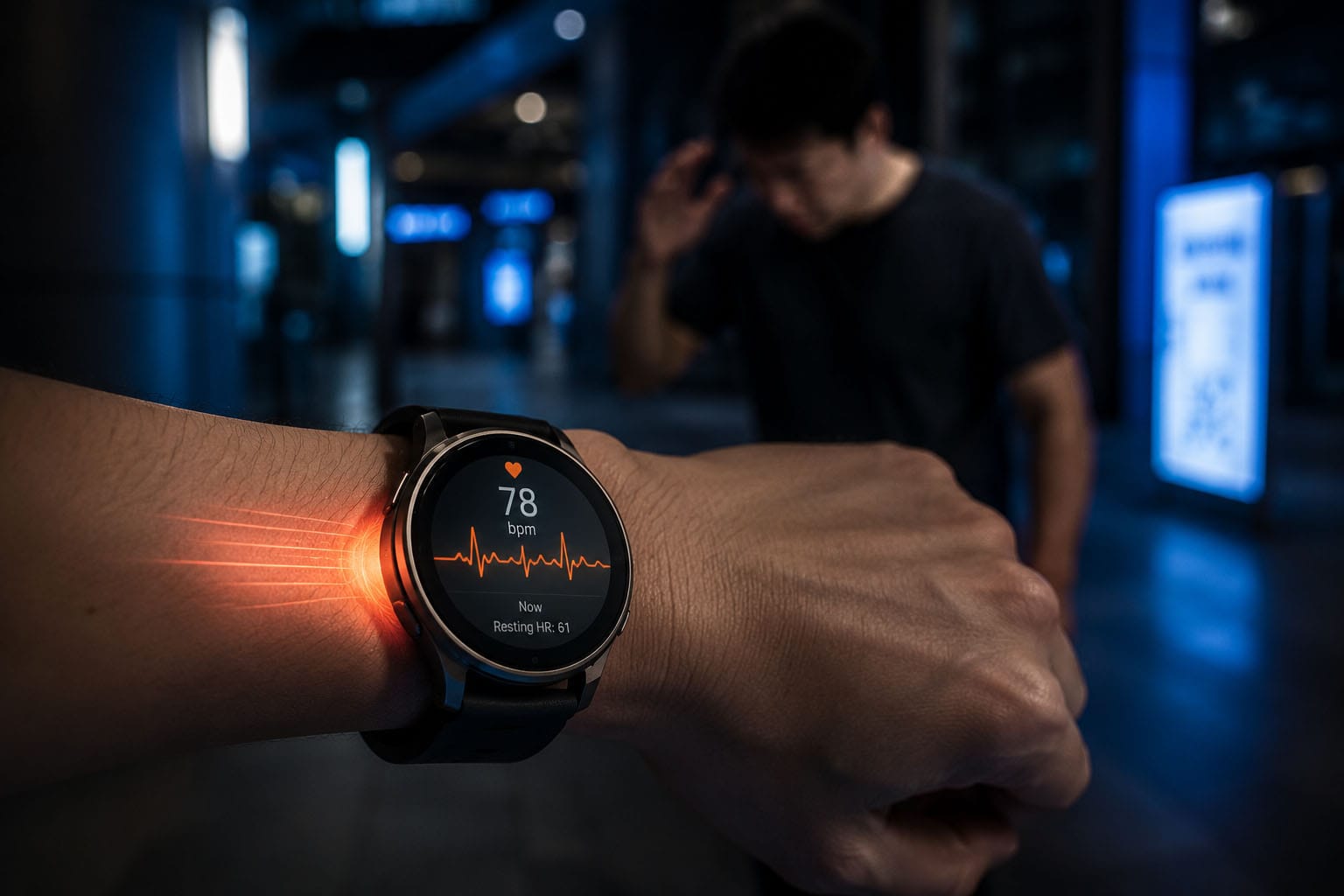
Samsung's Galaxy Watch can now predict that you're about to faint up to five minutes in advance, which means your wrist knew before you did, and that is either incredibly reassuring or mildly unsettling depending on your relationship with technology.
Samsung just announced that the Galaxy Watch6 can predict fainting episodes up to five minutes before they happen, and honestly, that's the kind of news that deserves a double take.
So, What Even Is Vasovagal Syncope?
Let's start with the medical term nobody asked for but everyone needs to know: vasovagal syncope. It is the fancy name for the most common type of fainting. You know that moment when someone suddenly goes pale, their knees buckle, and they hit the floor? That is vasovagal syncope in action.
It happens when your heart rate and blood pressure drop abruptly, usually triggered by stress, heat, standing too long, or even just the sight of blood. The fainting itself is usually harmless. The problem is what happens next: the fall. A sudden collapse can mean a fractured wrist, a cracked skull, or a very awkward scene in the middle of a packed LRT during rush hour.
And here is the stat that should get your attention: up to 40% of people experience at least one vasovagal fainting episode in their lifetime, and a third of those people will have it happen again. That is not a rare condition. That is basically almost half the population at some point in their lives.
How Does the Galaxy Watch Actually Predict It?
This is where it gets genuinely impressive. Samsung, working together with Chung-Ang University Gwangmyeong Hospital in Korea, ran a clinical study on 132 patients who were known to have vasovagal syncope symptoms. They used the Galaxy Watch6, specifically its PPG sensor (that is the photoplethysmography sensor, which is the green light that blinks on the underside of your watch), to monitor heart rate variability data in real time.
An AI algorithm then analysed those HRV readings and, remarkably, it was able to flag an incoming fainting episode up to five minutes before it happened, with 84.6% accuracy. The study also recorded a clinical sensitivity of 90%, which means it caught nine out of ten real fainting events before they occurred.
Five minutes might not sound like a lot, but it is more than enough time to sit down, call for help, or at the very least, not be standing on an escalator when it hits.
The findings were published in the European Heart Journal — Digital Health, which is a peer-reviewed medical journal. This is not just a Samsung press release. It has been through proper academic scrutiny.
Okay But Can I Get This Feature Right Now?
Here is the part where I have to pump the brakes a little.
No, you cannot. Not yet. This is a research breakthrough, not a software update rolling out to your watch this week. The fainting prediction feature is currently not available on any Galaxy Watch model, including the Watch6 that was used in the study.
What Samsung has done is prove that it is clinically possible using hardware that already exists in a consumer product. That is a significant step. The next step is building it into the Galaxy Watch software and getting it cleared by health regulators before it can be officially offered as a feature. Think of it like finding out your car's sensors are capable of detecting a pothole before you hit it — the technology is there, but someone still needs to write the code, test it extensively, and make sure it does not falsely alarm you every time you sprint for the bus.
Samsung has hinted that it plans to enhance the health monitoring capabilities of future Galaxy Watch models, which is about as close to a "stay tuned" as a corporate press release gets.
Why This Actually Matters Beyond the Hype
Smartwatches have been chasing health legitimacy for years. Early heart rate monitors were dismissed as gimmicks. Then ECG detection arrived and helped catch real cases of atrial fibrillation in real people. Sleep tracking became genuinely useful. Fall detection has already saved lives among elderly users.
Fainting prediction would be the next meaningful step in that same direction, and it is arguably more useful for a younger, active demographic than some of the other health features currently on the market. Vasovagal syncope is common among people in their 20s and 30s, not just the elderly.
For Malaysia specifically, where the heat alone is enough to trigger episodes in some people, having a five-minute heads-up before your body decides to shut down temporarily is not just a cool feature. It is a practical one.
My Take
I will be honest. When I first saw this headline, I had the same reaction most people do: that sounds like something a tech company made up to get attention. But the more I read into it, the more I think this one is real and worth watching.
The Galaxy Watch is already on the wrists of millions of people. The PPG sensor is already there. The AI capability is already proven in a clinical setting. The gap between "research validated" and "feature available" is mostly regulatory and engineering work at this point.
If Samsung does bring this to a future Galaxy Watch, and the accuracy holds up outside of controlled clinical conditions, this becomes one of the most genuinely useful things a smartwatch has ever done. Not the step tracker. Not the sleep score. The thing that tells you to sit down before your body makes that decision for you.
That is worth paying attention to.
Kamarul Azwan (k.azwan@gmail.com) is a content creator under the Newswav Creator programme, where you get to express yourself, be a citizen journalist, and at the same time monetize your content & reach millions of users on Newswav. Log in to creator.newswav.com and become a Newswav Creator now!
The User Content (as defined on Newswav Terms of Use) above including the views expressed and media (pictures, videos, citations etc) were submitted & posted by the author. Newswav is solely an aggregation platform that hosts the User Content. If you have any questions about the content, copyright or other issues of the work, please contact creator@newswav.com.