.jpg)
By Mihar Dias May 2026
There is something uniquely Malaysian about launching a political movement as though the Battle of Kedah against Siam is scheduled for next Tuesday at the village field behind a nasi lemak stall. One almost expects smoke signals from Gunung Jerai, followed by a solemn announcement that the buffaloes have been requisitioned for jihad electoral operations.
And so, the “gendang perjuangan” has once again been struck by none other than Muhammad Sanusi Md Nor — a man who speaks with the confidence of a warrior-poet accidentally given a microphone and unlimited Facebook access. https://www.facebook.com/share/p/1GRw7vap4E/
The posting arrives dripping with all the ceremonial urgency of a pre-modern Malay uprising. “Panji perjuangan mula dikibar.” “Lautan hijau bakal menjadi saksi.” “Takkan Melayu hilang di dunia.” https://www.facebook.com/share/p/1GRw7vap4E/
One half expects Hang Tuah himself to descend from the clouds riding a Honda EX5 while carrying a PAS flag.
Yet the truly fascinating part is not the rhetoric. Malaysia has long mastered the art of political theatre. Our politicians do not merely organise ceramah. They summon civilizations. Every election is framed not as a contest over drainage, water supply or potholes, but as the final defence of race, faith and cosmic destiny.
No, the truly remarkable feature is the wardrobe.
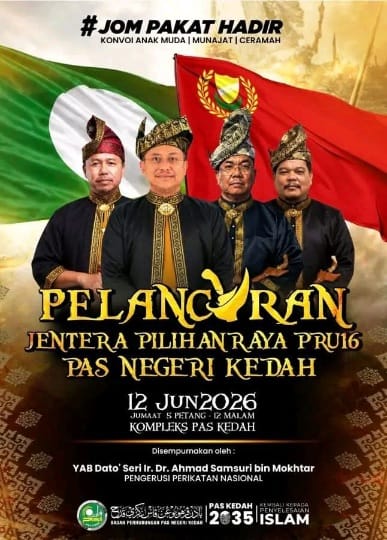
Observe carefully the imagery that usually accompanies such mobilisations: the traditional Malay attire worn with calculated historical nostalgia. The flowing baju Melayu. The sampin folded with near-military precision. The keris positioned somewhere between cultural dignity and subtle threat assessment. And above all, the headgear — the tanjak, tengkolok, or warrior-style ikatan kepala — carefully sculpted into upward folds resembling the wings of a hornbill preparing for ideological combat.
These are not mere fashion choices. They are political semiotics.
The old Malay warrior’s headgear once had practical meaning. In the age of the sultanates, it signified rank, state allegiance, courage, even battlefield readiness. A folded tanjak was the LinkedIn profile of the 17th century. One glance and people knew whether you were nobility, warrior, palace attendant or simply someone who wandered into the wrong royal feast.
Today, however, the warrior aesthetic has evolved into something more theatrical. Modern politicians wear these symbols less to prepare for combat and more to prepare for Facebook Live sessions.
One cannot help admiring the irony. The ancient Malay warriors whose imagery is now borrowed so liberally spent their days facing pirates, colonial cannons, jungle warfare and occasionally actual swords. Today’s political “warriors” face hashtags, TikTok edits and difficult questions about rice prices.
Yet the symbolism persists because it works. Malay politics has always understood one profound truth: nostalgia is more powerful than policy papers.
A man wearing a tengkolok while speaking of “maruah bangsa” instantly acquires the aura of historical legitimacy. Never mind whether the nearest battle he has fought recently involved the state water board or a parking dispute outside a surau. The attire performs emotional magic. It transports supporters into a mythological continuum where every ceramah becomes Melaka resisting the Portuguese.
This explains why political rallies increasingly resemble a cross between a silat tournament, historical reenactment society and motivational seminar for people preparing to reclaim Jerusalem via Kuala Nerang.
And then comes the language itself — “satukan saf,” “teguhkan perjuangan,” “kebangkitan rakyat.” The vocabulary of perpetual siege. Malay politics, regardless of party, remains addicted to the psychology of impending extinction. Malays are always supposedly seconds away from disappearing entirely, despite dominating the political machinery, civil service, monarchy, religious institutions and national symbolism for generations.
It is perhaps the only civilisation on earth permanently convinced of its own imminent disappearance while simultaneously controlling most of the furniture.
But fear is politically nutritious. A frightened electorate marches obediently. A calm electorate asks inconvenient questions about governance.
Which is why every election must be elevated into an apocalyptic struggle for survival. If the local council fails to repaint road dividers, it is no ordinary administrative lapse. It is an assault on “agama dan bangsa.” If someone complains about policy inefficiency, civilization itself trembles.
And presiding over this operatic performance is Sanusi — part village strongman, part stand-up comic, part accidental philosopher of Kedahan populism. He speaks the language of the kopitiam uncle elevated to statecraft: blunt, provocative, gloriously unsubtle. In another era he might have led village resistance against colonial tax collectors. In modern Malaysia, he leads viral clips.
Still, one must give credit where due. Few politicians today understand spectacle as instinctively as he does. The old Malay courts had court poets. Modern politics has Facebook captions written like war drums.
Perhaps that is the enduring genius of Malaysian political culture. We do not merely campaign. We cosplay entire civilizations.
And somewhere beneath the roaring slogans, fluttering green flags and ceremonial warrior headgear, the ordinary rakyat quietly wonders whether the coming “kebangkitan rakyat” might also include fixing flood drains, reducing onion prices and ensuring the internet stops collapsing every time it rains.
But alas, such mundane matters rarely sound heroic beneath a tanjak.
Mihar Dias (mihardias@gmail.com) is a content creator under the Newswav Creator programme, where you get to express yourself, be a citizen journalist, and at the same time monetize your content & reach millions of users on Newswav. Log in to creator.newswav.com and become a Newswav Creator now!
The User Content (as defined on Newswav Terms of Use) above including the views expressed and media (pictures, videos, citations etc) were submitted & posted by the author. Newswav is solely an aggregation platform that hosts the User Content. If you have any questions about the content, copyright or other issues of the work, please contact creator@newswav.com.