
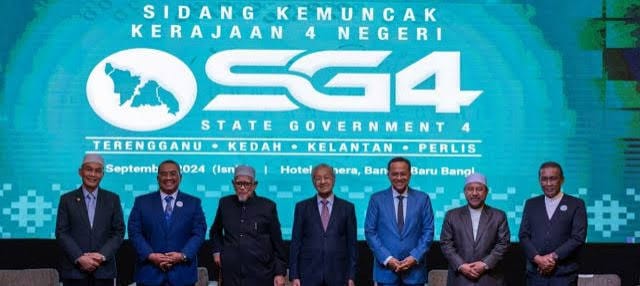
The Terengganu Menteri Besar reportedly announced at the SG4 Business & Economic Forum that the four opposition-led Malaysian states collectively hold approximately 70% of Malaysia's rare earth element (REE) resources.
He also said the overarching objective is to develop a comprehensive upstream and downstream ecosystem within these states to retain economic value, rather than just extracting and exporting raw mineral resources
Congratulations to the SG4.
But in moving forward, the Mentri Besar should be reminded of the most famous dilemmas in economics, often referred to as the "Resource Curse" or the "Paradox of Plenty."
Nigeria and Algeria are two of the most classic, frequently studied examples of the Resource Curse.
Despite generating hundreds of billions of dollars in oil wealth over the decades, Nigeria holds one of the world's largest extreme poverty populations.
Easy oil revenues largely bypassed the broader public, fueling a system of political patronage and massive corruption.
While they both share massive deposits of oil and natural gas, they illustrate different angles of how resource abundance can systematically distort a developing nation's economy.
Historically, nations with an abundance of natural resources often end up falling behind nations with zero natural resources, like South Korea and Japan.
While Malaysia is technically classified as an upper-middle-income nation, it has structurally lagged behind the meteoric rise of the East Asian "Tigers."
When a country discovers oil, timber, or minerals, it creates an illusion of permanent wealth. This wealth often leads to structural weaknesses.
Complacency will overtake innovation because money flows easily from the ground, governments face less pressure to build highly competitive, innovative domestic industries.
Compared to resourceless countries like Japan and South Korea where they have absolutely nothing in the ground.
They knew their only path to survival was human capital.
So they were forced to invest heavily in education, engineering, and creating global brands (like Samsung, Hyundai, Sony, and Toyota) because they had no commodities to fall back on.
Japan and South Korea imported Malaysia’s raw materials, used advanced engineering to turn them into high-tech electronics, microchips, and automobiles, and sold them back to the world at a thousand times the markup.
By capturing the downstream high-value market, they generated exponential wealth.
When money flows easily from the ground, it creates an economic narcotic that paralyzes the political will to do the hard work of industrialization.
Building a competitive downstream industry requires massive, long-term investments in high-tech infrastructure, intensive research and development (R&D), and a highly specialized workforce.
It takes decades of discipline.
In contrast, signing away logging concessions or exporting crude oil yields immediate, effortless cash.
Hopefully the SG4 governments will not fall back and follow the same pathway.
FLK (leekhean.foo@gmail.com) is a content creator under the Newswav Creator programme, where you get to express yourself, be a citizen journalist, and at the same time monetize your content & reach millions of users on Newswav. Log in to creator.newswav.com and become a Newswav Creator now!
The User Content (as defined on Newswav Terms of Use) above including the views expressed and media (pictures, videos, citations etc) were submitted & posted by the author. Newswav is solely an aggregation platform that hosts the User Content. If you have any questions about the content, copyright or other issues of the work, please contact creator@newswav.com.