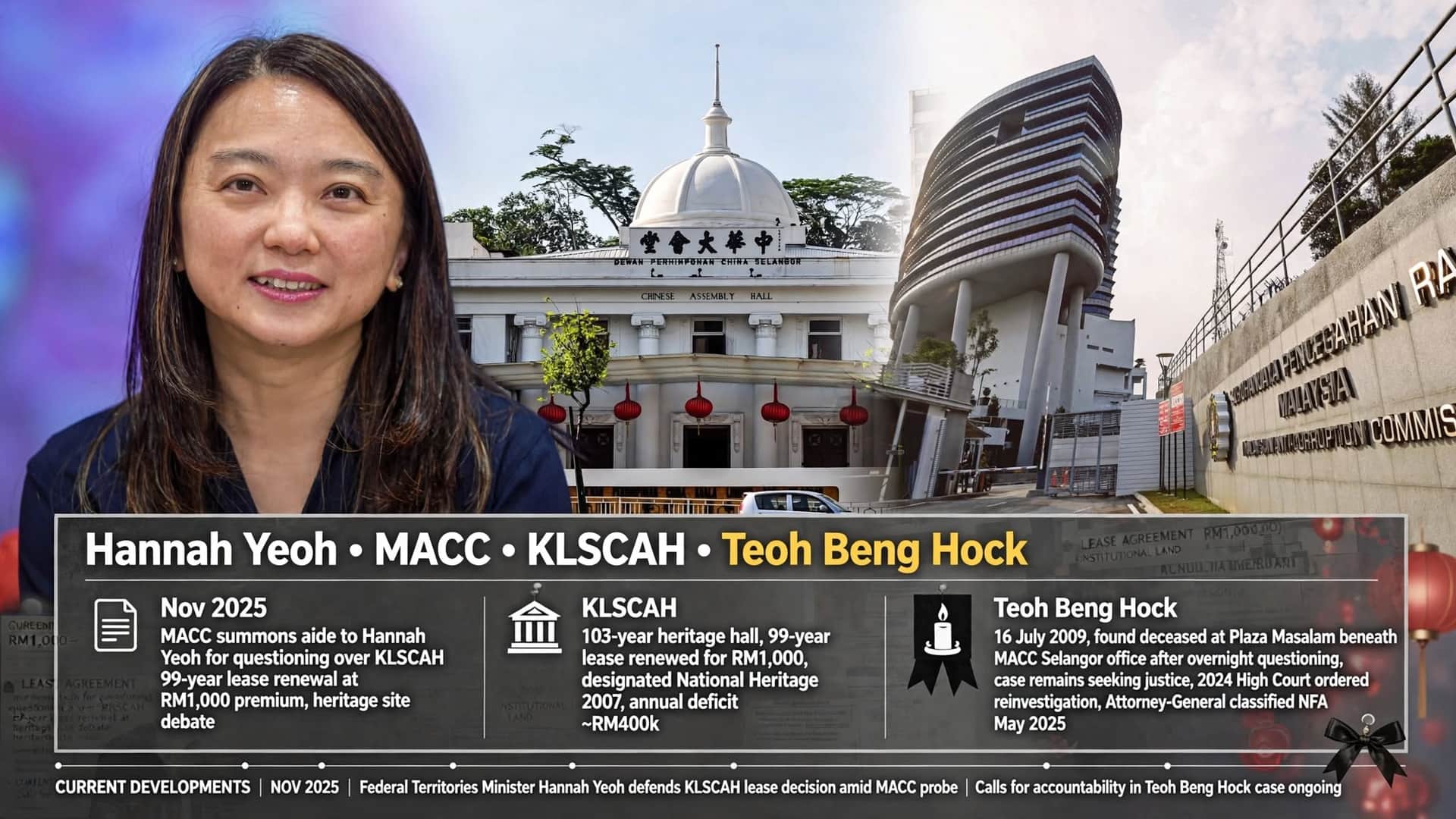
In Malaysian politics, few phrases carry as heavy an emotional and historical charge as "a DAP political aide summoned by the MACC."
For anyone who has followed this nation’s long, bruised journey toward democratic accountability, those words immediately summon the memory of July 2009 when Teoh Beng Hock, a 30-year-old political aide to a Democratic Action Party (DAP) state executive councillor, walked into the Malaysian Anti-Corruption Commission’s Selangor headquarters as a witness and never walked out alive. More than seventeen years later, despite a 2014 Court of Appeal ruling that unlawful acts caused his death, true closure remains elusive, and the institutional reforms promised in his name remain unfinished.
There is a bitter, almost poetic irony in the latest turn of events. Just last year, civil society leaders and citizens stood inside the Kuala Lumpur and Selangor Chinese Assembly Hall (KLSCAH) to demand justice for Teoh’s family and reject the closure of his case. Today, it is a 99-year lease renewal for that very same heritage hall that has brought an aide to Federal Territories Minister Hannah Yeoh into MACC’s interview rooms.
Beyond the haunting historical echo, this investigation exposes two glaring contradictions at the heart of Malaysian governance: the paradox of ministerial accountability and the selective velocity of enforcement.
Only days ago in the Dewan Rakyat, Yeoh mounted a vigorous defense over KLSCAH’s RM1,000 institutional lease premium. Her central argument was clear: she held no authority over the approval. Twice she emphasized that she had no power over the decision, pointing out that the reduction from the RM4.67 million commercial valuation was deliberated and approved entirely by the Federal Territory of Kuala Lumpur Land Committee, chaired by the Chief Secretary to the Government under Rule 10 of the Federal Territory Land Rules 1995.
Yet if a minister truly holds no authority over a land committee’s decision, why is an aide inside her ministerial office now being summoned by anti-corruption investigators to explain the process?
This is the unavoidable trap of modern coalition governance. When popular announcements are made at community dinners, political leaders readily step onto the stage to claim credit as proof that their administration delivers. When political heat arrives in Parliament, the narrative shifts immediately to institutional distance claiming the minister merely stood on the sidelines while civil servants made the call. In public office, you cannot claim political ownership of an outcome when the applause is loud, and plead total powerlessness when investigators come knocking for the paper trail.
Equally troubling is the unmistakable contrast in institutional speed.
KLSCAH is a gazetted National Heritage building whose commercial development rights were surrendered in exchange for an institutional rate already granted to at least seven other national and non-profit bodies, including the Malaysian Red Crescent Society and the Badminton Association of Malaysia. Yet within days of noisy parliamentary debate and racialized political pressure, enforcement machinery moved with remarkable speed to summon a ministerial aide treating a routine inquiry as though a verdict had already been rendered.
Compare that urgency with the glacial silence surrounding decades of opaque urban land disposals across Kuala Lumpur. Where was this rapid institutional reflex when dozens of prime urban parcels, public playgrounds, recreational green lungs, and retention ponds were quietly sold off to private commercial developers at below-market valuations during previous administrations? Where was the immediate scrutiny when the century-old Dewi Sri Pathrakaliamman Temple near Masjid India had its relocated ground quietly alienated to a private buyer without prior notice or a right of first refusal? When anti-corruption probes appear to accelerate in direct proportion to political noise over a RM1,000 heritage lease while multi-million-ringgit historical land transfers gather dust, public faith in institutional neutrality erodes.
The only way to permanently extinguish both political weaponization and public suspicion is radical, historical transparency. Instead of piecemeal defenses, the Federal Territories administration should publish a complete, audited ledger of every nominal-premium exemption, recreational land conversion, and direct parcel sale executed in Kuala Lumpur over the past three decades listing the market valuation, the actual transaction price, and the minister in charge at the time. Let the facts sit in plain sight for every citizen to judge.
For DAP and its reformist allies now sitting in the seats of federal power, this moment should also serve as a sobering mirror. When they were in the opposition, they marched to demand structural overhauls of enforcement agencies, strict witness protections, and an end to selective enforcement. Having won power, they left the architecture of those institutions largely intact hoping that clean intentions alone would shield them from the very machinery they once vowed to reform.
History has a way of reminding leaders that uncompleted reforms eventually return to test their own doorstep. Whether MACC’s inquiry clears Yeoh’s office of any procedural overreach or uncovers administrative missteps, one lesson is already undeniable: in a democracy, principles cannot be selectively invoked, and institutional reform cannot be indefinitely postponed.
Power does not shield leaders from the institutions they fail to reform; it merely puts them next in line to be tested by them. - Annan Vaithegi
Annan Vaithegi (annanvaithegi@icloud.com) is a content creator under the Newswav Creator programme, where you get to express yourself, be a citizen journalist, and at the same time monetize your content & reach millions of users on Newswav. Log in to creator.newswav.com and become a Newswav Creator now!
The User Content (as defined on Newswav Terms of Use) above including the views expressed and media (pictures, videos, citations etc) were submitted & posted by the author. Newswav is solely an aggregation platform that hosts the User Content. If you have any questions about the content, copyright or other issues of the work, please contact creator@newswav.com.