

“Irresponsible,” she said. “Two drivers cancelled my ride.”
She had already missed her train before she even got into my car. Even before she opened the door, I could see it—the tension in her face, the tightness around her eyes, the way she stood at the curb gripping her bag a little too firmly. As an E-Hailing driver for the past 7 years, you learn to read people before they even step into your car. She was an elderly woman, probably in her sixties, dressed neatly but visibly flustered—someone who had already had enough of the day before it had properly begun.
She got into the car a little quicker than most passengers, almost like she didn’t want to waste another second. The door closed a bit harder than usual—not out of anger at me, but out of frustration she had been carrying for a while.
For a brief moment, there was silence—the kind that feels heavy, like something is about to spill.
I wished her good morning in my usual manner.
She paused for a second, then turned slightly and returned the greeting.
We drove on for a while, the road stretching ahead in silence.
I could sense that she had calmed down a little—the tension in her shoulders easing, her breathing more steady.
After a moment, I glanced at her through the mirror and said gently,
“Rough morning, Madam?”
That was all the invitation she needed.
“I missed my train,” she said. “Two drivers accepted my ride and refused to come. I had to cancel both. The app even paused me—as if I was the problem.”
She shook her head, still trying to make sense of it.
“The first driver asked me to cancel because he was too far. The second one… he just disappeared. Accepted the job and didn’t move. I called. No answer. What was I supposed to do?”
She paused.
“My whole day is ruined.”
Then came the question every driver hears—but few passengers ever get a real answer to:
“Why accept the ride if you’re not going to do it?”
I hesitated for a moment, then decided to tell her the truth.
“There are many reasons, Madam. Some are genuinely the driver’s fault—he just doesn’t want to complete the job. But many times it’s because of the fares.”
She frowned slightly, waiting.
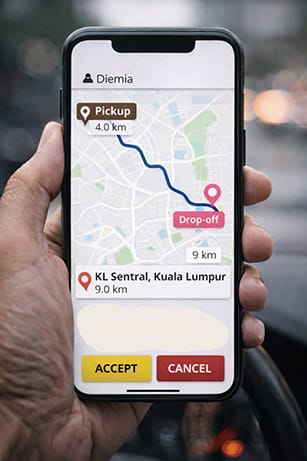
“You see, if you book a ride from this particular e-hailing company, the fare is not shown to the driver. The passenger and only the company knows the fare—not us.”
“What?” Her brow furrowed. “But that doesn’t make sense. How do you know if it’s worth your time?”
“We don’t,” I said. “Not until we accept the job.”
She turned in her seat, giving me her full attention now.
“The app shows us where you are. The distance in kilometers. Exactly where you’re going. But the price? That’s hidden. We only see the fare after we accept.”
“That’s…” She blinked, processing. “That’s backwards.”
"Yes,,” I said. “We have a five-second window to cancel after the job appears,” I continued. “Five seconds to decide if the job is worth doing without the fare being shown. If we don’t cancel in that window, we’re locked in and the job is auto-accepted. If we cancel after that, our ratings drop. Cancel too often without the fare being shown, and we get blocked. No jobs. No income.”
I paused for a moment, then added,
“And the details? They’re shown in small, faint text. Not exactly easy to read when you only have five seconds.”
She let out a slow breath. “So you’re punished either way.”
“Yes, Madam.”
I let that sink in for a moment before adding, “It’s like walking into a shop, picking up an item, and only finding out the price after you’ve consented to buy it. And if you refuse to pay—you get punished.”
She stared at the dashboard for a moment, then shook her head slowly. “That’s… that’s ridiculous. Is that even legal?”

I gave her the only honest answer I had. “I don’t know Madam. But it doesn’t feel right.”
She was quiet for a moment. When she spoke again, her voice had changed—less anger, more understanding.
“So when a driver accepts and doesn’t move… it’s not laziness.”
“Not usually,” I said. “Sometimes a driver has already accepted three low-paying jobs that day. The fourth might push him below cost. If the fare is too low, moving means losing money. So they wait. They hope you cancel.”
“Which is what I did.”
“Which is what you did,” I agreed. “And the app paused you for it.”
She exhaled—not the sharp exhale of frustration she’d walked in with, but something softer. Tired.
“In some rides,” I added quietly, “we end up making as little as RM0.50 per kilometre. Especially if it’s a far drop-off with an empty return trip.”
She turned to look at me again. Not with the irritation she’d had at the curb, but with something closer to recognition.
“It’s not just inconvenience,” I said. “It’s survival.”
Her anger had changed shape—I could hear it in her voice. No longer aimed at drivers.
“Thank you,” she said finally. “I understand now.”
“Thank you, Madam.”
I watched her walk toward the station entrance, her steps lighter than when she had arrived. But in my mind, I was thinking of the hundreds who would step into E-hailing cars today without ever knowing how the system really works. And how many of them, by the end of their ride, would still be angry at the wrong person.
Chris (protocall22@gmail.com) is a content creator under the Newswav Creator programme, where you get to express yourself, be a citizen journalist, and at the same time monetize your content & reach millions of users on Newswav. Log in to creator.newswav.com and become a Newswav Creator now!
The User Content (as defined on Newswav Terms of Use) above including the views expressed and media (pictures, videos, citations etc) were submitted & posted by the author. Newswav is solely an aggregation platform that hosts the User Content. If you have any questions about the content, copyright or other issues of the work, please contact creator@newswav.com.

