
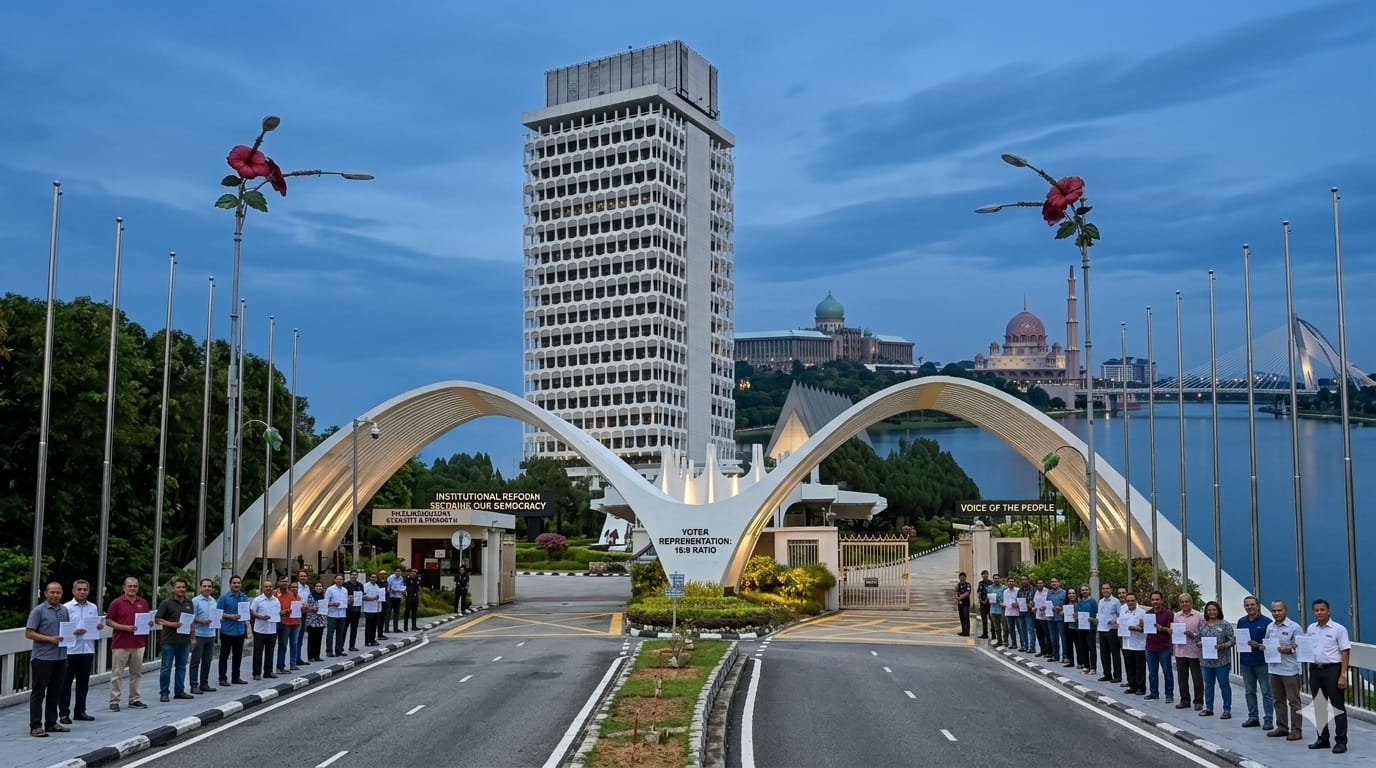
Malaysia has become accustomed to judging governments by how long they can survive rather than by what they accomplish while they are in office. Since the political upheavals after GE14, Malaysian politics has been filled with words such as numbers, majority, backdoor, coalition, stability and mandate. Now civil society organisations and individuals are calling for the 15th Parliament to complete its full constitutional term until December 2027, unless the government loses its majority. The proposal deserves serious consideration, but the question should not simply be whether Prime Minister Anwar Ibrahim deserves more time. The larger democratic question is whether Malaysia benefits from allowing Parliament to complete the mandate voters gave it, and, if so, what Parliament must accomplish before GE16.
A full parliamentary term has genuine value. Governments need time to implement policies, civil servants need policy certainty, businesses need stability, and Parliament needs enough time to debate and pass legislation rather than operating permanently under the shadow of another election. Malaysia has already experienced enough political instability to understand the costs of governments spending too much energy on survival. When political leaders are constantly counting parliamentary numbers, negotiating defections and preparing for possible elections, long-term governance becomes difficult. Ordinary Malaysians, meanwhile, are less interested in political arithmetic than whether their wages, schools, healthcare, housing and public services are improving.
But stability and political survival are not the same thing.
A call for Parliament to complete its term should not automatically become a defence of Anwar's tenure or the Unity Government. If a government loses the confidence of the Dewan Rakyat, constitutional mechanisms must remain available. But if it retains its majority, there is a strong democratic argument that it should normally be allowed to complete the mandate for which voters elected it. Parliament belongs to the voters, not to whichever coalition happens to occupy Putrajaya.
The problem begins when "stability" becomes an excuse for doing nothing.
Some public reactions to the civil society call argue that the government has already had more than three years to implement reforms. They ask a reasonable question: if certain reforms have moved slowly, been diluted or failed to pass during this period, why should another sixteen months suddenly produce a different result? That criticism should not simply be dismissed as hostility towards the government. It goes directly to the credibility problem facing any administration that promises institutional reform.
The answer should therefore be measurable.
If the 15th Parliament is to run until December 2027, the remaining period should come with a clear reform timetable. Malaysians should know which reforms are being prioritised, when legislation will be tabled, which measures require constitutional amendments, which require coalition agreement, and which can be implemented administratively. Parliament should regularly report what has passed, what remains pending and, importantly, why.
This is especially important because some reforms have already moved beyond political speeches. The Parliamentary Services Act represents an attempt to strengthen Parliament's institutional autonomy, while the government has also pursued the separation of the Attorney General and Public Prosecutor functions. The latter is particularly significant because the independence of prosecution is central to public confidence in the rule of law. But announcing reform is not the same as completing it, and passing legislation is not the same as making the institution genuinely independent.
The same principle applies to corruption.
Some Malaysians want the remaining parliamentary period used to investigate and prosecute alleged wrongdoing associated with previous administrations. Others fear that anti-corruption enforcement can become politically selective, where yesterday's enemies are pursued while today's coalition partners receive different treatment. Social-media comments expressing these views should not be treated as representative public opinion or proof of wrongdoing, but they reveal a serious public anxiety.
Malaysia needs an anti-corruption principle that survives changes of government. Investigations should be based on evidence, prosecution should follow due process, and courts should determine guilt. Anti-corruption cannot become political revenge. The strongest reform is one that future governments cannot easily manipulate against their opponents or use to protect their allies.
Civil society itself also deserves scrutiny.
Some critics question whether dozens of organisations and individuals can claim to speak for the rakyat. They do not possess an electoral mandate, and they should not pretend otherwise. But democracy does not belong exclusively to elected politicians. Civil society groups, professional bodies, academics, lawyers, journalists and ordinary citizens have every right to participate in public debate and demand institutional reform.
Their responsibility, however, is to remain transparent and inclusive. If a reform agenda is largely designed and discussed within the Klang Valley while Sabahans, Sarawakians, Orang Asli communities, rural Malaysians, workers and other groups feel absent, the conversation is incomplete. Civil society does not need to represent every Malaysian, but it should be honest about whom it represents.
This is particularly important when discussing Sabah and Sarawak.
MA63 cannot be treated simply as another item on a federal government's development checklist. It concerns the constitutional foundations of the federation and the relationship between the federal government and the two Borneo states. Any serious reform agenda must therefore address federal-state relations, representation, revenue, administrative authority and the distinct constitutional position of Sabah and Sarawak.
Parliamentary reform itself should also go beyond symbolism. Stronger select committees, greater executive accountability, parliamentary administrative independence, transparent political financing and meaningful oversight are important because governments change. The objective should not be to build institutions that benefit today's government. It should be to build institutions that remain useful when today's government becomes tomorrow's opposition.
That is also why the opposition carries responsibility.
A political party should not support institutional reform only when it is outside government and then resist the same restrictions once it gains power. If a parliamentary committee is useful today, it should remain useful tomorrow. If prosecutorial independence is important when investigating one's opponents, it must remain equally important when investigating one's own political allies. Reform cannot be a weapon; it must become a rule.
The emergence of new political vehicles such as Bersama adds another dimension to the debate. The political repositioning involving Rafizi Ramli, Nik Nazmi Ahmad and Wong Chen reflects a broader question faced by reform-oriented politicians: should they attempt to change established parties from within, or create new political vehicles outside them? That debate is larger than any single new party. It reflects continuing frustration over whether existing political structures are capable of carrying institutional reform through to completion.
Ultimately, Malaysians should not judge the 15th Parliament merely by whether it survives until December 2027. They should judge what it does with the time.
Can Parliament become stronger? Can prosecutorial independence become more credible? Can anti-corruption enforcement become more consistent? Can MA63 commitments advance meaningfully? Can parliamentary committees exercise real scrutiny? Can political financing become more transparent? Can the government explain clearly which reforms have failed and why?
And can the opposition support reforms even when those reforms might eventually constrain an opposition government?
These are more important questions than personalities.
The competing public reactions surrounding the full-term proposal reveal a genuine dilemma. Some Malaysians fear another premature election and the instability that could follow. Others fear that "stability" will simply become another word for unfinished reform. Both concerns deserve to be heard.
The answer should not be stability or reform.
Malaysia needs stability for the purpose of reform.
Give Parliament its full term if it retains the confidence of the Dewan Rakyat. But do not give it a blank cheque. Give it a timetable, measurable milestones and public scrutiny. Let Parliament use the remaining time to strengthen institutions rather than merely prepare for the next election.
Then, when GE16 finally arrives, voters should be able to judge something far more meaningful than personalities, race, religion or coalition loyalty.
They should be able to ask one simple question:
What did you actually do with the time we gave you?
Give Parliament its full term but not a blank cheque. Give it time to reform, then let voters decide whether that time was well spent.
Annan Vaithegi writing on governance, institutions, accountability and Malaysian society.
Annan Vaithegi (annanvaithegi@icloud.com) is a content creator under the Newswav Creator programme, where you get to express yourself, be a citizen journalist, and at the same time monetize your content & reach millions of users on Newswav. Log in to creator.newswav.com and become a Newswav Creator now!
The User Content (as defined on Newswav Terms of Use) above including the views expressed and media (pictures, videos, citations etc) were submitted & posted by the author. Newswav is solely an aggregation platform that hosts the User Content. If you have any questions about the content, copyright or other issues of the work, please contact creator@newswav.com.