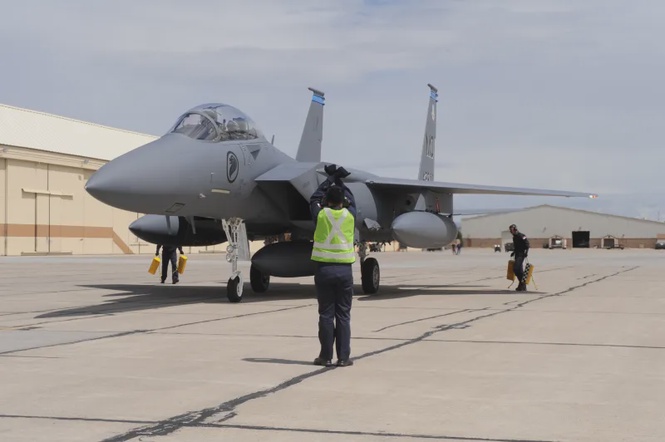
Taiwan's air force needs 107 more fighter pilots to fly the 66 F-16V Block 70 jets now arriving from the United States. Its budget for persuading experienced aviators to stay in uniform has fallen for the fourth consecutive year.
The retention allowance for flight officers is set at NT$755.78 million for the coming year, down NT$32.35 million from the current budget and lower every year since 2023. Kuomintang lawmaker Ma Wen-chun put the risk bluntly in Taiwan's legislature, the Legislative Yuan, saying she worries the air force will take delivery of new fighters and find no one to fly them. Defense analyst Chieh Chung has warned that departures among senior aviators show no sign of slowing, leaving squadrons with a distorted ratio of veterans to novices and combat power that will not rise simply because the fleet does.
Roughly 2,000 miles to the south, a city-state with about a quarter of Taiwan's population is doing the opposite. A declassified U.S. Defense Department report published this month set out how Singapore will operate the 20 F-35s it is buying for US$4.06 billion: 12 short-takeoff F-35Bs permanently based at Ebbing Air National Guard Base in Fort Smith, Arkansas, and only eight conventional F-35As at Tengah Air Base at home, where a dedicated operating base is due to open in the final quarter of fiscal 2029.
The contrast is not a story about money or about population. Singapore has never built its combat power on the assumption that it would have enough people.
Singapore Trains Its Fighter Pilots Across Three Continents
Singapore's airspace is too small to complete realistic combat training at home, so the Republic of Singapore Air Force moved the problem offshore rather than shrinking the syllabus.
Its 130 Squadron has run the nine-month Basic Wings Course at RAAF Base Pearce in Western Australia for more than three decades, producing over 2,000 pilots, fighter weapon systems officers and instructors and accumulating more than 200,000 flying hours, according to Singapore's defense ministry. The two governments have extended the arrangement to 2043. Singapore also rotates F-15SG fighters, G550 airborne early warning aircraft and A330 MRTT tankers through Darwin for live-fire work at the Delamere Air Weapons Range, sends advanced flying students to France and Italy, and will run all initial F-35 conversion in Arkansas alongside other operators of the aircraft.
The effect is that a constraint became an asset. Basic flying happens in Australia, advanced flying in Europe and the United States, and joint operations at home. The training space available to the RSAF is larger, not smaller, than its borders.
Project SOAR Screens Pilot Potential Before First Flight
Singapore has also pushed selection earlier. Under Project SOAR, trainees spend 10 days on high-fidelity simulators at the Air Force Training Command before they ever reach the grading center in Australia. Sensors in the cockpit log roughly 36,000 data points per trainee, while wearable devices track eye movement, heart rate and facial expression in real time.
Maj. Jeremy Lim, the F-16 pilot and flying instructor who heads the project, has said the simulator phase lets candidates "work on their weaknesses during a live flight" instead of discovering them there. Instructors previously had about an hour of airborne observation to judge a student. About 250 trainees have gone through the program since its first run in September 2021, and the air force is using the data to build a model that predicts who will complete training.
A Career Path That Runs To Age 50
Retention in Singapore is handled as career design rather than as an annual line item. The Singapore Armed Forces raised the officer retirement age from 45 to 50 under its enhanced officers' career scheme, so aviators are not planning a second career in their early 40s. The SAVER Plan builds a retirement reserve alongside that longer runway: officers joining today will see their SAVER benefits rise by an average of 40%, worth about three years of final annual salary at retirement, and officers between 25 and 34 receive a cash bonus for every three years served.
The point is not the size of the payment. It is that a Singaporean fighter pilot at the peak of professional value is not being asked to think about what comes next.
Taipei Diagnosed Its Retention Problem A Decade Ago
Taiwan's difficulty is the mirror image, and it has been documented from inside the service. A 2014 study in the air force's bimonthly academic journal found that job stress and role stress both depressed pilots' intention to stay, and that while better pay satisfaction correlated with retention, it did nothing to reduce either form of stress. The study recommended cutting unnecessary duty travel, inspections and exercise loads.
By 2019, when the air force publicly explained the crewing requirement for its new fighters, it said plainly that adjusting the retention allowance would not be enough and that pilots' working conditions and workload had to improve as well. Nearly 50 senior aviators at key service milestones have left this year, and the allowance has now fallen four years running. The diagnosis was made; the treatment was not.
Three Changes Taiwan Could Make This Budget Cycle
First, identify flying aptitude earlier. Singapore screens for it during national service through medical examinations, psychological testing and the COMPASS aptitude battery, and competition for places is intense. Taiwan could add a flight-aptitude module to the intelligence and psychological assessments already used in volunteer recruitment, extending the search for suitable candidates beyond the military academy pipeline to the whole conscript-age population.
Second, promote the simulator from teaching aid to training platform. Taiwan has already contracted CAE for F-16V Block 70 simulators in a deal worth close to US$70 million, and the devices will let pilots master the jet's systems before they strap into one. That is the right direction, but it needs a target attached: a stated proportion of syllabus items to be moved off the aircraft and onto the simulator.
Third, audit what pilots actually do all week. When a squadron's most experienced aviators are absorbing flying duties, administration, meetings, inspection travel and standing watch, and staff billets are filled by captains and first lieutenants acting up, retention stops being a pay question and becomes an organizational design question.
Singapore's air force chief has described the force he is building as a mix of high-end and low-cost systems, a small number of exquisite platforms supported by expendable ones such as drones. The underlying logic is that no part of the plan may rest on having enough people.
Taiwan has far more pilots than Singapore does. But a numerical advantage that institutional friction steadily erodes is a figure on a page rather than combat power in the air. The question worth asking in Taipei is not what to do about a shortage of people. It is whether Taiwan has built a system that stops wasting the people it already has.
*The author works at Aerospace Industrial Development Corporation (AIDC).
Social Media Links & Editor Tag - Penny