Starting April 21, all students in schools and institutions under the Ministry of Education will be required to wear a Jalur Gemilang badge on their uniforms. This move, according to the Ministry, aims to instill patriotism, unity, discipline, and a sense of responsibility among the younger generation. In a circular issued on March 24, Education director-general Datuk Azman Adnan confirmed that the Cabinet had approved the guideline on February 14, 2025.
The directive covers all government and government-aided schools, matriculation colleges, and teachers' training institutes. While it's compulsory for these institutions, other educational institutions are also encouraged to follow suit. “Other educational institutions are also encouraged to adopt the practice,” said Azman.
As per the guideline, the badge must measure exactly 5cm x 2.5cm and be made of top-quality epoxy embossed plastic. Students must wear it on the right side of their uniform, aligned with their name tag. Any modification of the badge’s shape, color, or position is strictly prohibited—and if the badge fades or wears out, it must be replaced. The rule also extends beyond formal school uniforms, covering sportswear, traditional attire, uniforms for co-curricular activities, and even vocational college corporate shirts.
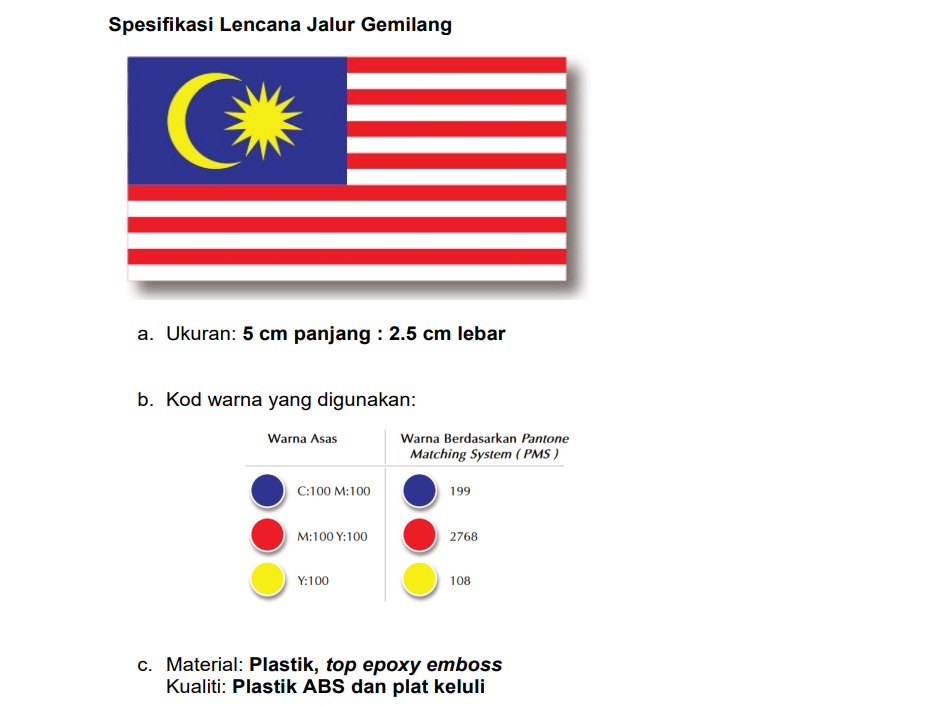
I believe making Jalur Gemilang badges compulsory on school uniforms is a superficial move that wastes both time and money. And I’m clearly not the only one who thinks so. Gerakan president Dominic Lau, on March 27, called on the Education Ministry to go beyond surface-level efforts and instead focus on revamping the school curriculum to truly instill patriotism and foster interethnic harmony. A day later, on March 28, 2025, Free Malaysia Today reported similar concerns from Mak Chee Kin of the Melaka Action Group for Parents in Education. He warned that the initiative would be meaningless if children aren’t first raised with core values like unity and tolerance.
So how did Prime Minister Anwar Ibrahim respond to the backlash? He brushed off concerns, calling the issue a simple matter. “We’re giving the flag badges to students for free—what’s so difficult? Just stick it on,” he told reporters after Friday prayers on the 28th of March at Masjid Jamek Raja Tun Uda.
Anwar defended the initiative, saying it was meant to instil patriotism in students from a young age. He also pointed out that similar practices have long been in place in neighbouring countries. “But here,” he added, “something as simple as this turns into a long-drawn-out debate.” His remarks suggest that the government sees the badge rule as a minor, symbolic gesture.
I beg to differ.
Making Jalur Gemilang badges compulsory on school uniforms feels like a superficial approach that doesn’t address the real issue. While the intention to promote patriotism is understandable, the idea that simply wearing a flag can nurture a deep love for the country is, at best, optimistic—and at worst, ineffective.
Let’s be honest: slapping a flag on a child’s chest won’t magically stir up national pride. If patriotism could be sparked that easily, why stop at one badge? Why not five, ten, or better yet, cover the entire uniform with miniature Jalur Gemilangs? Surely, by that logic, the more badges they wear, the more patriotic they’ll become?
This approach reduces love for the country to a decorative symbol—one that says everything on the surface, but achieves nothing meaningful beneath it. If we truly want to nurture patriotism in our youth, we need to look beyond fabric and plastic, and start focusing on substance.
Based on the Ministry of Education’s move to make flag badges mandatory, it’s clear they’re trying to foster a sense of national identity—one that transcends race and background. Whether you’re Malay, Chinese, Indian, Dayak, or from any other ethnic group, the goal is to remind students that we are all Malaysians.

However, it’s incredibly difficult to build a genuine sense of national identity and patriotism when students are made to feel like outsiders in their own country. How can we expect a student of Chinese descent to love Malaysia when a teacher tells them to “go back to China” simply because they struggle with Bahasa Malaysia?
It’s disheartening—if not outright damaging—for any young person to be reminded that their roots trace back to another land, especially when their father, grandfather, and even great-grandfather were all born and raised here as proud Malaysians. Must we hold them accountable for where their ancestors came from? Must we continue to imply that they are somehow less Malaysian?
This mindset ignores the contributions of countless Malaysians of all backgrounds who have defended this nation with loyalty and courage. People like retired Special Branch officer Supt Paul Kiong, or the late Tan Sri Khoo Chong Kong, who gave his life in the line of duty, are powerful reminders that patriotism cannot—and should not—be defined by race or origin.
So how should the Malaysian government cultivate patriotism among students? By making Malaysia a better place to belong to. While long-term policies are important, the Ministry of Education can start by holding educators accountable—especially those who make racially insensitive remarks like telling students to “go back to China.” Taking firm disciplinary action against such behaviour sends a clear message that racism has no place in our schools, and ensures every student, regardless of race, feels safe, accepted, and proud to call Malaysia home.
Patriotism isn’t stitched onto a uniform—it’s nurtured through respect, fairness, and belonging. If we want students to genuinely love their country, we must first make sure they feel seen, heard, and valued within it. Rather than relyingon symbolic measures, we should focus our efforts on long-term initiatives that actually shape character and unity. It’s not about what students wear—it’s about what they believe in and how they’re taught to understand their role as citizens. True national pride isn’t imposed—it’s inspired. And that inspiration begins in the classroom, not with a badge, but with the values we choose to uphold.
Aaron Colt is a content creator under the Newswav Creator programme, where you get to express yourself, be a citizen journalist, and at the same time monetize your content & reach millions of users on Newswav. Log in to creator.newswav.com and become a Newswav Creator now!
The User Content (as defined on Newswav Terms of Use) above including the views expressed and media (pictures, videos, citations etc) were submitted & posted by the author. Newswav is solely an aggregation platform that hosts the User Content. If you have any questions about the content, copyright or other issues of the work, please contact creator@newswav.com.