
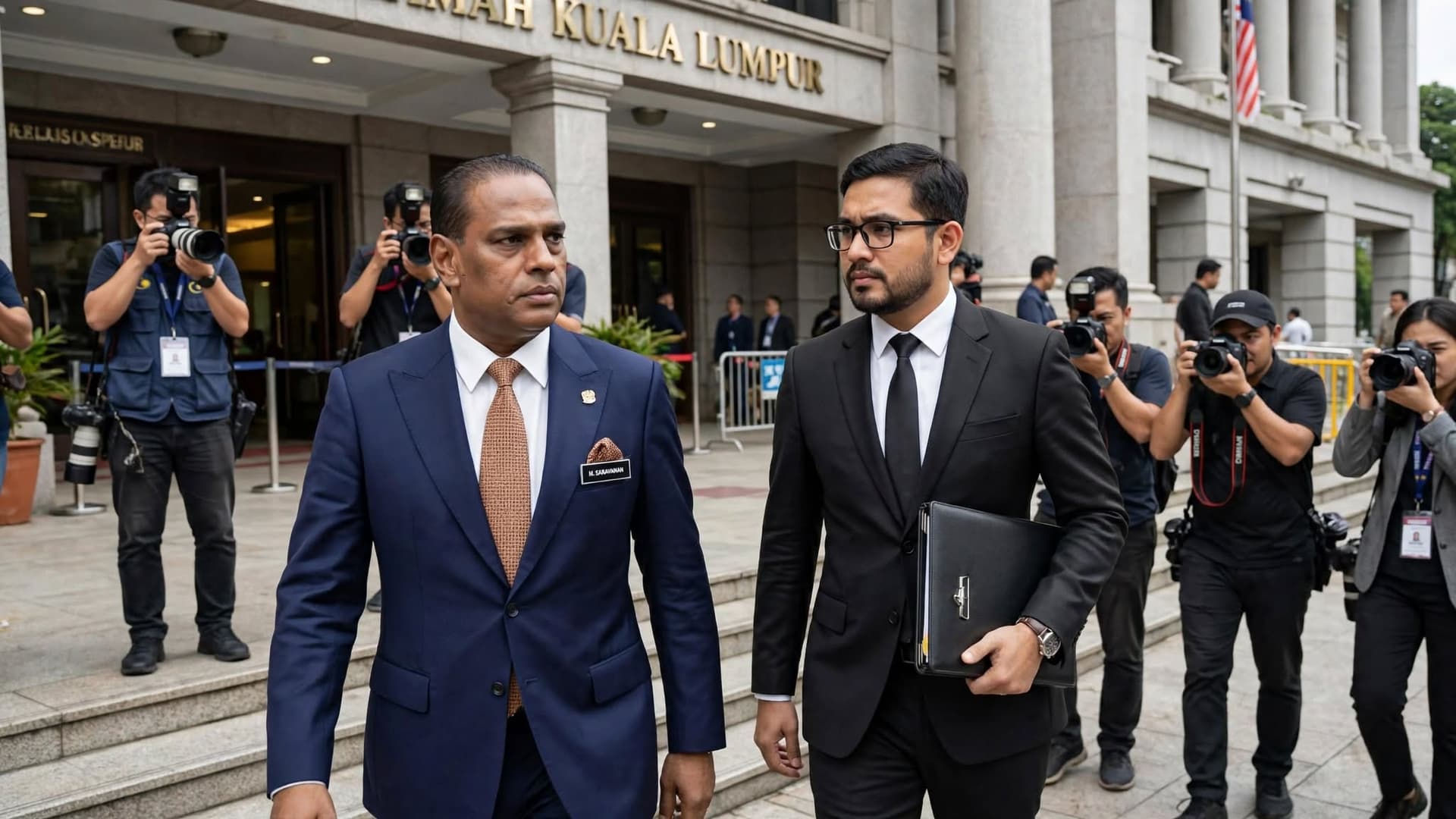
If you were expecting explosive legal fireworks at the Kuala Lumpur Sessions Court on September 29, you were instead treated to a classic Malaysian judicial anticlimax.
Datuk Seri M. Saravanan marched into court declaring he was fully prepared to go to trial immediately. His defense lawyers pressed the judge for the earliest possible trial date, pointing out a glaring fact: the alleged foreign worker quota offenses date back to 2022, and MACC has already been investigating the file for nearly four long years.
Yet, the prosecution asked for more time to finalize document bundles and witness statements, pushing the next mention date to November 3.
For the average Malaysian watching from the sidelines, this raises a fundamental question: If anti-graft investigators have had four years since 2022 to examine an alleged RM1.097 million paper trail, why show up on mention day asking for another month just to hand over trial papers?
The answer lies in the subtle art of political timing in Boleh Land.
The Four-Year Drag and the "NFA" Quantum Physics
Saravanan and his supporters have openly questioned why charges surrounding 2022 foreign worker quotas were suddenly activated now. According to Saravanan, these exact files were investigated previously and quietly shelved under "No Further Action" (NFA).
In Malaysian politics, an NFA file operates under its own laws of quantum physics: it is officially closed, yet fully capable of re-opening the moment political alignments shift. When a political figure maintains useful leverage, the file stays buried in an administrative drawer. But when coalition arithmetic changes or elections draw near, those exact same papers are conveniently pulled out to remind everyone who holds the reins in Putrajaya.
Saravanan’s 15-page novel to Prime Minister Datuk Seri Anwar Ibrahim wasn't just a legal explanation; it was an outcry against this exact four-year drag. But in Boleh Land, writing 15 pages complaining about re-opened files rarely works when the state has already decided it’s time to call your number at the counter.
The 12-Year-Old Minor and "Trial by Process"
This brings us to the most controversial twist: MACC serving asset notices under Section 36 of the MACC Act 2009 on Saravanan’s entire family, including his 12-year-old son.
From a forensic investigation standpoint, checking if illicit funds were parked in family trusts or nominee accounts makes legal sense. But physically requiring a 12-year-old primary school child to be served an enforcement notice crossed the line from thorough investigation into administrative overkill. As former minister P. Waytha Moorthy pointed out, a statutory power to inspect assets is not a license to subject a minor to enforcement drama. A 12-year-old cannot legally execute a foreign worker bribe; any bank account in his name is managed by his parents.
In political prosecutions, however, the process itself is the punishment. The state doesn't need a swift court verdict to achieve its goal. By dragging an accused figure through four years of investigations, media circuses, and family-wide financial interrogatories, his political momentum is effectively neutralized long before a judge ever delivers a verdict.
The Grand Contrast: RM200 Million vs. RM1 Million
When you step back, the mathematical contrast in Malaysian justice remains utterly breathtaking:
- When political heavyweights handling hundreds of millions in party-level funds face the dock such as the recent RM200 million Jana Wibawa acquittals involving Bersatu figures prosecution applications under Section 254(1) of the Criminal Procedure Code can lead to swift, clean clearances.
- But when a former minister gets caught in a RM1.097 million foreign worker quota file, the case transforms into a four-year saga of endless court mentions, 30-day asset notices, and family-wide financial scrutinies.
As the classic Anneh stall joke goes: Handle hundreds of millions through party bank accounts, and it’s called political donation arithmetic; get accused over a single million, and even your 12-year-old son gets a notice from Putrajaya!
The Veteran's Verdict
In Malaysian political commentary, there is a golden rule: Never confuse a postponed court date with a dropped charge.
Saravanan’s demand for an immediate trial is a clever legal maneuver by emphasizing that investigators had four years since 2022 to build their case, his legal team highlights the prosecution's unreadiness and portrays him as an eager, innocent party being dragged through administrative delays.
But Putrajaya’s legal apparatus prefers the long game. By extending the timeline to November 3, the state ensures that Saravanan spends the next month answering detailed financial interrogatories rather than delivering speeches outside the court complex.
So, Datuk Seri, leave Tapah out of this for now. Save the grandstanding for November. Let your accountants organize the bank statements, let your lawyers challenge the prosecution’s paper trail, and let the court decide.
Because in Boleh Land, whether a politician walks free, gets convicted, or lands a DNAA down the road, the political machinery always moves at its own calculated pace slowly, deliberately, and with maximum political utility.
In Malaysian governance, four years of investigation can vanish into a one-month court adjournment, proving that the timing of a charge reveals far more than the actual date on the receipt. - Annan Vaithegi
Annan Vaithegi (annanvaithegi@icloud.com) is a content creator under the Newswav Creator programme, where you get to express yourself, be a citizen journalist, and at the same time monetize your content & reach millions of users on Newswav. Log in to creator.newswav.com and become a Newswav Creator now!
The User Content (as defined on Newswav Terms of Use) above including the views expressed and media (pictures, videos, citations etc) were submitted & posted by the author. Newswav is solely an aggregation platform that hosts the User Content. If you have any questions about the content, copyright or other issues of the work, please contact creator@newswav.com.
